Materializing the Foundation of Suncheon Bay, National Garden, and Dongcheon
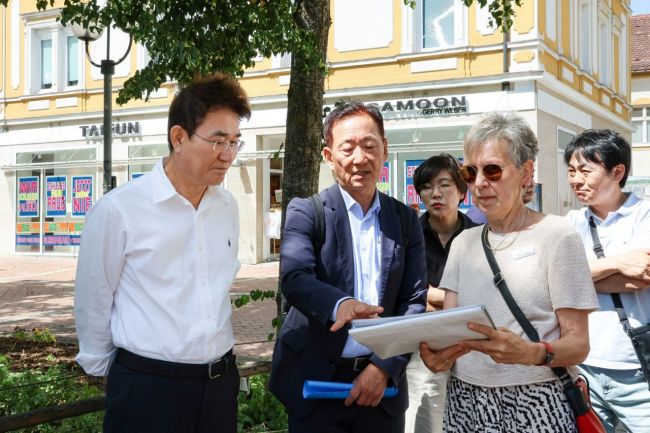 Noh Kwangyu, mayor of Suncheon, is visiting Bad Woerishofen, a healing city in Germany, and listening to an explanation about the healing infrastructure in daily life. Provided by Suncheon City
On June 26, the city of Suncheon in South Jeolla Province announced that it had obtained valuable information through an eight-day overseas training program, including a six-night stay, aimed at expanding the concept of "healing" throughout Suncheon, including the development of a tidal flat healing tourism platform.
This training provided an important opportunity to directly observe advanced European examples where entire cities are designed as healing spaces, and to further develop the vision and implementation strategies for a Suncheon-style healing industry.
Maggie's Centre in Manchester, United Kingdom, is a non-medical emotional healing space for cancer patients and their families, serving as a model where the space itself becomes the starting point for recovery.
Through the example of Maggie's Centre, the city confirmed that the concept of "architecture blending into nature" is central to planning healing city spaces, and that well-designed buildings can promote understanding of the natural environment and raise awareness of the importance of nature among people. Suncheon plans to create spaces where recovery and relaxation coexist, preserving the wetland and tidal flat ecosystems within the vast natural garden of Suncheon Bay.
Bad Woerishofen in Bavaria, Germany, is a representative example of a city designed as a healing infrastructure based on the Kneipp natural therapy method. Despite being a small city with a population of 15,000, it attracts more than 900,000 visitors annually and has established a healing ecosystem where parks, walking trails, pharmacies, accommodations, and restaurants are organically connected.
Suncheon confirmed that the strategy of connecting the entire city as a healing space aligns with its own goals, and is working to realize a Suncheon-style healing strategy based on its unique ecological resources such as Suncheon Bay, gardens, Dongcheon, and forest trails.
Mayor Noh Kwangyu stated, "In an era of rapid change, Suncheon has implemented various strategies based on its identity as a garden city, including cultural content, aerospace, and the bio industry, and most of these are now well established."
Meanwhile, the tidal flat healing tourism platform is designated as a cultural park area in the city plan, excluded from the wetland conservation area. As part of the Ministry of Culture, Sports and Tourism's Southern Region Wide-Area Tourism Development Project, 16 billion won in national funding has been secured for the Korean-style wellness tourism zone theme project. A design firm has been selected through a public competition to create the platform, with design work to be completed by the first half of next year and construction scheduled for completion in 2027.
© The Asia Business Daily(www.asiae.co.kr). All rights reserved.

















