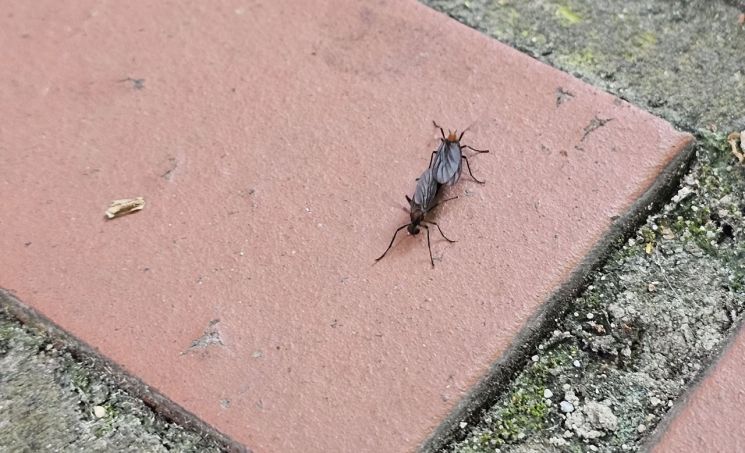
Lovebugs (Plecia nearctica) have been appearing in homes, offices, and parks. Lovebugs typically inhabit subtropical climates such as southern China and Taiwan. However, as global warming causes the Korean Peninsula's climate to shift toward subtropical conditions, insects that once lived only in warmer regions have expanded their habitat into Korea.
According to a paper published by a Seoul National University research team in the journal 'Integrated Pest Management,' issued by the Entomological Society of America in December 2022, it is predicted that within the next 50 years, much of Northeast Asia and Japan will become suitable habitats for lovebugs. Early heatwaves have further contributed to mass outbreaks of lovebugs. Lovebugs are known to cause discomfort because they tend to fly toward people. However, they do not bite or transmit diseases; instead, they feed on decaying weeds and help pollinate plants, making them beneficial insects. In 2024, there were 9,296 complaints about lovebugs reported to the Seoul Metropolitan Government, which is more than double the 4,418 cases reported the previous year.
Local governments are preparing measures to reduce public inconvenience caused by 'epidemic nuisance insects' such as lovebugs and Asian mayflies (also known as Tinkerbell). Starting at the end of June 2025, when a mass outbreak of lovebugs is expected, the Seoul Metropolitan Government plans to operate light and attractant traps in the Baekryeonsan area of Eunpyeong District. In Ttukdo Market, Seongdong District, lighting fixtures without blue light?which is believed to attract Asian mayflies?have been installed. On the surface of the Han River near Yeongdong Bridge, floating traps are being operated. The Seoul Metropolitan Government is cooperating with the Ministry of Environment and district health centers, and based on these pilot projects, it plans to establish management strategies for epidemic nuisance insects.
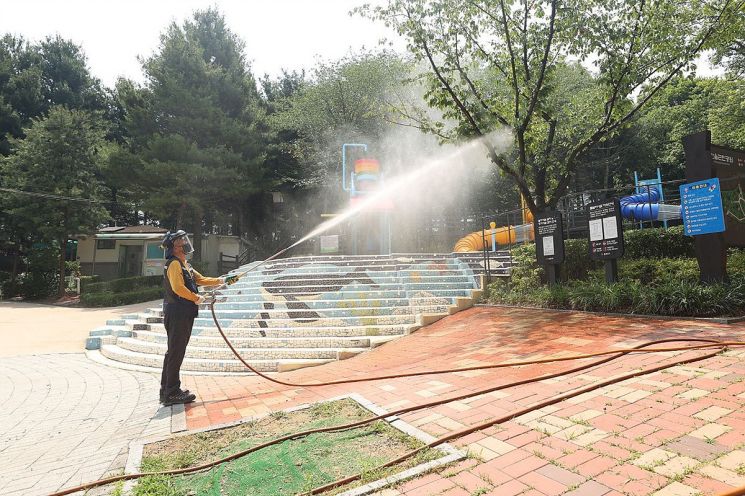 Last summer, a public-private emergency quarantine activity site in preparation for Lovebug outbreaks. Photo by Asia Economy DB
Yangcheon District has organized a 'public-private emergency quarantine task force' consisting of about 400 people and has launched special pest control operations. The infectious disease management team at the public health center oversees complaint reception and situation management, while the mobile quarantine team and the park quarantine team conduct eco-friendly water spraying in major outbreak areas. 'Community gap quarantine' is also being carried out, centered on the 18 neighborhood community centers.
Seongbuk District is conducting public awareness campaigns using various media, including the district office website, social networking services (SNS), and text message alerts. The district also provides information on personal pest control methods. Interdepartmental cooperation systems are being strengthened to enable joint responses in emergencies, and green areas and major complaint sites are divided among teams for pest control. During peak outbreak periods, eco-friendly water spraying will be conducted, and the district plans to quickly respond to the surge in complaints by contracting with professional pest control companies. Since May 2025, Guro District has begun mobile vehicle patrol pest control operations, led by the public health center's pest control team and the Saemaeul Volunteer Quarantine Group. The 'Mosquito Sweep Promotion Team' is engaged in larval control and environmental improvement activities, while the 'House-to-House Quarantine Volunteer Group' is providing door-to-door pest control services for vulnerable households.
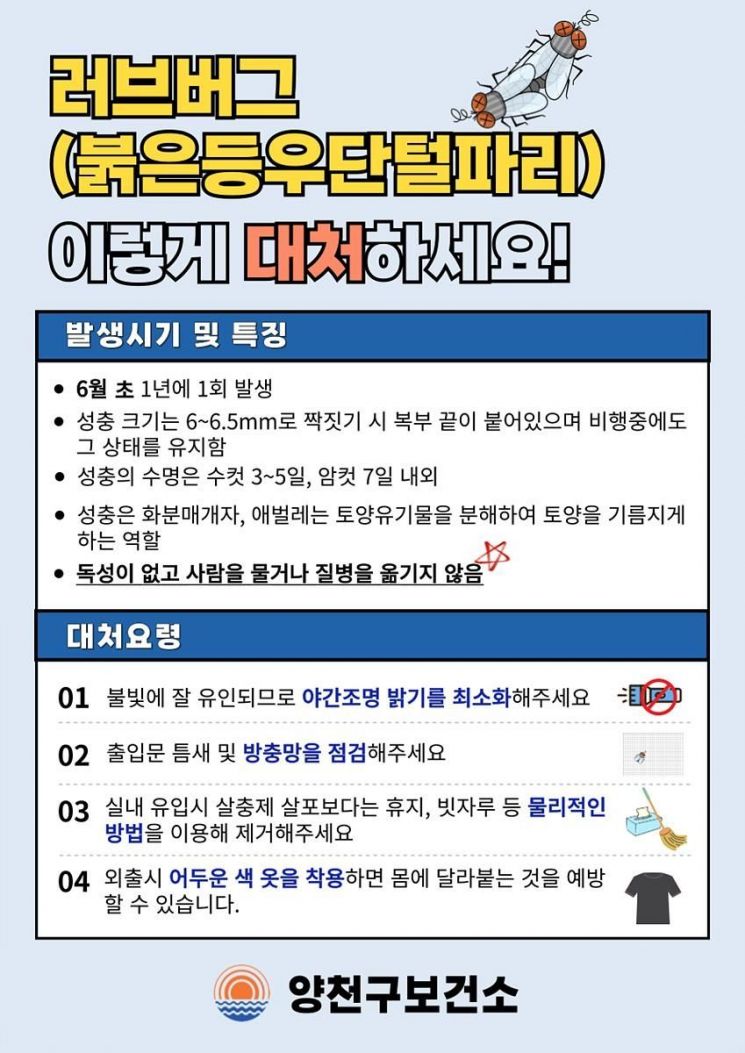
Experts advise that chemical control methods, such as spraying insecticides, may actually exacerbate mass outbreaks of lovebugs. They recommend reducing lights at night and removing lovebugs that enter indoors using physical methods such as tissues or brooms.
© The Asia Business Daily(www.asiae.co.kr). All rights reserved.
![Clutching a Stolen Dior Bag, Saying "I Hate Being Poor but Real"... The Grotesque Con of a "Human Knockoff" [Slate]](https://cwcontent.asiae.co.kr/asiaresize/183/2026021902243444107_1771435474.jpg)

















