President Lee Jae Myung Officially Announces Establishment of National-Level Task Force
Expectations Rise for Resolving Conflicts Among Gwangju City, Jeonnam Province, and Muan County
Ongoing Disputes Remain, Including Gwangju City's 1 Trillion Won Support for Muan County
Calls to Focus on Uniting Divided Public Opinion
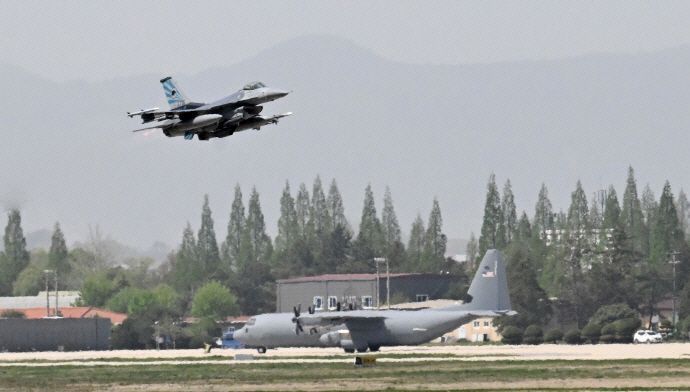 Pilots of the 1st Combat Flight Group in Gwangsan District, Gwangju, are landing after completing flight training with combat aircraft. Photo by 1st Combat Flight Group
The issue of integrating and relocating the Gwangju civilian and military airports, which had been at a standstill, now appears to be shifting into the hands of the central government. While there is a positive assessment that this represents progress after years of stagnation due to conflicts among the main stakeholders?Gwangju City, Jeonnam Province, and Muan County?there is also a consensus that the challenge of resolving the contentious issues that have sharply divided the parties remains for the future.
◇Expectations for a Shift to the National Level
On June 25, President Lee Jae Myung held a town hall meeting with Gwangju citizens and Jeonnam residents at the National Asia Culture Center, where he officially announced the establishment of a six-party task force (TF) under the Presidential Office to resolve the issue of integrating and relocating the Gwangju civilian and military airports.
The six-party TF will include Gwangju City, Jeonnam Province, and Muan County, as well as the Ministry of National Defense, Ministry of Land, Infrastructure and Transport, and Ministry of Economy and Finance?three local governments and three central government ministries. This signifies that the issue, which had previously been handled only by the local governments, will now be addressed at the national level. Furthermore, President Lee's decision for national involvement in the airport integration and relocation issue is also connected to a willingness to revisit the "contribution for compensation" method, which has been a source of conflict among local governments behind the scenes.
◇Possibility of Resolving Project Instability
The Gwangju military airport relocation project involves constructing a new airport on a 15.3 km² site in the relocation area and developing the existing 8.2 km² airport site. The main approach is the "contribution for compensation" method, as stipulated by the Special Act on the Relocation and Support of Military Airports.
The core issue of the contribution for compensation method (where the party donating substitute facilities is granted rights to the decommissioned property, enabling the relocation of state-owned facilities) is that, after the military airport is relocated, if the total project cost exceeds the development profits from sales within the development-restricted area (the former site), Gwangju City's finances must cover the shortfall after building the new facilities.
The estimated scale of the project under the contribution for compensation method is reported to be about 5 to 10 trillion won. The problem is that the risks associated with the project's uncertainty are considerable.
Gwangju City has promised Muan County about 1 trillion won for the relocation project. Of this, 450.8 billion won is to be covered by profits from developing the airport site, with the remainder coming from Gwangju City's own resources. The focus is on improving residents' quality of life through new town development, securing noise buffer zones and supporting residential relocation, and attracting and relocating public institutions.
However, in order to develop a development-restricted area, at least 50% public ownership is required. Even if a project financing (PF) structure is arranged to raise funds, Gwangju City ultimately bears the risk of guaranteeing it.
If, as is currently the case, the construction market remains sluggish and unsold units result after development, the contingent liabilities and related risks could fall entirely on Gwangju City.
Given the scale of Gwangju City's annual budget, this could seriously threaten its fiscal soundness. This is especially concerning given that, as of this year, Gwangju City's local government bonds total 2.07 trillion won?the highest in the country?indicating poor fiscal efficiency. From 2020 to 2024, Gwangju City has paid approximately 119.5 billion won in interest alone due to the issuance of local government bonds over five years.
This fiscal instability of Gwangju City has been one of the main reasons Muan County has consistently opposed the military airport relocation, alongside noise issues. Within Gwangju City as well, there have reportedly been significant concerns about the contribution for compensation method. Both sides have expressed discomfort with the situation.
Even during the Q&A session with the president on this day, Muan County Governor Kim San once again stated, "I do not trust Gwangju City's promise to provide 1 trillion won in support for Muan," maintaining his existing stance.
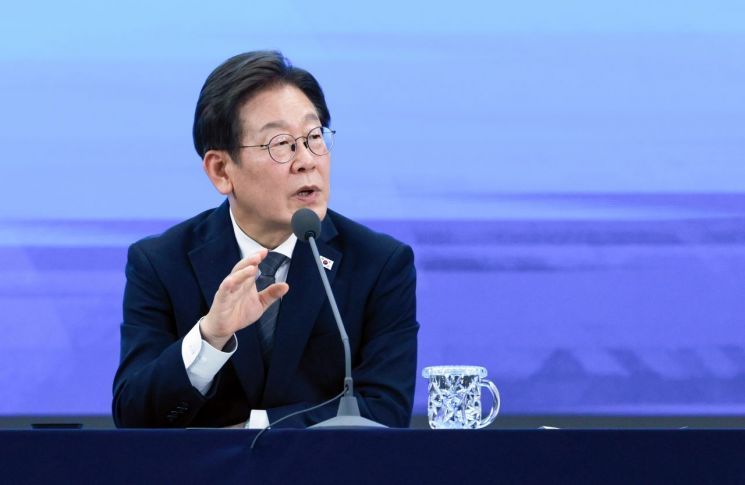 President Lee Jae Myung is attending the "Gwangju Citizens and Jeonnam Residents Town Hall Meeting" held on the 25th at the National Asia Culture Center in Gwangju Metropolitan City, discussing regional issues with event participants. Photo by the Presidential Office Press Photographers Group
◇Alternatives
On December 17, 2023, Gwangju City and Jeonnam Province issued a joint statement regarding the relocation of the Gwangju military and civilian airports, announcing that "if meaningful progress is made on the military airport relocation, the civilian airport will also be relocated to Muan International Airport."
However, due to strong opposition from Muan County, no further progress was made.
Some have consistently suggested forming a special purpose company (SPC) to guarantee Muan County's participation in the development project related to the military airport relocation, and to give Muan County priority rights to the disposal profits. This is one exit strategy aimed at alleviating Muan County's concerns and enhancing the project's stability.
President Lee also supported this proposal on the same day, stating, "The government should bear part of the financial burden and devise a solid guarantee mechanism. When forming an SPC, it should be structured so that Muan County has priority acquisition rights."
To implement such policy changes, it will be unavoidable to revise certain provisions of the Special Act on Military Airport Relocation, including the "contribution for compensation" method.
Unless the relevant laws are amended to effectively convert the project into a national undertaking and minimize the economic and administrative losses borne by local governments, it will be difficult to persuade Gwangju City, Jeonnam Province, and Muan County to cooperate.
While the national government has expressed its intention to get involved in the military airport relocation issue, the lack of concrete plans for a complete transition means that this will remain another challenge for the Lee Jae Myung administration.
Regarding this, an official from a local government stated, "The military airport relocation issue stems from complex problems that go beyond simple regional conflict and encompass both politics and administration. Since each region faces different circumstances and environments, efforts to consolidate diverse public opinions are essential to resolve the issue. There must be intense debate over how to revise the contribution for compensation method and other related matters."
Meanwhile, with President Lee Jae Myung's decision to operate a six-party task force under the Presidential Office to facilitate the integration and relocation of Gwangju's military and civilian airports to Muan Airport, Gwangju City, Jeonnam Province, and Muan County have also begun working on concrete implementation plans.
© The Asia Business Daily(www.asiae.co.kr). All rights reserved.


















