Linked with Ozone Oxidation Technology
Stable Compliance with NOx Emission Standards
Yeongpung Seokpo Smelter has strengthened its air pollutant reduction system, including nitrogen oxides (NOx), by completing its sixth oxygen plant in Bonghwa-gun, North Gyeongsang Province.
On June 26, Yeongpung announced that it held a completion ceremony for the new oxygen plant at Seokpo Smelter Plant 3. The event was attended by about 60 employees from the smelter and partner companies. The newly completed oxygen plant was finished approximately 20 months after construction began in November 2023 and is capable of supplying up to 116 tons of high-purity oxygen per day. With this addition, the smelter now operates a total of six oxygen plants?three at Plant 2 and three at Plant 3.
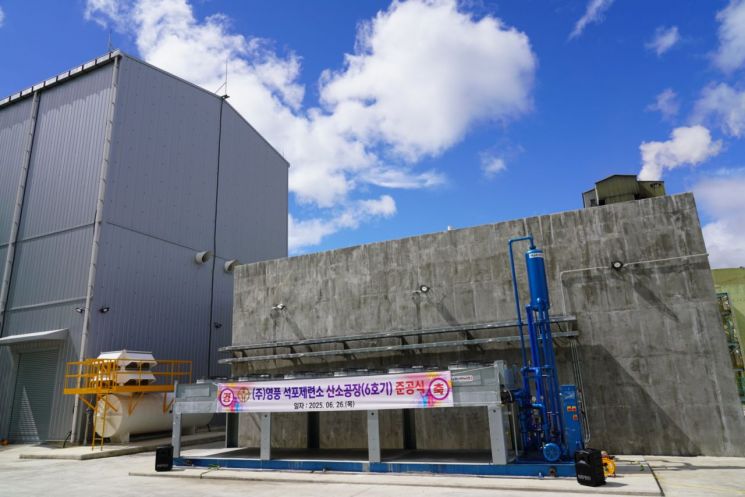
Oxygen is supplied to ozone generation equipment in each smelting process and is used as a pre-treatment agent in the ozone oxidation method for processing nitrogen oxides in exhaust gases. Yeongpung expects that this will enable the company to reliably meet the stricter air pollutant emission standards required by the Integrated Environmental Permit (IEP). Kim Jaemin, Yeongpung's environmental director, stated, "With the operation of Oxygen Plant No. 6, we have enhanced our ability to reduce air pollutant emissions and established a foundation for a sustainable, eco-friendly smelter for the next 100 years."
Yeongpung Seokpo Smelter is a comprehensive non-ferrous metal smelter with the world's fourth-largest zinc production capacity, and it invests approximately 100 billion KRW in environmental initiatives each year. In 2021, it became the first smelter in the world to introduce a zero-discharge water treatment system, purifying and recycling all wastewater without external discharge. The company has also set a "2050 carbon neutrality" goal and is focusing on ESG management by improving air emission reduction facilities, operating waste heat power generation and energy storage systems (ESS), and supporting wind power generation.
Meanwhile, the smelter has installed a Tele-Monitoring System (TMS) on its eight main stacks to automatically transmit real-time pollutant emission data to environmental authorities.
© The Asia Business Daily(www.asiae.co.kr). All rights reserved.

















