
Gwangju Institute of Science and Technology (GIST) announced on the 26th that a research team led by Professor Lee Jongseok from the Department of Physics and Optical Science, in collaboration with Sogang University, has elucidated how two-dimensional materials (WTe2, MoTe2), known as "van der Waals Weyl semimetals," change their structure and electronic properties under high-pressure conditions.
This research has drawn attention for experimentally demonstrating that structural phase transitions and superconductivity in topological materials under high pressure are closely interconnected.
Van der Waals Weyl semimetals are special two-dimensional metallic materials in which atomic layers are loosely bound by van der Waals forces, and electrons exhibit unique quantum properties known as the "Weyl state." Representative examples include WTe2 (tungsten ditelluride) and MoTe2 (molybdenum ditelluride). Due to their asymmetric structures and strong spin-orbit coupling, these materials display unusual phenomena such as the anomalous Hall effect, giant magnetoresistance, and Fermi arcs. MoTe2, in particular, can transition between a topological metal and a superconductor depending on temperature, making it a subject of interest for next-generation electronic devices and quantum technology applications.
The research team quantitatively demonstrated that, under applied pressure, the structure of van der Waals materials changes differently between inter-layer and intra-layer regions. They also proposed a new structural transformation model to explain these changes, thereby enhancing the academic significance of their work. These findings are expected to serve as an important theoretical foundation not only for high-pressure material research but also for the development of nano and quantum materials.
Van der Waals materials have a stacked structure of thin atomic layers, with very weak bonding between layers, giving them the characteristics of two-dimensional materials and strong anisotropy. When Weyl semimetal properties are added, "Weyl fermions"?which behave like massless particles when current flows?emerge, making these materials particularly intriguing in the field of physics.
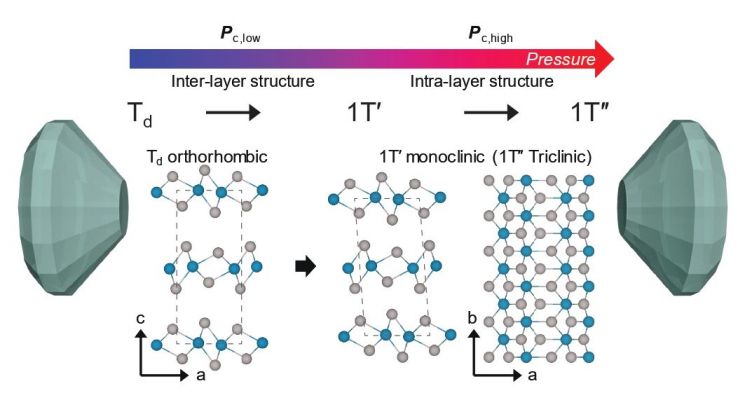
The core of this research is the experimental demonstration that the structure of van der Waals Weyl semimetals changes stepwise under pressure, and that these structural transitions are directly linked to changes in electronic states and the emergence of superconductivity. At around 2.5 GPa, the team confirmed that WTe2 undergoes a structural transition from the Td (orthorhombic) phase to the 1T' (monoclinic) phase, accompanied by a sharp decrease in magnetoresistance and the simultaneous appearance of superconductivity.
These results were clearly observed through Raman spectroscopy and optical pump-probe spectroscopy, providing direct evidence of the connection between structural transitions, changes in electronic properties, and the onset of superconductivity.
Another important finding is that the structural transition occurs in two stages as pressure increases. At lower pressures, the inter-layer structure changes first. Then, under higher pressures above approximately 10 GPa, the intra-layer atomic arrangement becomes distorted, leading to a transition from the 1T' (monoclinic) phase to the 1T'' (triclinic) phase.
These high-pressure transitions were experimentally confirmed through abrupt changes in second harmonic generation (SHG) signals, the disappearance of Raman modes, and changes in optical reflectivity. The timing of these transitions also precisely matched previously known changes in charge carrier concentration, providing crucial clues for unraveling the complex multi-step mechanisms of structural transitions under high-pressure conditions.
Professor Lee Jongseok stated, "This study is significant in that it experimentally confirmed the relationship between structural transitions, topological state changes, and the emergence of superconductivity, and proposed a model for structural changes under pressure, thereby establishing a new theoretical basis for high-pressure research. By revealing the close connection between structure and electronic properties in two-dimensional topological materials, this work will provide an important starting point for the development of topological control technologies in future spintronics and quantum computing devices."
© The Asia Business Daily(www.asiae.co.kr). All rights reserved.


















