283 High Schools Nationwide Have Fewer Than 100 First-Year Students
Regional Proportion: 3% in Seoul vs. 50% in Gangwon
"Fewer Students Means Greater Focus on Regular Admission"
An analysis has found that it is more advantageous for first-year high school students in Gangwon and North Jeolla provinces to prepare for college admissions through the College Scholastic Ability Test (CSAT)-focused "regular admission" rather than the school record-focused "early admission." This is because the smaller the student population, the harder it is to achieve high school grades, and in these regions, nearly half of the schools have fewer than 100 students per grade.
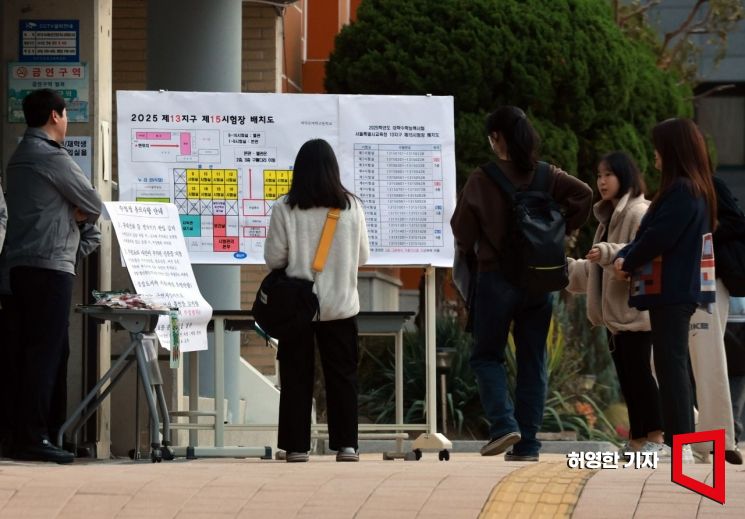 On the 14th, the day of the 2025 College Scholastic Ability Test, examinees at Yeouido Girls' High School in Yeongdeungpo-gu, Seoul, are checking their classrooms by looking at the exam venue guide map. Photo by Huh Younghan
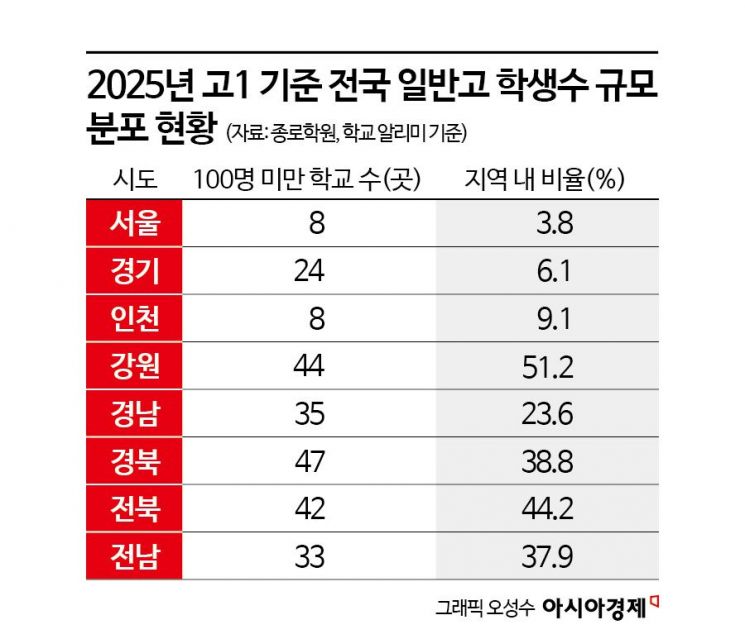
According to data compiled by Asia Economy on June 26, based on a request to Jongro Academy to analyze the "2025 National General High School Student Population Distribution," there are 283 schools nationwide (16.6% of 1,703 schools) with fewer than 100 first-year students. Of these, 86% are concentrated in regions outside Seoul, Gyeonggi, and Incheon.
Looking at the proportion of schools with fewer than 100 students in each region: Seoul has 3.8% (8 out of 213 high schools), Gyeonggi has 6.1% (24 out of 396), and Incheon has 9.1% (8 out of 88), all of which are single-digit percentages.
However, North Gyeongsang and North Jeolla provinces stand out with much higher proportions: 38.8% (47 out of 121 high schools) and 44.2% (42 out of 95 high schools), respectively. In particular, in Gangwon, 44 out of 86 high schools (51.2%) have fewer than 100 students per grade, reaching nearly half.
Experts in the college admissions industry advise that the fewer students there are in a region, the more students should focus on preparing for the CSAT. They point out that the perception that it is easier to get good school grades in the provinces than in Seoul, where academic competition is fierce, is structurally unfounded.
Starting this year, the new five-tier school grading system applies to first-year high school students: the top 10% receive the highest grade (Grade 1), the next 34% receive Grade 2, the next 66% receive Grade 3, the next 90% receive Grade 4, and those below the 90th percentile receive Grade 5. If there are fewer than 100 students in a grade, it becomes that much more difficult to earn a top grade.
Especially with the introduction of the high school credit system, the number of students per subject will be further divided. In subjects with only 1 to 9 students, it is not possible for any student to receive the highest grade, regardless of ability, making it structurally impossible to achieve Grade 1 in such cases.
There are also concerns that the high school credit system, which was introduced to expand students' career and aptitude opportunities, may not be implemented as originally intended.
Lim Seongho, CEO of Jongro Academy, said, "In reality, students are forced to choose subjects with more participants where it is easier to get good grades, rather than those suited to their aptitude," adding, "The policy may not proceed as intended." He also pointed out, "The need to prepare for the CSAT is even greater in provincial areas, but ironically, these regions lack the educational infrastructure to support regular admission preparation," and emphasized, "This is an issue that public education must address."
© The Asia Business Daily(www.asiae.co.kr). All rights reserved.
![Clutching a Stolen Dior Bag, Saying "I Hate Being Poor but Real"... The Grotesque Con of a "Human Knockoff" [Slate]](https://cwcontent.asiae.co.kr/asiaresize/183/2026021902243444107_1771435474.jpg)
















