Gyeongnam Province, Gyeongsangnam-do Medical Association, and Three University Hospitals Join Forces for Regional Essential Doctor System
Gyeongnam Province, together with three university hospitals in the province and the Gyeongsangnam-do Medical Association, is joining forces to ensure the successful establishment of the pilot project for the regional essential doctor system.
On June 25, Gyeongnam Province, Gyeongsang National University Hospital, Yangsan Pusan National University Hospital, Samsung Changwon Hospital at Sungkyunkwan University, and the Gyeongsangnam-do Medical Association signed a "Joint Cooperation Agreement for the Promotion of the Regional Essential Doctor System Pilot Project" in the provincial government meeting room.
The agreement was signed by Park Wansu, Governor of Gyeongnam Province; Ahn Sungki, Director of Gyeongsang National University Hospital; Lee Sangdon, Director of Yangsan Pusan National University Hospital; Oh Juhyun, Director of Samsung Changwon Hospital at Sungkyunkwan University; and Kim Mingwan, Chairman of the Gyeongsangnam-do Medical Association.
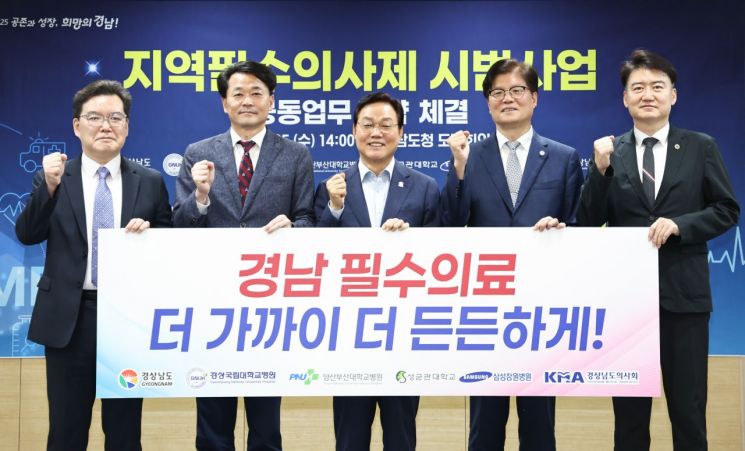 Oh Juhyun, Director of Samsung Changwon Hospital at Sungkyunkwan University (far left), Ahn Sungki, Director of Gyeongsang National University Hospital, Park Wansu, Governor of Gyeongnam Province, Lee Sangdon, Director of Yangsan Pusan National University Hospital, and Kim Mingwan, Chairman of the Gyeongsangnam-do Medical Association, are taking a commemorative photo after signing a joint cooperation agreement for the pilot project of the regional essential doctor system. Provided by Gyeongnam Province
They have agreed to work together to address the shortage of doctors in essential medical fields, which has resulted in medical service gaps in the province, and to improve residents' access to healthcare.
The term "regional essential doctor" refers to a physician who is a specialist within five years of certification in one of the eight key essential departments?internal medicine, surgery, obstetrics and gynecology, pediatrics, emergency medicine, cardiovascular and thoracic surgery, neurology, and neurosurgery?and who has signed a contract to work in the region for five years.
This pilot project, promoted as a Ministry of Health and Welfare public offering, will be implemented starting July 1 in four regions: Gyeongnam, Gangwon, Jeonnam, and Jeju.
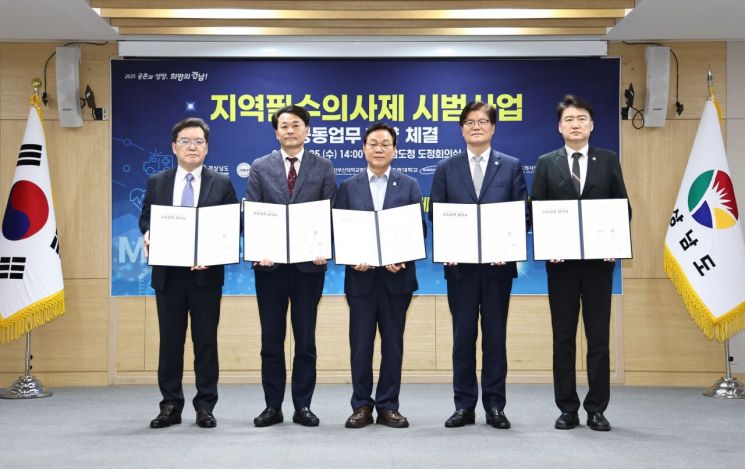 Oh Juhyun, Director of Samsung Changwon Hospital at Sungkyunkwan University (from the far left), Ahn Sungki, Director of Gyeongsang National University Hospital, Park Wansu, Governor of Gyeongnam Province, Lee Sangdon, Director of Yangsan Pusan National University Hospital, and Kim Mingwan, Chairman of the Gyeongsangnam-do Medical Association, are holding up the signed "Regional Essential Doctor Pilot Project Joint Cooperation Agreement." Provided by Gyeongnam Province
Under this agreement, Gyeongnam Province will provide administrative and financial support to ensure the smooth implementation of the pilot project, and the three participating medical institutions will each hire eight regional essential doctors by the end of this year, for a total of 24 doctors.
The Gyeongsangnam-do Medical Association will cooperate by providing policy advice to ensure that the voices from the medical field are reflected in policy.
In addition, Gyeongnam Province will pay each regional essential doctor contracted with the three hospitals a monthly regional work allowance of 4 million won during the contract period, plus an additional 1 million won in settlement support funded by the province, for a total of 5 million won per month.
Furthermore, the province will introduce various settlement support measures for families of doctors relocating from other regions, including a welcome grant for relocating families, childcare support for preschool children, and educational support for children in elementary, middle, and high school.
Governor Park stated, "With public concern over medical services running high, the issue of essential medical service gaps in the regions is a particularly serious challenge. Although there may be areas that need improvement as we are just starting out, I hope this pilot project will provide real help to the local medical field."
He added, "In the long term, it is also necessary to establish an institutional foundation to stably train the workforce needed in essential medical departments. The province will actively address and improve any issues that arise during the operation of the program."
© The Asia Business Daily(www.asiae.co.kr). All rights reserved.
![Clutching a Stolen Dior Bag, Saying "I Hate Being Poor but Real"... The Grotesque Con of a "Human Knockoff" [Slate]](https://cwcontent.asiae.co.kr/asiaresize/183/2026021902243444107_1771435474.jpg)
















