Seoul Announces Changes to the 2030 Urban and Residential Environment Maintenance Master Plan
Easing Public Contribution in Height-Restricted Areas, Introducing Three-Dimensional Parks, and Upgrading Quasi-Residential Zones Near Stations
"Preliminary Review System" to Be Implemented for Redevelopment Sites Lacking Sufficient Resident Consent
The Seoul Metropolitan Government announced that it will implement the "2030 Urban and Residential Environment Maintenance Master Plan," which includes measures to lift regulations on maintenance projects, starting June 26, 2025. The plan details measures such as easing public contribution requirements in height-restricted areas, relaxing floor area ratio (FAR) regulations when creating three-dimensional parks for maintenance projects, and establishing clearer standards for upgrading quasi-residential zones near subway stations. In addition, the "preliminary review system," which allows for a review of maintenance plans before securing resident consent in redevelopment projects, will also be introduced.
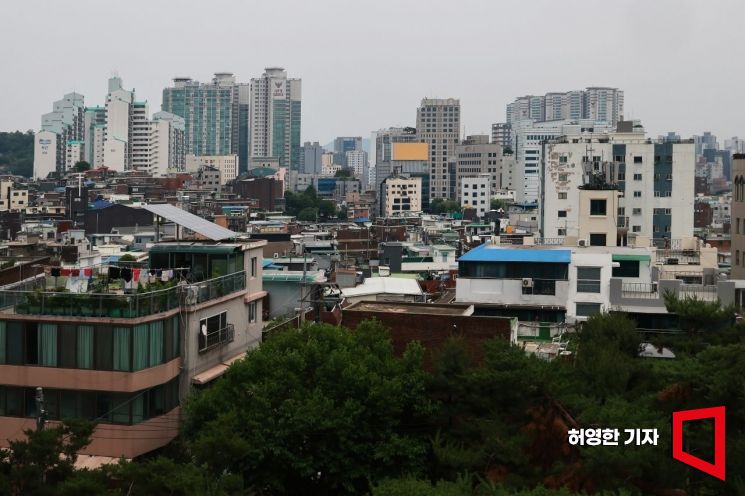 View of the old district of Changsin-dong and the redevelopment complex in Hwanghak-dong, Jung-gu, as seen from Hanyangdoseong. Photo by Younghan Heo
The regulatory relief measures reflected in the "2030 Urban and Residential Environment Maintenance Master Plan" consist of three main points: easing public contribution requirements in height-restricted areas, introducing three-dimensional parks, and upgrading quasi-residential zones near subway stations. The plan also specifies the criteria for the "preliminary review system," which allows the Urban Planning Committee to review redevelopment maintenance plans before securing resident consent.
The easing of public contribution requirements in height-restricted areas mainly allows regions subject to height restrictions?such as altitude and landscape districts, areas near cultural assets, and areas around schools?to be subject to a lower public contribution rate than the standard 10% when their land use designation is upgraded. This is expected to improve redevelopment conditions for aging residential areas where height restrictions have previously hindered project progress.
In general areas, a public contribution equivalent to 10% of the upgraded area is required when the land use designation is raised by one level. However, in areas where development density is limited due to height restrictions, only the additional FAR obtained needs to be contributed. If it is deemed necessary to secure project viability, a more relaxed public contribution rate may be applied through committee review.
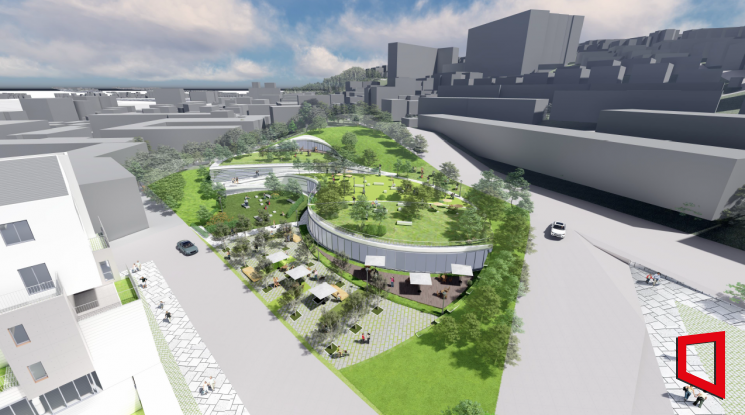
The three-dimensional park system allows the area designated for park creation to be recognized as part of the site area, thereby increasing the number of housing units that can be built and improving project viability. This system will be applied to redevelopment and reconstruction sites that have undergone feasibility reviews through fast-track integrated planning and feature creative park designs and sufficient public value. FAR relaxations granted for the creation and provision of three-dimensional parks will be determined based not only on park area, but also on the quality of the park, land values in the area, and overall project conditions.
The plan to upgrade quasi-residential zones in station area maintenance projects will also be actively promoted. This measure will be prioritized for maintenance sites in station areas where the average officially assessed land price is below the overall average for redevelopment and reconstruction projects in Seoul. In principle, the scope of the upgrade applies to areas within 250 meters of a subway station boundary, but may be extended up to 350 meters through committee review, depending on the conditions of each maintenance zone. The city will comprehensively consider whether the area can accommodate mixed-use development within the city center and whether sufficient infrastructure can be secured through development before deciding on the upgrade.
With the introduction of the "preliminary review system" for redevelopment projects, the designation process for maintenance zones can be shortened by up to six months. Once the maintenance plan is completed, the procedures for resident consent and Urban Planning Committee review can proceed simultaneously, making the process more efficient. This system will apply to approximately 50 candidate sites for fast-track integrated planning redevelopment that are currently at the pre-review stage, as well as all future candidate sites. However, if there is conflict among residents, the district mayor must confirm the level of resident consent before initiating the plan as before, and if the opposition rate is 20% or higher (25% for public redevelopment), a re-examination of the plan must be conducted first.
Choi Jinseok, Director of Housing at the Seoul Metropolitan Government, stated, "Following the announcement of regulatory relief, the swift implementation of administrative procedures in this regulatory innovation will secure momentum for maintenance projects and serve as a turning point for balanced regional development." He added, "We will spare no effort in supporting the rapid application of these three measures through training for district officials and public outreach, so that the tangible effects can be maximized in as many maintenance zones as possible."
© The Asia Business Daily(www.asiae.co.kr). All rights reserved.


















