Korea Federation of Credit Finance Holds Seminar on "Overseas Expansion Strategies and Future Tasks for Specialized Credit Finance Companies"
"Opportunities Await in Indonesia, Laos, and Uzbekistan"
"Localization and Digital Strategies Are Essential for Success"
There has been a suggestion that specialized credit finance companies, such as card and capital firms, need to enter the Southeast Asian auto finance markets in countries like Indonesia and Laos in order to overcome the structural issue of sluggish domestic demand.
Seo Jiyong, professor of the Department of Business Administration at Sangmyung University, made this statement during a seminar titled "Strategies for Overseas Expansion of Women Finance Professionals and Future Tasks" held on the 25th at the Grand Lecture Hall of the Korea Federation of Women Credit Finance in Jung-gu, Seoul. Professor Seo said, "Specialized credit finance companies are seeing their profitability and soundness deteriorate due to high funding costs, lowered merchant commission rates, and financial regulatory authorities' regulations." He added, "Entering the auto finance markets of Indonesia, which is the largest automotive market in Southeast Asia, and Laos, whose economy is rapidly growing, will open up new opportunities."
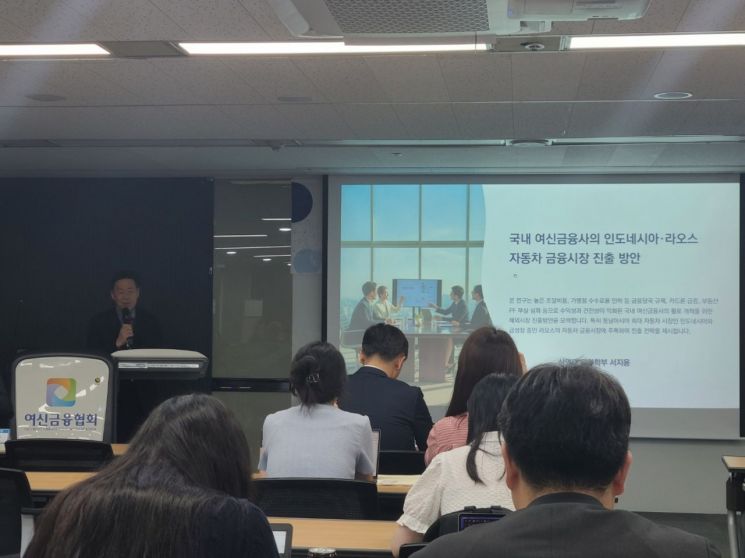 Seo Jiyong, professor of the Department of Business Administration at Sangmyung University, is conducting a seminar on the topic "Strategies for Overseas Expansion of Women Finance Professionals and Future Tasks" on the 25th at the Grand Lecture Hall of the Korea Federation of Women Credit Finance in Jung-gu, Seoul. Photo by Choi Donghyun
Indonesia is experiencing rapid growth, recording an economic growth rate in the 5% range for three consecutive years. The policy interest rate remains at 5.75%, with the average bank lending rate at 8.62% and the deposit rate at 4.63%. There is also ongoing innovation in digital finance and fintech (finance + technology). Last year, under the administration of President Prabowo Subianto, efforts have been underway to attract foreign direct investment.
The Indonesian automotive industry is sizable, with approximately one million vehicles sold annually. Multi-purpose vehicles (MPVs), sport utility vehicles (SUVs), and low-cost green cars (LCGCs) are the main sellers. The government is also promoting the adoption of eco-friendly vehicles, such as electric cars and low-carbon vehicles.
The Indonesian auto finance market has a high installment finance utilization rate of 75% for new cars. Approximately 80% of the population does not have a bank account. The used car finance market is led by banks and is valued at $42.3 billion (about 58 trillion won). Professor Seo explained, "For entry into Indonesia, acquisition or equity investment in local financial companies is preferred over obtaining new licenses and establishing local subsidiaries," citing the large presence of foreign financial institutions and the difficulty of obtaining new licenses due to the protection of local financial companies.
Professor Seo believes that, to succeed in Indonesia's auto finance market, it is necessary to strengthen digital channels, secure a leading position in the electric vehicle finance market, and advance credit evaluation systems. He stated, "Already, 35% of auto finance applications in Indonesia are made online," and emphasized, "It will be difficult to succeed without making loan applications, screening, and approvals digital-centric through digital platforms." He added, "Since there is a large population but not many high-income individuals, efforts to advance credit evaluation are also needed," and "It is important to establish effective strategies for managing non-performing loans."
Laos is also experiencing rapid growth, maintaining an annual economic growth rate in the 4% range. Although it is a socialist single-party state led by the Lao People's Revolutionary Party, there are many business opportunities as the country is promoting foreign investment, digital economic transition, and expansion of financial accessibility.
The Laotian automotive industry is growing by 8-9% annually in terms of vehicle registrations. Due to an increasing middle class and rising demand for personal transportation, the proportion of passenger car and motorcycle sales is high. Recently, the electric vehicle market has also been growing rapidly, driven by government eco-friendly policies and expansion of electric infrastructure.
Professor Seo emphasized that market research and building local partnerships are crucial for success in the Laotian auto finance market. He stated, "It will be difficult for Korean companies to independently develop auto finance businesses in Laos without collaborating with Kolao Group, the largest private enterprise in the country." He further explained, "Since Laotian consumers are highly price-sensitive, it is necessary to develop various financial options such as low-interest installment plans, reduced down payments, and long-term repayment to lower the initial burden."
Following Professor Seo, Bae Seungwook, CEO of the Venture Market Research Institute, gave a presentation on "Strategies for Domestic Capital Companies Entering the Uzbekistan Credit Finance Market." CEO Bae diagnosed, "Uzbekistan is a blue ocean with high growth and low debt structure, but the credit penetration rate is only 38.8%." He added, "If reforms such as bank privatization and accession to the World Trade Organization (WTO) are implemented smoothly, the market is expected to see improved financial system efficiency."
CEO Bae suggested that domestic capital companies should enter the market by dominating the vehicle and equipment-centered financial leasing market and by obtaining approval as microfinance organizations (MFOs) to provide small installment and retail financing. He also recommended strategies such as collaborating with buy-now-pay-later (BNPL) fintech companies and establishing compliance systems based on data localization.
Park Taejun, head of the Credit Finance Research Institute, pointed out, "Specialized credit finance companies have been striving to pioneer overseas markets for a long time, but have not yet achieved significant results." He cited lack of understanding of local markets, difficulties in local funding, and inefficiencies in local human resource management as the reasons. He further explained, "To succeed in overseas business, it is necessary to provide customized financial products that combine accumulated consumer-oriented products and services with captive strategies and digital technology," and added, "It is also important to effectively utilize the strengths of the credit finance industry."
© The Asia Business Daily(www.asiae.co.kr). All rights reserved.

















