Kim Sungkeun, President of POSTECH, Interview
POSTECH Celebrates 40th Anniversary Next Year
Fostering Independent Thinkers and Pathfinder-type Talents
All Freshmen Receive 10 Million Won Vouchers
Opportunities for Experiential Path Exploration Outside the Classroom
Focus on Educating 'Creative Humans Equipped with AI'
Mandatory AI Fundamentals for All Majors, AI-based Administration
"Education Aiming for Both-And, Not Either-Or"
Everyone walks along familiar paths. However, it is those who break away from familiarity and seek new paths who change the world. Kim Sungkeun, President of Pohang University of Science and Technology (POSTECH), has put forward the idea of the 'Pathfinder'?someone who seeks a different path?as the spirit of POSTECH, aiming to lead the future of science in fields such as artificial intelligence (AI), quantum technology, and biotechnology through creative thinking and interdisciplinary research.
POSTECH will celebrate its 40th anniversary next year. President Kim felt a sense of crisis about whether the university could continue to grow as a world-class institution, and last year declared a 'Second Founding,' vowing to make a fresh start. President Kim said, "We will overhaul the entire structure of education, research, and industry-academia cooperation with the determination to rebuild the university from scratch," adding, "In the age of AI, creative talents who can see things differently, rather than just being smart, are more important." Asia Economy spoke with him about his vision. The following is a Q&A.
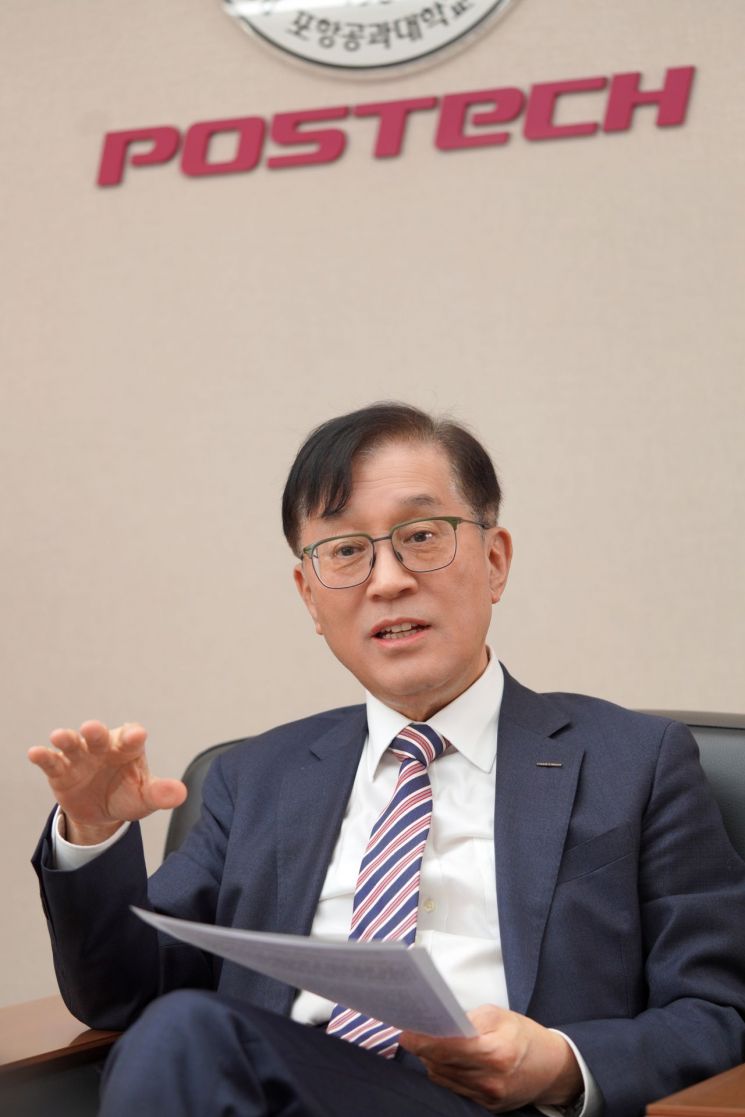 Kim Sungkeun, President of Pohang University of Science and Technology, is being interviewed by Asia Economy. Photo by Pohang University of Science and Technology
-What concerns led to the 'Second Founding'?
▲Simply improving or fixing a few things was not enough. I took a hard look at how much of our founding ideals we have realized and whether we could continue to grow as a world-class university, and I concluded that optimism was unwarranted. The 'Second Founding' is not about minor improvements or supplements, but about starting over with the determination to build the university anew.
-What kind of talents are needed in the age of AI?
▲Today, it is more important to be someone who sees things differently than just being smart. In the past, the ideal student was someone who excelled academically. The speed and proficiency of acquiring knowledge were considered the standards of competence. However, AI is making this meaningless. The key now is how I can be meaningfully different from the other 8 billion people. Ultimately, we need people who ask questions while looking in a different direction, not those who follow the crowd, and those who can think independently. POSTECH aims to nurture such pathfinder-type talents.
-Can you share POSTECH’s efforts to foster such talents?
▲To give students the experience of asking questions on their own, facing challenges, and finding their own paths, we created a program called 'Experiential Path Exploration.' Every undergraduate freshman is provided with vouchers worth a total of 10 million won, which can be freely used during their studies. Students use these to attend Nobel Prize ceremonies, participate in world-class technology exhibitions and conferences, and even challenge themselves with overseas exchanges or startups. The core of this program is to enable students to learn and experiment in the real world, not just in the classroom.
-What are POSTECH’s directions for AI research and education?
▲AI should be more than just a technology; it should be a tool that augments human abilities. Therefore, our focus is not on technology itself, but on nurturing 'creative humans equipped with AI.' We have already made AI fundamentals a mandatory course for all freshmen, regardless of their major, and we are expanding cooperation with global companies and universities through our Graduate School of Artificial Intelligence and research institutes. We are also currently implementing the 'AI Campus' project, which aims to transform all aspects of education, research, and administration to be AI-based.
-POSTECH is recognized as having the top domestic capabilities in quantum technology. What are your specific strategies?
▲Quantum technology is not just a promising field but is becoming the main battleground for national technological sovereignty. POSTECH aims to go beyond simply acquiring equipment or following trends, setting its sights on securing world-class, detailed technologies. For example, decisions such as which materials or states to select for qubit (the basic unit of quantum computing) devices, how to simultaneously solve the two challenges of qubit count and stability, and how to correct errors and implement efficient algorithms in an environment where errors are inevitable?these are the points that make the real difference in capability. In the quantum field, it is impossible to take the lead without concrete strategies and persistent technical depth.
-The social environment for nurturing scientific talent is becoming increasingly difficult. Not only is there a rush toward medical schools, but regional extinction is also a real barrier.
▲The craze for medical schools is not just a matter of career choice. It is the result of a societal structure that avoids uncertainty and is obsessed only with predictable success. However, science is inherently a field where one must accept uncertainty and failure. Now is the time when we need scientists?the people who create new paths, not those who walk well-paved ones. POSTECH, too, is not free from the impact of regional extinction, but it is interesting that over 70% of our incoming students are from the Seoul metropolitan area. I believe this is thanks to our admissions philosophy, which seeks out promising raw talent rather than focusing solely on scores. Starting this year, we have increased the interview component in some admissions tracks from 33% to 50%, and we comprehensively evaluate thinking skills, creativity, problem-solving ability, character, and community competence. While many universities are reducing the weight of interviews, POSTECH, as a small and elite institution, maintains what could be called a 'luxurious selection process.'
-We have heard that policies to secure and nurture excellent faculty are also being strengthened.
▲We have quadrupled the settlement research grant for new faculty members to a maximum of 1 billion won and introduced, for the first time, a system for early confirmation of tenure extension. Tenure can now be extended in advance from age 50 to 70, allowing for long-term research as is common overseas. We have also abolished the seniority system. From new assistant professors to senior professors nearing retirement, we evaluate everyone annually based solely on achievements and provide exceptional performance bonuses. In the past, our faculty tended to move to the Seoul metropolitan area, but recently, some have started coming to Pohang from the nation's top universities.
-Are there any strategies or achievements in attracting distinguished scholars from abroad?
▲POSTECH operates a Global Distinguished Professorship system to attract renowned scholars from overseas. We are currently in discussions with world-class scholars who have expressed their intention to join us. Since relocating their base of activity is involved, it will take some time, but we expect one or two appointments to be finalized soon. The 'Experience POSTECH' program, which started last year, is also attracting attention. This program allows international scholars to experience POSTECH’s education and research firsthand through collaborative stays of up to one month, rather than just short visits. Since its launch in July last year, nine international researchers have participated, overcoming a 5:1 competition ratio, and the response has been very positive. Recently, more world-class researchers are voluntarily proposing collaborations with POSTECH, and we expect an even stronger international research network in the future.
-Are there plans to expand the industry-academia-research cooperation model or branch into new fields?
▲I believe it is now time to elevate our industry-academia-research cooperation system to an international level. We plan to actively participate in government initiatives such as the 'Glocal University' and the 'Regional Innovation-led University Support System (RISE),' aiming to make Pohang a national innovation testbed. Our goal is to establish a Pohang-led innovation model that first experiments with new technologies, new educational models, and new industry-academia collaboration methods, and then spreads successful cases nationwide.
-Please tell us about POSTECH’s social contribution activities.
▲A representative example is the Apple Developer Academy. It is the only institution in Korea dedicated to training application (app) developers, and its location in Pohang is particularly meaningful. Many apps for the visually and hearing impaired are being developed here, with POSTECH students also participating. Through the Future Intelligence Academy, we also offer advanced lectures to local citizens, creating an open space for knowledge that connects science, humanities, and the arts. In Pohang, it is common for citizens to converse with quantum physicists and for high school students to debate with philosophers. These activities stem from the belief that science and technology alone cannot change the world?intellectual empathy and cultural imagination must accompany them.
-What kind of president do you want to be during the remainder of your term? Is there a goal you definitely want to achieve?
▲What matters is not the image of the president as an individual, but creating a university where members can feel and participate in change. A university should not be a cram school, but a place that produces future talents through education and research. At last year’s graduation ceremony, I said, "Soar like a bumblebee that knows no limits." Just as the bumblebee can fly because it does not know it is aerodynamically incapable, I want to create an environment where students try their possibilities before learning about impossibility. As Harvard President Alan Garber said, I want to encourage a 'Both-And' life rather than an 'Either-Or' one. Instead of closing off other possibilities by making a single choice, I want to realize an education that keeps multiple possibilities open until the end.
About Kim Sungkeun, President of POSTECH
From 1989 to 2022, President Kim served as a professor in the Department of Chemistry at Seoul National University, dedicating himself to nurturing the next generation. He has served as Dean of the College of Natural Sciences at Seoul National University, Director of the Institute for Basic Science, and Chairman of the Science Committee of the KAOS Foundation. In 2008, he contributed to science and technology policy as a member of the Presidential Council for Future and Vision under the Lee Myungbak administration. He has also exerted academic influence overseas, serving as a Fellow of the Royal Society of Chemistry (RSC) and Editor-in-Chief of the international chemistry journal PCCP.
President Kim's educational goal goes beyond technology-centered education: he aims to nurture talents who ask questions and seek new paths on their own. He is committed to fostering 'creative humans equipped with AI.' Since taking office as POSTECH president a year and a half ago, he has been promoting the 'AI Campus' project, which aims to transform all aspects of education, research, and administration to be AI-based. He also envisions making Pohang a national innovation testbed. He says, "The role of the president is to create an environment where students can experiment with their own possibilities through education and research."
© The Asia Business Daily(www.asiae.co.kr). All rights reserved.
![Clutching a Stolen Dior Bag, Saying "I Hate Being Poor but Real"... The Grotesque Con of a "Human Knockoff" [Slate]](https://cwcontent.asiae.co.kr/asiaresize/183/2026021902243444107_1771435474.jpg)















