Ordinary Citizens Participate in Trials and Mock Verdicts
"As you are here to represent the people, I trust that you will make an objective and fair judgment." On June 24 at 11:00 a.m., during the first citizen participation trial of the year at the Seoul Central District Court, the prosecutor made this statement before delivering the opening remarks.
On this day, alongside the official jurors, the "shadow jury" program was also conducted, allowing ordinary citizens to participate in the trial as if they were jurors. There were seven official jurors, one alternate juror, and twenty shadow jurors.
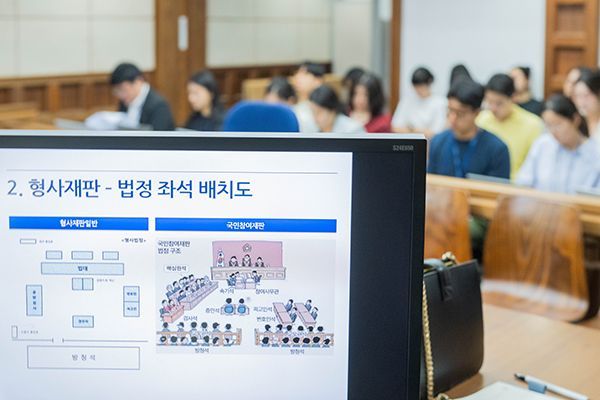 Shadow jurors are receiving an explanation about the citizen participation trial and the shadow jury program. Photo by Legal Times
They observed the proceedings of the Criminal Division 23 of the Seoul Central District Court (Presiding Judge Oh Seyong) concerning the Special Act on the Prevention of Damage from Telecommunication Financial Fraud and the Refund of Damages (abbreviated as the Telecommunication Fraud Damage Refund Act), commonly known as a voice phishing case (2024GoHap1491).
Before the trial began, at 10:00 a.m. in Room 425 of the West Wing, the shadow jurors received a preliminary briefing under the guidance of Judge Woo Minje (46th class of the Judicial Research and Training Institute) from Criminal Division 50 of the Seoul Central District Court.
Judge Woo stated, "Shadow jurors can participate in mock deliberations and verdicts after observing the trial, following the same procedures as official jurors. They will move to separate deliberation rooms in groups of ten to discuss the defendant's guilt or innocence and determine sentencing." Although the verdicts of the shadow jurors do not influence the actual trial, they are provided with the same case materials as the official jurors and can participate in the entire trial process.
The differences between shadow jurors and official jurors were also explained. Official jurors may write down any questions they have during the trial and submit them to the court. Although they cannot ask questions directly to ensure smooth proceedings, the presiding judge may ask the defendant on their behalf at the court's discretion. As a common rule, jurors were instructed not to disclose any confidential information. They must not reveal specific details discussed during the verdict or mock verdict stages, and the disclosure of case materials is strictly prohibited.
Afterward, in Room 417 of the West Wing, the official jurors were seated in the jury box between the court and the prosecutor, while the shadow jurors took seats at the very front of the public gallery.
The shadow jury system implemented on this day was introduced in September 2010 to enhance public understanding of citizen participation trials, and to date, more than 10,000 people have participated. Citizen participation trials are generally conducted for cases under the jurisdiction of a panel of judges, according to Article 5, Paragraph 1 of the Act on Citizen Participation in Criminal Trials. In practice, cases where the key issues have been relatively clarified are selected so that the jury can observe the entire trial process.
Seo Hayeon, Legal Times Reporter
※This article is based on content supplied by Law Times.
© The Asia Business Daily(www.asiae.co.kr). All rights reserved.

















