Korea Eximbank Overseas Economic Research Institute Analysis
Chinese Government's Strong Commitment to Protecting Domestic Cultural Industry
Enhanced Capacity for Domestic Cultural Content Also a Factor
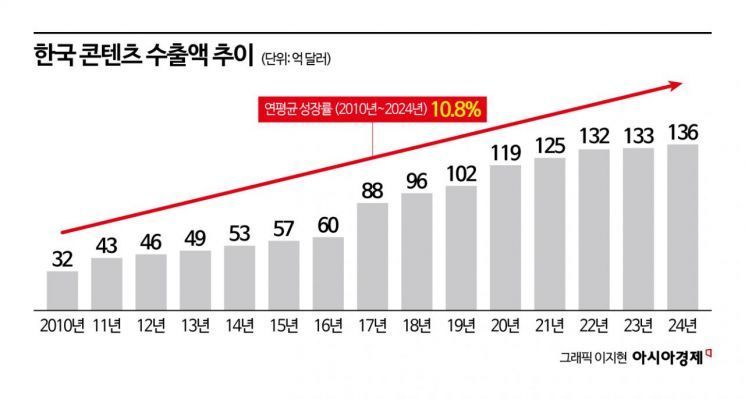
Even if the Chinese government lifts the ban on Korean cultural content, it is unlikely that Korea's cultural content will see a comprehensive market expansion in China similar to the previous Korean Wave boom, according to recent forecasts.
According to the "Status and Key Issues of the Content Industry" report released by Korea Eximbank on June 26, expectations for the lifting of the ban in China have recently increased, leading to growing interest in whether Korea's content industry will be able to expand its presence in the Chinese market after the ban is lifted.
The ban was an unofficial retaliatory measure by the Chinese government in response to Korea's decision to deploy THAAD in 2016, effectively restricting the activities of Korean content and entertainers in China. Although there was no official announcement from the Chinese government, the ban was enforced in various ways, including failed broadcast reviews, performance prohibitions, and advertising blocks. As a result, the distribution of Korean dramas, music, advertisements, and games in China was halted, causing the spread of the Korean Wave in China to slow dramatically.
Korea Eximbank analyzed that China's decision to impose the ban was not only due to the THAAD deployment issue, but also part of its "cultural security" strategy, which regards culture as an area of national security. Initially, the Korean Wave was accepted as an alternative to Western pop culture, but when its popularity exceeded a certain threshold, China moved to restrict it.
If China lifts the ban, some sectors are expected to benefit to some extent. For example, Korean dramas and films, which are likely to see expanded licensing, K-pop, which could resume performances and merchandise sales, and games, which could receive more publishing licenses. If the ban is lifted, Korean dramas and films could be sold additionally on Chinese online video service (OTT) platforms without extra production costs, and not only could suspended K-pop performances resume, but the distribution of albums and merchandise could also restart.
In the gaming industry, after issuing 35 publishing licenses for Korean games in 2016, China stopped issuing licenses from 2017 when the ban began. Since then, China has issued 1 license in 2020, 2 in 2021, 8 in 2022, 8 in 2023, and 11 in 2024. If the lifting of the ban becomes official, the pace of license approvals for Korean games is likely to accelerate further.
The challenge is that the Chinese government continues to show a strong commitment to protecting its domestic cultural industry, making it difficult to expect a full-scale market expansion as seen in the past, even if the ban is lifted. Since the ban, China has significantly enhanced its capacity for domestic content production, weakening the competitiveness of Korean content compared to Chinese content, which is cited as a negative factor for the spread of the Korean Wave. The report also predicts that Chinese companies are likely to import and distribute Korean content very selectively, in line with the government's perspective.
Kim Yoonji, Senior Researcher at Korea Eximbank's Overseas Economic Research Institute, stated, "Considering that the ban was a control measure under China's cultural security strategy, it is highly unlikely that lifting the ban will lead to a rapid market expansion as seen in the past." She added, "Accordingly, a 'post-ban' strategy is needed to establish a structure and political trust that can ensure stable long-term revenue from China."
© The Asia Business Daily(www.asiae.co.kr). All rights reserved.
![Clutching a Stolen Dior Bag, Saying "I Hate Being Poor but Real"... The Grotesque Con of a "Human Knockoff" [Slate]](https://cwcontent.asiae.co.kr/asiaresize/183/2026021902243444107_1771435474.jpg)















