Bloomberg: "UK Is the Only Country to Reach a Deal with the US"
US and EU Struggle to Find Common Ground in Talks
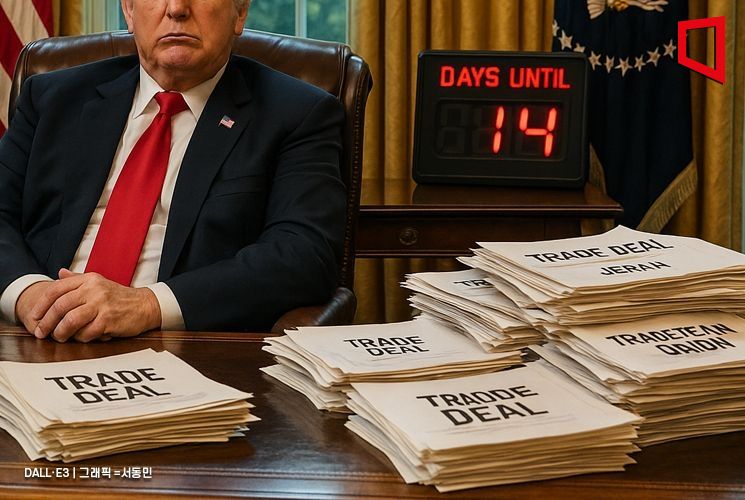
With the United States' self-imposed "negotiation deadline" of July 8 (local time) just two weeks away, there is growing speculation that the U.S. may extend the 90-day mutual tariff suspension period. This is because, so far, the only country with which the U.S. has actually reached a deal is the United Kingdom, and it is facing significant difficulties in finding common ground with the European Union (EU).
On June 24, Bloomberg News reported that the U.S. is struggling to reach agreements with its major trading partners.
On April 2, President Donald Trump announced country-specific mutual tariffs against nations around the world, but within a week, he suspended these mutual tariffs for 90 days?except for China?and entered into negotiations with other trading partners. South Korea, which had faced a high tariff rate exceeding the basic tariff of 10%?as much as 25%?was also granted temporary relief.
Currently, the only country to have concluded a trade agreement with the U.S. is the United Kingdom, which reached a deal on June 16. Even in this case, the U.S. maintained the 10% basic tariff it had imposed on most countries, and measures such as steel tariffs were only addressed in a stopgap manner, according to assessments.
Talks with the EU, a key negotiating counterpart, have been particularly difficult. While the U.S. has entered into tariff negotiations with various countries, it has made clear that the current 10% basic tariff is a "floor." However, the EU has stated that it cannot accept the U.S.'s unilateral demands. European countries have prepared a "retaliation package" in anticipation of a negotiation failure and are fully prepared for such a scenario.
Stephane Sejourne, the EU's Executive Vice-President for Prosperity and Industrial Strategy, told Bloomberg in an interview, "If the U.S. insists on an asymmetric agreement, it may be necessary to take retaliatory and rebalancing measures in some key sectors." He also mentioned the possibility that European Airbus could be put at a disadvantage in its competition with Boeing.
Previously, on June 11, U.S. Treasury Secretary Scott Besant told Congress that if mutual tariffs are reinstated on July 9, the U.S. could extend the mutual tariff suspension period if necessary. On the same day, however, President Trump, when asked by reporters whether he was willing to extend the negotiation deadline, said, "Yes. But we don't think we need to."
Adam Parra, Senior Analyst at Bloomberg Economics, predicted, "Since the U.S. is in negotiations with about 20 countries, there is a growing likelihood that the U.S. will extend the tariff suspension for those countries deemed to be negotiating in good faith." However, he added that the U.S. may unilaterally impose tariffs on other countries, stating, "It is unclear what the U.S. wants or is proposing in these agreements."
© The Asia Business Daily(www.asiae.co.kr). All rights reserved.
![Clutching a Stolen Dior Bag, Saying "I Hate Being Poor but Real"... The Grotesque Con of a "Human Knockoff" [Slate]](https://cwcontent.asiae.co.kr/asiaresize/183/2026021902243444107_1771435474.jpg)















