First Female Pilot Deployed on B-2 Bomber
37 Hours of Nonstop Flight from U.S. Mainland
24-Hour Simulation Training and Dietary Adjustment
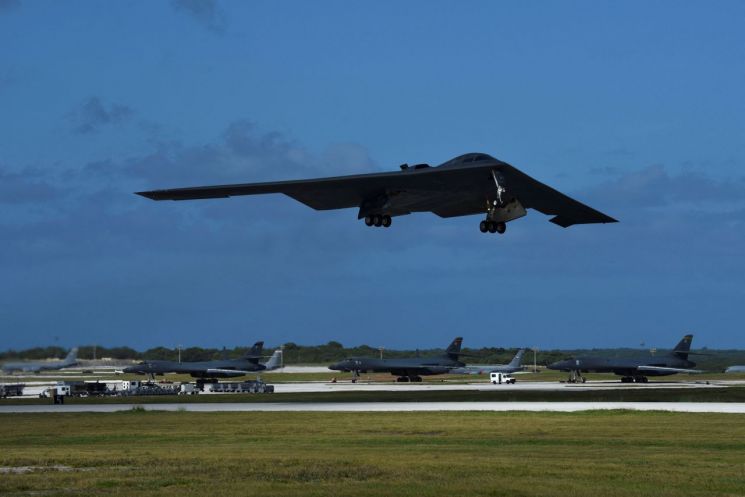
It has been reported that a female pilot was deployed to fly the B-2 bomber, which played a key role in the U.S. strike on Iranian nuclear facilities, drawing significant attention. This marks the first time a female pilot has participated in an actual combat mission with a B-2 bomber. Traditionally, only male pilots have been assigned to such missions, as piloting a strategic bomber requires continuous flights of over 30 hours, which is extremely physically demanding. The pilots also underwent flight training that included dietary adjustments prior to deployment, in preparation for emergencies.
"First Female Pilot Deployed on B-2 Bomber"...37 Hours of Continuous Flight
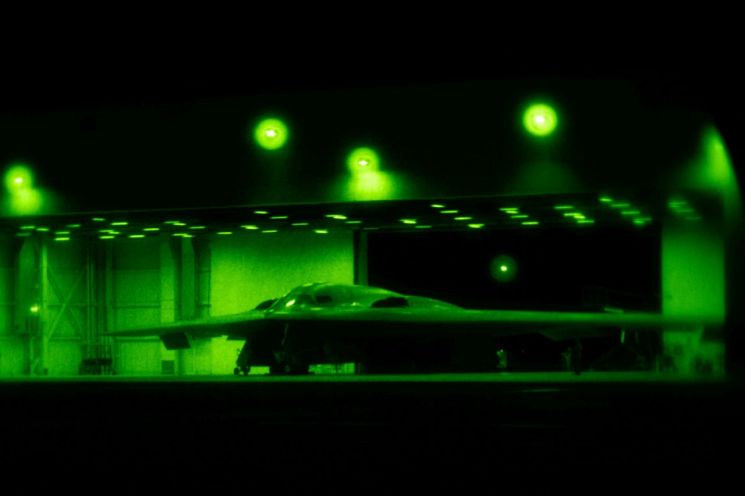 On the 20th (local time), a B-2 bomber preparing for takeoff at Whiteman Air Force Base in Missouri, USA, was captured using a night vision camera. Photo by Reuters Yonhap News
On the 24th (local time), U.S. defense media outlet Military.com, citing a senior U.S. military official, reported, "One of the B-2 bomber pilots who struck Iranian nuclear facilities was a female pilot," adding, "This is the first time a female pilot has participated in an actual combat mission with a B-2 bomber." The U.S. Department of Defense has not yet officially confirmed whether a female pilot participated.
Military.com reported that it is rare for female pilots to be deployed on B-2 bombers due to the extreme physical demands, as the aircraft typically flies continuously for over 30 hours. A total of seven B-2 bombers were mobilized for the "Midnight Hammer" operation targeting Iranian nuclear facilities, flying a round-trip distance of 24,000 kilometers between Whiteman Air Force Base in Missouri, USA, and Iran, over a continuous 37-hour period.
This continuous flight set a new record for the B-2 bomber, surpassing its previous record of 44 hours of continuous flight during unlimited bombing operations in the 2001 Afghanistan War. U.S. Secretary of Defense Pete Hegseth also emphasized during a press briefing, "The B-2 bomber has completed its longest mission in 20 years and returned," adding, "The precision strikes on three Iranian nuclear facilities were astonishing and overwhelmingly successful."
Christine Goodwin, former U.S. Air Force brigadier general, told Military.com, "There are only about 10 female pilots qualified to fly stealth bombers," and added, "Although there is often talk that women should not participate in combat or cannot endure long flights, this pilot was undoubtedly selected because she was fully qualified."
24-Hour Flight Simulator Training Before Deployment...Dietary Adjustment Training Also Conducted
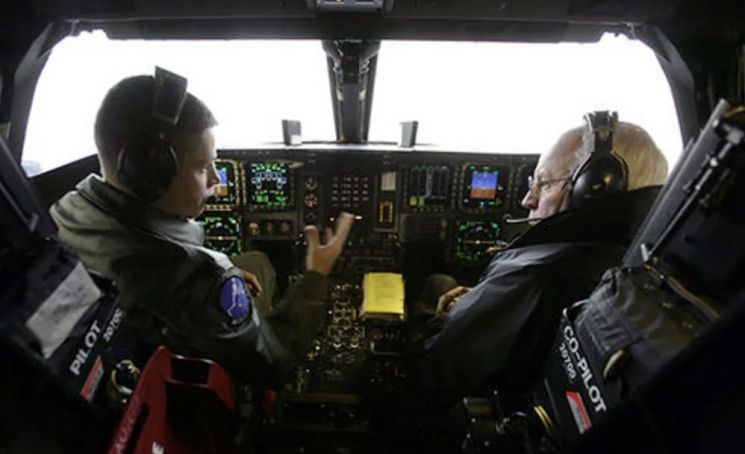 At the time in 2006, Vice President Dick Cheney (right) boarded the cockpit together with B-2 bomber pilot Captain Luke Jane. White House website of the United States
Pilots of the B-2 bombers reportedly underwent intensive training for this operation. The New York Times (NYT) reported, "Pilots selected for this mission were gathered at secret training bases located in mountainous areas, where they received 24 hours of continuous training in a B-2 bomber flight simulator replicating the cockpit, along with dietary adjustment training."
B-2 bomber pilots, who are typically deployed for large-scale bombing operations across vast battlefields, receive special training to fly nonstop with aerial refueling. In particular, because the number of pilots is limited to two per aircraft, physical training to withstand long-duration flights is crucial.
The B-2 bomber can fly up to 11,000 kilometers without refueling, but in practice, more than five to six aerial refuelings are conducted to ensure operational capability. Aerial refueling requires advanced piloting skills, as the aircraft must be precisely aligned with the refueling boom while in flight. Steven Basham, a retired lieutenant general who served as a B-2 bomber pilot during the Kosovo War in Yugoslavia in 1999, told the NYT, "Because your life is on the line, it's difficult to sleep for more than an hour at a time, and aerial refueling requires intense concentration."
He added, "In the case of the B-2 bomber, there is a small cot and a single restroom located behind the cockpit for brief naps, and pilots generally prefer simple meals like sandwiches," explaining, "Spending too much time in the restroom makes it difficult to respond to emergencies, so easily digestible meals are important. Pilots also learn to drink plenty of water in advance."
© The Asia Business Daily(www.asiae.co.kr). All rights reserved.



















