Cross-Shareholding by Korea Zinc Recognized as a Legitimate Procedure
Insufficient Grounds for Breach of Duty or Fair Trade Act Violation in Share Acquisition
Youngpoong and MBK Partners lost their appeal in the case requesting a suspension of the effect of resolutions passed at Korea Zinc's annual general shareholders' meeting. Following the dismissal by the Seoul Central District Court, the Seoul High Court, which handled the appeal (second instance), also ruled in favor of Korea Zinc. Youngpoong and MBK Partners expressed their intention to contest the appeal decision and announced plans to file a further appeal with the Supreme Court.
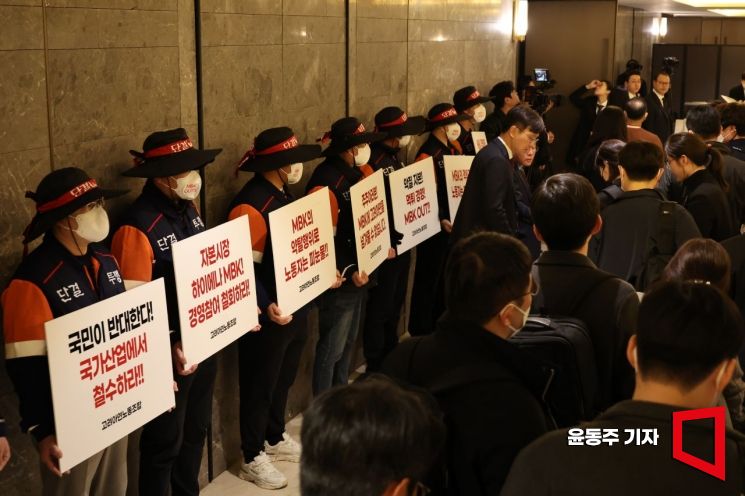 The court dismissed the provisional injunction filed by Youngpoong and MBK Partners against Korea Zinc, requesting permission to exercise voting rights at the shareholders' meeting. On March 28, union members of Korea Zinc held a picketing protest in front of the Korea Zinc shareholders' meeting venue scheduled to be held at the Mondrian Hotel in Yongsan-gu, Seoul. 2025.03.28 Photo by Dongju Yoon
On June 25, Korea Zinc announced that the Civil Division 25-3 of the Seoul High Court had dismissed all applications filed by Youngpoong and MBK Partners seeking to suspend the effect of the resolutions passed at Korea Zinc's annual general shareholders' meeting. The court rejected all arguments from Youngpoong and MBK Partners that the restriction of Youngpoong's voting rights due to cross-shareholding was illegal or unfair. The court also stated that it was difficult to conclude that Korea Zinc's series of defensive actions constituted an abuse of defensive rights or violated the principle of good faith and trust.
The Seoul High Court stated, "At the time of the annual general meeting, Sun Metal Holdings (SMH) held 190,226 shares of Youngpoong, and as of the record date for the annual general meeting, December 31 of the previous year, Youngpoong held shares in Korea Zinc. Therefore, it is difficult to consider Korea Zinc's restriction of the creditor's voting rights under Article 369, Paragraph 3 of the Commercial Act to be illegal."
The court further clarified, "Article 342-3 of the Commercial Act is a provision that, in accordance with the so-called cross-shareholding voting rights restriction (Article 369, Paragraph 3 of the Commercial Act), prevents both companies from exercising voting rights in each other's companies. This is intended to eliminate the possibility of mutual control and to ensure the stability of management rights." The court also made it clear that cross-shareholding is a legitimate means of defending management rights. Additionally, the court stated, "It is difficult to conclude that the debtor's restriction of the creditor's voting rights on these shares constitutes an abuse of defensive rights or a violation of the principle of good faith," and added, "Therefore, the creditor's application is not accepted."
Furthermore, the court rejected all claims that the acquisition of shares by Korea Zinc and its subsidiaries during the process of forming cross-shareholdings constituted breach of duty or violations of the Capital Markets Act, and in particular, that it violated the Monopoly Regulation and Fair Trade Act, such as the prohibition on circular shareholding. The court pointed out that these claims lacked sufficient basis and that there was no supporting evidence.
In response, Youngpoong and MBK Partners immediately filed a further appeal, stating their intention to prove the illegality of Korea Zinc's actions. A Youngpoong representative said, "Restricting the shareholder rights that we have legitimately exercised as Korea Zinc's largest shareholder for more than 50 years by creating the appearance of cross-shareholding is not only a distortion of Article 369, Paragraph 3 of the Commercial Act, but also an act that deceives the legal order. We cannot agree with the High Court's decision, which stated that it is difficult to reach a different conclusion from the first instance in a provisional injunction case due to the need for sufficient time for evidence review and thorough examination in the main lawsuit."
Previously, on March 27, the Seoul Central District Court dismissed the provisional injunction filed by Youngpoong and MBK Partners seeking to allow them to exercise voting rights at Korea Zinc's annual general meeting, stating that the application lacked grounds. The first-instance court found that it was insufficient to conclude that Korea Zinc and SMH's restriction of Youngpoong's voting rights on the grounds of cross-shareholding, in order to block Youngpoong and MBK's merger and acquisition (M&A) attempt, was illegal. The appellate court reached the same conclusion and dismissed all applications to suspend the effect of the shareholders' meeting resolutions.
As a result, Korea Zinc has secured a legal foundation to proceed without disruption with measures to improve governance and enhance shareholder value, including setting a maximum number of directors (no more than 19), appointing an outside director as chair of the board, and changing the dividend record date, all of which were resolved at the annual general meeting. A Korea Zinc representative said, "Youngpoong and MBK's attempts to take control of Korea Zinc's board of directors are ongoing. All executives and employees of Korea Zinc will do their utmost to defend against hostile M&A attempts so that Korea Zinc, as the nation's only strategic mineral production base and a key national industry possessing core national technology, can continue to contribute to the national economy as it does now."
© The Asia Business Daily(www.asiae.co.kr). All rights reserved.

















