Strengthening Quantum Science and Technology Cooperation Networks with Over 100 Participants from 17 Countries at Quantum Korea
Joint Seminars Including Korea-EU, US QED-C, and Finland Roundtables
On the occasion of the 'Quantum Korea 2025' event, six international cooperation events are being held intensively in Seoul. The Ministry of Science and ICT announced on the 25th that, as part of the 'Quantum Korea 2025' event, six international cooperation events will take place at the Yangjae aT Center over three days from June 24 to 26.
These international cooperation events have been organized to mark the United Nations-designated 'International Year of Quantum Science and Technology.' The aim is to connect Korea's quantum technology ecosystem with global networks and to strengthen the foundation for international cooperation.
In particular, to establish close cooperative frameworks with major countries such as Denmark, the European Union (EU), Finland, the Netherlands, Switzerland, and the United States, roundtables between countries and institutions, as well as a joint seminar among four countries, are being held. In addition, a workshop co-hosted by the Organisation for Economic Co-operation and Development (OECD) and the Ministry of Science and ICT is also taking place.
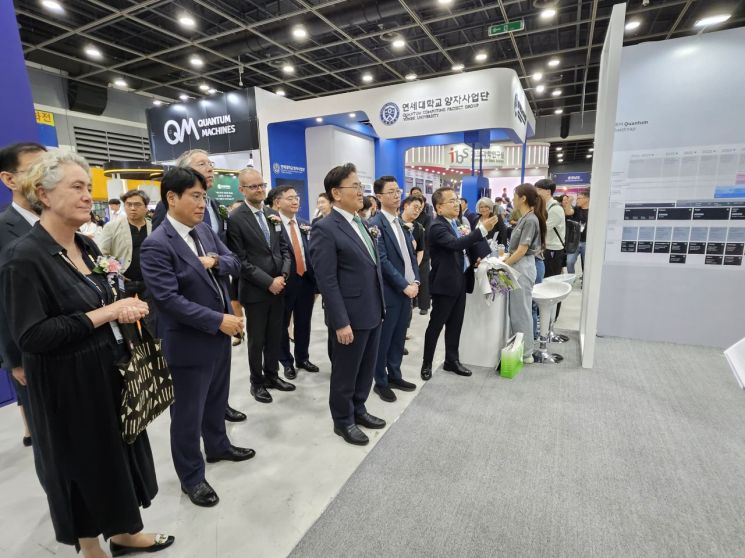 Science and ICT Minister Sangim Yoo is touring the 'Quantum Korea 2025' event venue, which opened on the 24th, together with Dagma Schmidt Tartalli, Swiss Ambassador to Korea (first from the left), and other guests, listening to an explanation in front of a booth. Photo by Jonghwa Kim
First, at 11:30 a.m. on the 25th, the 'Quantum Networking Reception' will be held in the Lucia Hall at the Yangjae aT Center. Kwangjun Ryu, Director-General for Science and Technology Innovation, will attend as the representative of the Korean government. The event will bring together more than 100 government, industry, academia, and research experts, as well as embassy officials from 17 countries, including the EU, United States, India, Denmark, Switzerland, Hungary, the Netherlands, Austria, Sweden, the United Kingdom, and the OECD. Participants will discuss major issues of interest in the quantum field and seek opportunities for cooperation.
On June 24, when 'Quantum Korea 2025' opened at the Yangjae aT Center, the 'Korea-EU Roundtable' and the 'Korea-US QED-C Roundtable' were held. On the 26th, the 'Korea-Finland Roundtable' is scheduled to take place.
At the Korea-EU Roundtable, there were active discussions on the latest policy and program trends in the quantum technology sector between the two sides, as well as on expanding areas of intergovernmental cooperation. At the Korea-US QED-C Roundtable, 13 American companies and institutions and 18 Korean companies participated, strengthening exchanges and cooperation between the quantum industries of Korea and the United States.
The Korea-Finland Roundtable will serve as a venue to discuss ways to expand cooperation in quantum technology and industry between Korea and Finland, a leading European country in quantum technology. Presentations and in-depth discussions will be held on quantum testbeds and user experiences, as well as strategic research and development (R&D) plans in the industrial sector.
The workshop co-hosted by the OECD and the Ministry of Science and ICT will be held consecutively at the Grand Hall of the Yangjae aT Center on the 26th and the Elgarden Hall of the Yangjae L Tower on the 27th. As part of the OECD's 'Forward-looking Technology Impact Assessment on Quantum Science and Technology (2025-2026)' project, the workshop aims to examine the ripple effects of industrial applications of quantum technology and to minimize negative impacts through international cooperation.
The public session on the 26th will feature the introduction of the OECD's latest report on the global quantum ecosystem, sharing of quantum technology policies and ecosystem characteristics of major countries, as well as expert presentations and discussions. On the 27th, a closed session will be held with more than 40 domestic and international experts, where there will be in-depth discussions on the impact of quantum technology on future industries, challenges to realization, and bottlenecks. The results of the two days of discussions are expected to make a substantial contribution to the 'Quantum Technology Recommendations' that the OECD plans to announce in the first half of next year.
At the 'Quantum Networking Reception' held that day, Kwangjun Ryu, Director-General for Science and Technology Innovation, stated, "Quantum itself is very small, but the conversations we share here today are by no means small," adding, "I hope this will be a time for us to reaffirm our shared aspirations to create a better future through quantum technology."
© The Asia Business Daily(www.asiae.co.kr). All rights reserved.

















