On the 24th, the won-dollar exchange rate plunged by more than 24 won, quickly falling to the 1,360 won level. This was due to the easing of concerns over geopolitical risks in the Middle East following news of a ceasefire agreement between Israel and Iran.
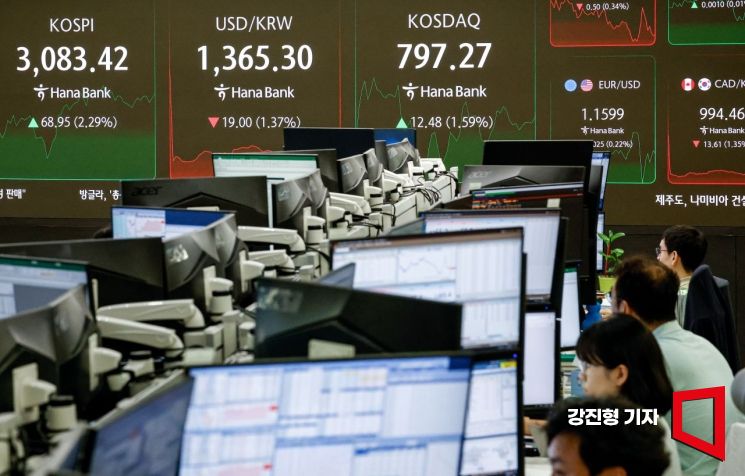 On the 24th, as the KOSPI surged more than 2% due to easing tensions in the Middle East and surpassed the 3070 mark, dealers were working in the dealing room at the Hana Bank headquarters in Jung-gu, Seoul.
In the Seoul foreign exchange market, the won-dollar exchange rate closed weekly trading at 1,360.2 won as of 3:30 p.m., down 24.1 won from the previous trading day. This is the lowest level since the 12th of this month, when it closed at 1,358.7 won. The exchange rate opened at 1,369.0 won, down 15.3 won from the previous day, and continued to widen its decline throughout the session. Before the close, it even dropped to 1,359.2 won.
On the 23rd (local time), U.S. President Donald Trump wrote on the social networking service Truth Social that Israel and Iran had agreed to a "complete and comprehensive" ceasefire. He stated that Iran would begin the ceasefire, Israel would follow 12 hours later, and the war would end 24 hours after that.
As risk appetite recovered, major indices on the New York Stock Exchange rose overnight: the Dow Jones Industrial Average by 0.89%, the Standard & Poor's (S&P) 500 Index by 0.96%, and the Nasdaq Composite Index by 0.94%. In Korea, the KOSPI Index also surged, closing at 3,103.64, up 89.17 points (2.96%) for the day. This is the first time in three years and nine months that the index has surpassed the 3,100 mark. The KOSDAQ Index also jumped 16.14 points (2.06%) to close at 800.93, exceeding the 800 mark for the first time in about eleven months since August 1 last year.
The dollar index, which measures the value of the dollar against the currencies of six major countries, fell 0.33% from the previous day to 98.054.
© The Asia Business Daily(www.asiae.co.kr). All rights reserved.
![Clutching a Stolen Dior Bag, Saying "I Hate Being Poor but Real"... The Grotesque Con of a "Human Knockoff" [Slate]](https://cwcontent.asiae.co.kr/asiaresize/183/2026021902243444107_1771435474.jpg)















