Forum on "Automotive Industry Policy Tasks Desired by the New Government"
"Government Should Increase R&D Budget and Promote Cross-Industry Convergence"
"Worsening Export Environment and Unstable Domestic Market Require Comprehensive Support"
There is a growing argument that the government needs to provide active support, such as increasing the research and development (R&D) budget, for the Korean automotive industry to secure cutting-edge technology in the future vehicle market and strengthen the related ecosystem. China, which is leading future vehicle technologies such as electric vehicles and autonomous driving, is often cited as a precedent for government support.
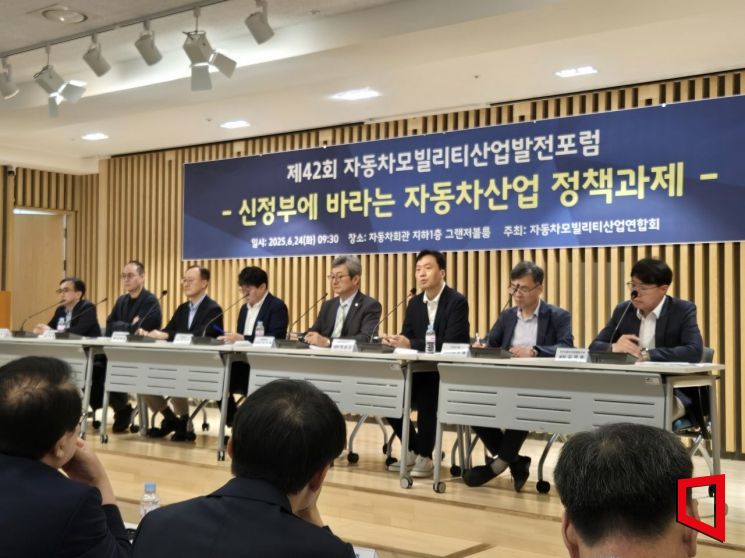 On the 24th, the Auto Mobility Industry Development Forum was held at the Automobile Hall in Seocho-gu, Seoul, under the theme "Automotive Industry Policy Tasks Desired by the New Government." Photo by Kyungjo Noh
Cho Chul, Senior Research Fellow at the Korea Institute for Industrial Economics and Trade, stated at the Auto Mobility Industry Development Forum held on the 24th under the theme "Automotive Industry Policy Tasks Desired by the New Government," that "considering the importance of the automotive industry and its transition to the future, corporate R&D spending is quite low, and government support is also relatively weak."
Cho pointed out, "Even though the Special Act on Promoting the Transition and Fostering the Ecosystem of the Future Automotive Parts Industry came into effect in July last year, the automotive industry was not considered at all in the government budget. This year, the automotive industry R&D budget stands at 432.6 billion won, which is only 1.5% of the total R&D budget and even falls short of the 434.7 billion won allocated in 2023."
He emphasized, "Given the poor R&D investment environment for parts companies and small to medium-sized enterprises that form the ecosystem, the government should expand the budget to enhance support for various future vehicle ecosystems, including autonomous vehicles, connected cars, and software-defined vehicles (SDVs)."
Today’s mobility market requires rapid progress toward autonomous vehicles and technological adaptation. In particular, China believes that the first half, characterized by electrification, has ended, and the second half, symbolized by intelligence, has begun. The Chinese government is introducing a variety of policies related to autonomous driving and connectivity at the national level. China has already entered Level 3 autonomous driving and is leading the global market across the entire supply chain.
Jung Gumin, Professor in the Department of Electronic Engineering at Kookmin University, who participated as a panelist, remarked that the cooperation between the Chinese government and companies is impressive. He noted, "In the case of Huawei, the authorities have enabled horizontal expansion by developing processors, operating systems (OS), LiDAR, radar, and autonomous driving software. Meanwhile, Horizon Robotics has grown into a leading autonomous driving technology company in China." He added, "The Chinese government completed standardization for SDVs in 2022, and companies are making various efforts to reduce costs."
Professor Jung suggested, "With the rapid development of Chinese automakers posing a threat, our government should also expand support for new technologies such as SDVs, AI, and autonomous driving, and promote convergence between different industries. It is necessary to spread industry-linked R&D and discover and support promising companies."
From this perspective, he assessed that it is timely for the new government to present AI as a means of economic growth. Park Sungkyu, Executive Director at HMG Management Research Institute, stated, "The key to smartization will be the utilization of AI. The automotive industry needs to accelerate its response in this area, and nationwide efforts to utilize AI within the industry should be pursued in the future."
He added, "Although electrification is somewhat delayed, it is important to maintain current momentum through continuous demand creation. Government support is needed to stimulate demand in various fields, including new car purchases, used car replacements, support for vulnerable groups, and commercial vehicles."
Automotive parts companies have suggested long-term low-interest financing, increased R&D investment, and the introduction of new employment subsidies as measures to counter deteriorating profitability. According to the Korea Auto Industries Cooperative Association, domestic parts companies cited increased financial burden (28.2%) and concerns about sharing tariff burdens (26.6%) as major difficulties. As policy directions, they proposed "tariff exemption and reduction negotiations" (43%), "responding to export risks due to exchange rate fluctuations" (20.2%), and "support for local market entry" (18.7%).
Kang Namhoon, President of the Korea Auto Industries Alliance (KAIA), said, "The export environment has worsened due to strengthened protectionism, China's expanding dominance in future vehicles, and a slowdown in global electric vehicle demand. Domestically, the recovery of the local market remains unstable, and the production base is being shaken. Comprehensive policy responses are necessary."
© The Asia Business Daily(www.asiae.co.kr). All rights reserved.

















