Through a Five-Minute Speech
"A Chance to Reestablish Hongseong as a Sacred Site of the Independence Movement"
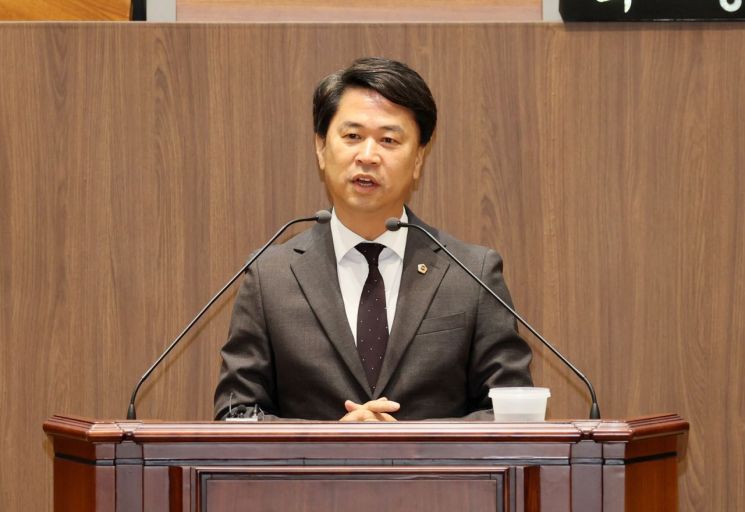 Assemblyman Lee Sanggeun of Chungnam Provincial Council, who argues through a five-minute speech that the tomb of the monk Han Yongun should be relocated to Hongseong. / Provided by Chungnam Provincial Council
A proposal has been raised to relocate the tomb of Manhae Han Yongun, a prominent historical figure from Chungnam who was an independence activist, poet, and monk who led the movement for Korea’s independence, to his hometown of Hongseong.
On June 24, Lee Sanggeun, a member of the Chungnam Provincial Council (Hongseong 1, People Power Party), officially proposed to Chungnam Province during a five-minute speech at the 4th plenary session of the 359th regular meeting of the council that the tomb of Manhae Han Yongun should be relocated to his hometown of Hongseong.
Lee emphasized, "There is no place that can fully honor the spirit of Manhae Han Yongun as much as his hometown of Hongseong, where his life and philosophy began," and added, "Hongseong is home to his birthplace, a shrine, and the Manhae Literature Experience Center, providing the most complete historical and cultural foundation for honoring and educating about his life, philosophy, and the spirit of the independence movement."
Manhae Han Yongun, born in 1879 in Hongseong, Chungnam, was one of the 33 national representatives during the March 1st Movement. He was a poet, monk, and thinker who became a symbolic figure of the national spirit by advocating for independence and awakening during the Japanese colonial period.
However, his tomb is currently located at Mangwoo Historical and Cultural Park in Jungnang-gu, Seoul. Although Hongseong County has made several attempts to relocate the tomb to Hongseong, these efforts have been thwarted due to opposition from his descendants and legal and administrative restrictions following its designation as a National Registered Cultural Heritage site in 2012.
Lee stated, "There are clear limits to what Hongseong County can achieve on its own. Now, Chungnam Province must take the lead and actively consult with the National Heritage Administration, the descendants, and Buddhist orders." He further emphasized, "Legal and administrative restrictions can be improved through discussion and consensus, and if we communicate with sincerity, it is possible to change the minds of the descendants as well."
He continued, "The relocation of Manhae Han Yongun's tomb is not simply the return of one individual, but is expected to serve as a valuable opportunity for Chungnam Province to be newly recognized as a sacred site of the independence movement. It will also firmly establish Chungnam’s historical status and instill a correct view of history and pride in future generations, making it a truly meaningful decision."
Lee appealed, "This proposal reflects the long-held wishes of both the Buddhist community and the 100,000 residents of Hongseong County. I earnestly ask for the special attention and active cooperation of all residents so that Manhae’s noble spirit can bloom once again in his hometown."
© The Asia Business Daily(www.asiae.co.kr). All rights reserved.
![Clutching a Stolen Dior Bag, Saying "I Hate Being Poor but Real"... The Grotesque Con of a "Human Knockoff" [Slate]](https://cwcontent.asiae.co.kr/asiaresize/183/2026021902243444107_1771435474.jpg)















