29 Billion Won Investment by 2030
Establishment of Architecture Foundation as Control Tower
Creation of Seoul International Urban Space Design Award
The Seoul Metropolitan Government will invest approximately 29 billion won by 2030 to foster domestic architectural talent. The city will expand opportunities for emerging architects to participate in the market and significantly ease requirements for entering public project competitions. The plan aims to nurture highly capable architects and thereby strengthen Seoul’s urban competitiveness.
On the morning of June 24, Seoul Mayor Oh Sehoon held a press conference at Seoul City Hall in Jung-gu to announce the “K-Architecture Culture Comprehensive Support Plan.” This initiative is a continuation of Mayor Oh’s urban architecture innovation policies, which have been pursued since 2006.
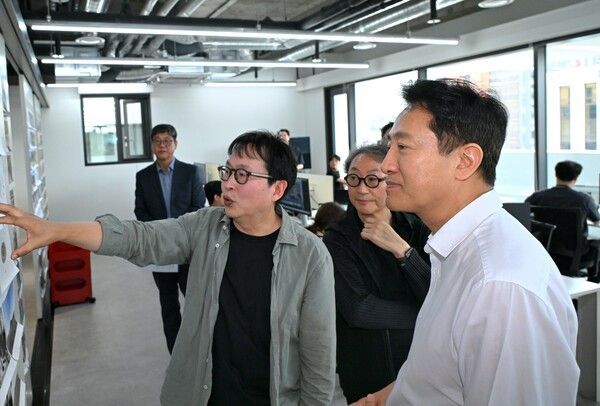 Seoul Mayor Oh Sehun is listening to architect Kim Chanjung's explanation about the building at the Uran Cultural Foundation on the 19th of last month. Photo by Seoul City
By 2030, the city will nurture emerging architects through 11 tasks across four key areas: expanding opportunities for domestic project participation and supporting overseas advancement; establishing a new International Urban Space Design Award; discovering and supporting innovative architects; and fostering a culture that honors architects. The estimated budget required to implement the K-Architecture Culture Comprehensive Support Plan is about 29 billion won.
Mayor Oh stated, “Urban transformation and the improvement of citizens’ quality of life begin with architecture,” adding, “Seoul will become both a testbed and a platform, enabling Korean architects to realize their potential and creativity.”
Establishment of International Urban Space Design Award... Creation of Architecture Foundation as Control Tower
First, the city will introduce the “Seoul International Urban Space Design Award” (tentative name), which will carry international prestige in the field of architecture. The award will recognize innovative urban spaces that reflect global agendas in various fields such as cities, architecture, and landscapes. Winners will be selected through a systematic evaluation by distinguished international judges, with the first recipients to be announced in 2027. The award will be presented every two years.
Mayor Oh said, “We have confirmed that presenting our own awards has a greater impact on enhancing the city’s brand than receiving awards from the international community,” and added, “We plan to divide the awards into three major categories: infrastructure, urban architecture, and urban gardens, rather than limiting it to the field of architecture alone.”
Additionally, the city will establish a control tower to ensure the smooth organization of architectural cultural events. The Seoul Architecture Foundation (tentative name), which will oversee all architectural events starting in 2027, is expected to be launched. Mayor Oh explained, “Currently, various architectural cultural events such as the Seoul Architecture Festival and Biennale are held in Seoul, but the lack of a unified organizing body has caused confusion. Through the Seoul Architecture Foundation, we plan to manage these events consistently.”
Expanded Participation of Domestic Architects in Projects... Promotion of Two-Stage Competitions
The city will also greatly expand opportunities for domestic architects to participate in large-scale domestic projects. In particular, the proportion of domestic architects participating in international design competitions will be maximized. This reflects feedback from the field, where the increasing selection of foreign architects in recent large-scale domestic projects has led to a higher preference for foreign architects and a shrinking space for domestic architects.
Accordingly, winners of architecture awards will be nominated for important projects?after public architectural reviews?through invited competitions (1?2 projects per year), and will be given opportunities to participate in public planning for city-led projects such as public wedding halls and Seoul-style kids cafes (20 projects per year). A city official stated, “For large-scale projects conducted through invited competitions, we intend to increase the participation of domestic architects as much as possible, provided that fairness is not compromised.”
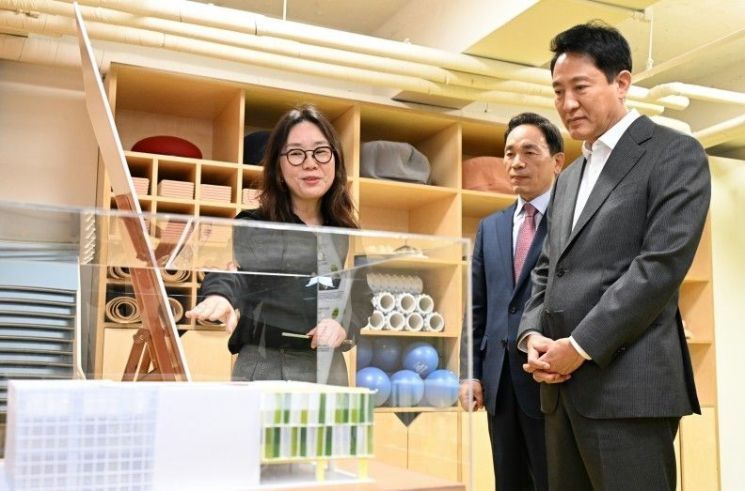 Seoul Mayor Oh Sehoon, who embarked on an "Architectural Tour," is receiving an explanation from architect Park Hyunjin of the Gangnam-gu Well-Aging Center, who won the "2024 Architecture Award (Grand Prize)" on the 14th of last month. Photo by Yonhap News
To lower the barrier to entry for competitions, the city will also expand the “two-stage competition” system, in which architects are first selected based solely on their design proposals. Architects who pass the first round of idea screening will then be evaluated in a second round based on their architectural and spatial environment designs. The city will also increase “digital competition evaluations,” in which the design competition process is conducted digitally. This is expected to help small and medium-sized architectural firms save both time and costs.
To enable architects to realize creative designs, the city will also pursue the enactment of a special law for government and urban architectural design innovation. In addition, institutional support will be provided in parallel, including regulatory relaxation, prevention of design distortion through integrated reviews, and shortening of project periods, so that architects can fully demonstrate their capabilities.
A city official said, “Currently, 20 sites have been selected as creative innovation design project locations, but there are many related laws?such as the National Land Act, Parking Lot Act, and Housing Act?and it is challenging to comply with all the required reviews individually. We will pursue the enactment of a special law that includes ‘beyond zoning’ provisions, so that architects’ creative ideas can be realized.”
© The Asia Business Daily(www.asiae.co.kr). All rights reserved.
![Clutching a Stolen Dior Bag, Saying "I Hate Being Poor but Real"... The Grotesque Con of a "Human Knockoff" [Slate]](https://cwcontent.asiae.co.kr/asiaresize/183/2026021902243444107_1771435474.jpg)
















