Ministry of Food and Drug Safety Releases "2024 Statistics on the Handling of Medical Narcotics"
People in Their 40s to 60s Account for 60% of All Patients Prescribed
Prescription Volume Highest for Anxiolytics, Followed by Hypnotic Sedatives and Antiepileptics
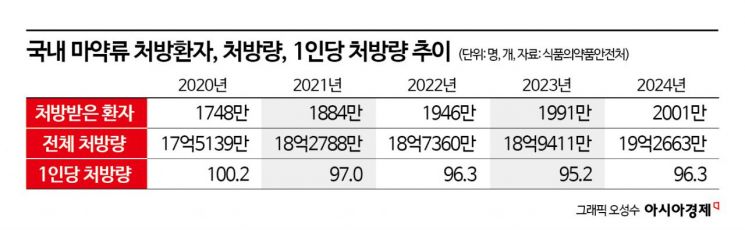
Last year, the number of patients in South Korea who took medical narcotics at least once?including for procedures such as sedation endoscopy?exceeded 20 million. This means that 4 out of every 10 people in the country were prescribed medical narcotics. In terms of prescription volume, an average of about 96 medical narcotic items were prescribed per person.
According to the "2024 Statistics on the Handling of Medical Narcotics" released on June 24 by the Ministry of Food and Drug Safety and the Korea Institute of Drug Safety & Risk Management, the number of patients who were prescribed medical narcotics at least once last year (excluding duplicates) totaled 20.01 million. This represents an increase of 0.5% (100,000 people) compared to the previous year (19.91 million). The total prescription volume also increased by 32.52 million items (1.7%), from 1.89411 billion in 2023 to 1.92663 billion in 2024.
The Ministry of Food and Drug Safety has been releasing annual reports on the handling of medical narcotics since 2019. The report includes information on the prescription and dispensing (administration) status of medical narcotics during 2024, the number of medical narcotics handlers, and statistics on the manufacture, import, and export of medical narcotics in Korea, as well as related changes and trends.
Among patients prescribed medical narcotics last year, 56.6% (11.32 million people) received propofol (an anesthetic), and 38.2% (7.64 million people) received midazolam (a hypnotic sedative). These are the main ingredients used in sedation endoscopy during health checkups.
By age group, those in their 50s accounted for the largest share of patients prescribed medical narcotics, at 4.15 million people or 20.8% of the total. This was followed by those in their 60s (3.93 million, 19.7%) and those in their 40s (3.83 million, 19.1%). Patients in their 40s to 60s made up 59.5% (11.91 million) of all patients prescribed medical narcotics. This is interpreted as being due to the increased incidence of disease with age. With the ongoing trend of population aging and the advancement of medical services, the use of medical narcotics in Korea is expected to continue increasing.
By type of prescribed medication, anxiolytics accounted for the largest share at 921.21 million items, or 47.8% of the total. This was followed by hypnotic sedatives at 312.22 million items (16.2%), antiepileptics at 246.14 million items (12.8%), and appetite suppressants at 219.24 million items (11.4%).
In particular, the category with the most rapid increase in prescriptions was attention-deficit hyperactivity disorder (ADHD) medications, with prescription volumes rising by more than 20% each year over the past five years. This is attributed to the nature of diseases treated with ADHD medications, as about 50% of pediatric and adolescent patients require ongoing treatment into adulthood. Changes in the healthcare environment, such as improved access to psychiatric hospitals and clinics, have also played a role.
In contrast, prescriptions for appetite suppressants and fentanyl (tablets and patches) have been declining. Prescriptions for appetite suppressants decreased by 13.6% compared to 2020, and fentanyl prescriptions decreased by 20.6% over the same period. This is analyzed as a policy effect of measures such as the "pre-notification" system and the mandatory review of patients' medication histories when issuing fentanyl prescriptions, which were implemented to prevent drug misuse and abuse.
Meanwhile, the number of entities handling medical narcotics?including pharmacies, medical institutions, and animal hospitals?reached 48,417 last year, continuing to increase since 2020 (44,854), when statistics were first compiled. The number of doctors, dentists, and veterinarians who actually prescribed narcotics also rose by 95 from 2023, reaching a total of 114,108.
Last year, the domestic production of medical narcotics was 1.66107 billion items, and imports were 290.75 million items, down by 121.28 million and 48.98 million items, respectively, compared to 2023. In contrast, exports increased by 760,000 items to a total of 14.26 million.
The Ministry of Food and Drug Safety stated, "We will continue to do our utmost to manage medical narcotics by strengthening education and public relations to prevent misuse and abuse, as well as increasing oversight and supervision of medical institutions, based on the approximately 130 million annual reports on the handling of narcotics."
© The Asia Business Daily(www.asiae.co.kr). All rights reserved.
![Clutching a Stolen Dior Bag, Saying "I Hate Being Poor but Real"... The Grotesque Con of a "Human Knockoff" [Slate]](https://cwcontent.asiae.co.kr/asiaresize/183/2026021902243444107_1771435474.jpg)

















