Following news of a ceasefire between Israel and Iran reported before the market opened, both the KOSPI and KOSDAQ are showing strong gains of over 2%. The KOSPI has climbed above the 3090 mark, while the KOSDAQ has recovered the 800 level for the first time in about 11 months.
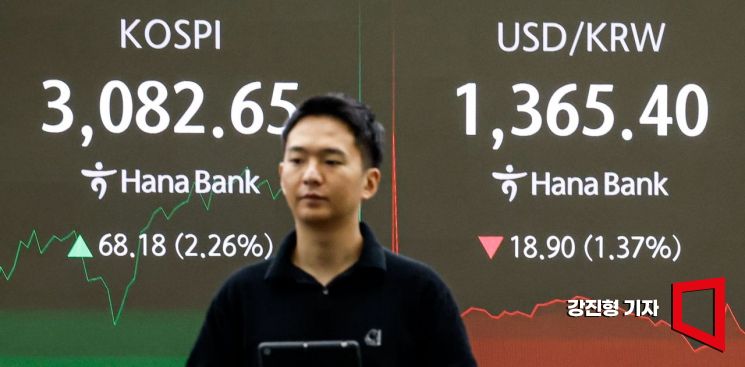 On the 24th, as the KOSPI surged more than 2% due to easing tensions in the Middle East and surpassed the 3070 level, dealers were working in the dealing room at the Hana Bank headquarters in Jung-gu, Seoul. 2025.6.24. Photo by Kang Jinhyung
As of 10:25 a.m. on June 24, the KOSPI was up 79.10 points (2.62%) from the previous day, standing at 3093.57. The KOSDAQ was up 16.17 points (2.06%) at 800.96. This is the first time the KOSDAQ has surpassed the 800 level during trading hours since August 1 of last year, marking an interval of approximately 11 months.
Foreign investors and institutions are driving the index higher. Foreign investors have recorded net purchases of 285.2 billion won in the KOSPI market and 116.1 billion won in the KOSDAQ market. Institutions have also bought a net 196.6 billion won in the KOSPI market and 54.1 billion won in the KOSDAQ market. In contrast, individual investors, who had defended the index from falling with net purchases the previous day, are now recording net sales in both markets this month.
With the easing of geopolitical risks originating from the Middle East, the indices have managed to reverse course and rise within a single day. Han Jiyeong, a researcher at Kiwoom Securities, stated, "After exchanges between the United States and Iran, at around 7 a.m. today, U.S. President Donald Trump announced that Israel and Iran had agreed to a complete ceasefire within 24 hours. It is appropriate to say that uncertainties stemming from the Middle East have now receded beneath the surface of market anxiety." Han added, "The stock market opened higher today due to the sharp drop in international oil prices following the ceasefire news, as well as the strong performance of the U.S. stock market, particularly centered on Tesla."
There are forecasts that the upward momentum of the KOSPI, now free from Middle East risk, will continue. Lee Kyungmin, a researcher at Daishin Securities, said, "In the second half of this year, noise from tariffs and policies stemming from Trump will be inevitable, and we must take into account the resulting market fluctuations." Lee continued, "Nevertheless, the KOSPI is expected to maintain a steady upward trend in the second half of this year." Lee further noted, "In the liquidity-driven market of the second half, as the transition to an earnings- and fundamentals-driven market in 2026 becomes more visible, the KOSPI is likely to head toward historic highs next year."
The KOSDAQ, which has recovered the 800 level, is also drawing attention. Na Junghwan, a researcher at NH Investment & Securities, said, "While support measures for small and venture businesses are part of the new government's policy, it is important to remember that this warmth has not yet spread to the KOSDAQ." Na added, "In particular, the KOSDAQ bio sector deserves attention, as policy expectations such as R&D investment and bio-specialized funds have not yet been reflected in this sector."
© The Asia Business Daily(www.asiae.co.kr). All rights reserved.
![Clutching a Stolen Dior Bag, Saying "I Hate Being Poor but Real"... The Grotesque Con of a "Human Knockoff" [Slate]](https://cwcontent.asiae.co.kr/asiaresize/183/2026021902243444107_1771435474.jpg)















