'Middle East Expert' at US Think Tank Analyzes the Situation
Pragmatic Diplomacy Preserves Iran's Dignity over Escalation
Controlled Strikes with No American Casualties
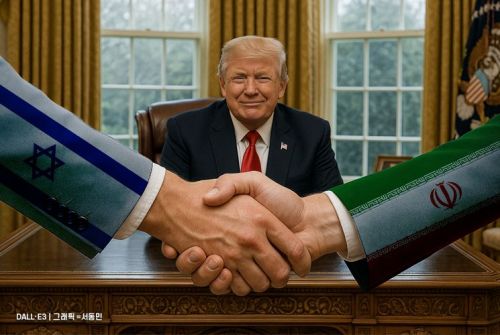
On June 23 (local time), Iran carried out a 'symbolic retaliation' against US military bases in Qatar and Iraq. The background behind Iran's acceptance of the US-proposed ceasefire lies in a realistic calculation that it lacks the capacity to wage war against both the United States and Israel.
Jonathan Panikoff, a Middle East expert at the US think tank Atlantic Council, said in an interview with Fox News on the same day, "I was surprised by the speed of the ceasefire," but added, "Iran had two options for retaliation: the first was a very strong response that could lead to escalation, and the second was a symbolic retaliation."
He further explained, "Iran's method of retaliation was highly symbolic, similar to the attack it launched against Israel in October or its response to the operation that eliminated top military commander Qasem Soleimani during the first Trump administration." He added, "In itself, this seems to have immediately opened the door for diplomatic discussions."
As part of its retaliation against the United States for attacking three major nuclear facilities, Iran targeted US military bases located in Qatar and Iraq. However, Iran notified the US of its attack plans in advance, resulting in no American casualties. Panikoff commented, "This shows that Iran staged a show of force to save face, while in reality trying to avoid further escalation."
Dennis Ross, a senior fellow at the Washington Institute for Near East Policy and former Middle East envoy under former US President Bill Clinton, told Bloomberg News on the same day, "For now, it appears this ceasefire will hold and the war will end," adding, "Iran has no intention of resuming action in the near future."
The United States, which played a leading role in mediating the dispute between the two countries, is also said to have made the ceasefire proposal through the Emir of Qatar, recognizing that Iran's capacity for a military response is limited. The Guardian reported, "According to close aides, President Trump believed that Iran would accept the US ceasefire proposal to avoid further Israeli airstrikes after carrying out only a symbolic level of retaliation."
Additionally, it is observed that the current moment?when there have been no American fatalities following US involvement in the war?serves as the last opportunity for Iran's Supreme Leader Ayatollah Ali Khamenei to maintain his regime, providing a personal motivation. Khamenei has ruled as the 'living authority' in Iran for more than 35 years since 1989.
Senior fellow Ross also posted on the social media platform X (formerly Twitter) that "Iran had to retaliate to avoid appearing to have surrendered or to look weak," but pointed out, "Khamenei knows that as long as no Americans have died, there is an opportunity to end the war with the US and preserve his regime." He particularly emphasized that 'regime preservation' is Khamenei's top priority, highlighting his personal motivation.
The White House, without further explanation, has only reshared President Trump's Truth Social post regarding the ceasefire on social media. Reuters, citing a senior White House official who requested anonymity, reported that the US agreed to the ceasefire on the condition that Israel does not carry out additional attacks. However, the Iranian side stated, "There is currently no ceasefire agreement," adding, "A decision will be made later."
© The Asia Business Daily(www.asiae.co.kr). All rights reserved.

















