
What do teenagers consider the number one factor for happiness? It was not family, friends, appearance, health, or dreams. It was wealth.
On June 24, the University Tomorrow 20s Research Institute released a report analyzing the consumption, spending, and career perceptions of middle and high school students aged 14 to 18. The report focused specifically on perceptions of economic class and happiness.
In this survey, more than half (50.6%) of teenage respondents expected that they would belong to the middle economic class when they turn 30. This was followed by upper-middle class (22.4%), lower-middle class (18.4%), upper class (6.5%), and lower class (2.1%). The percentage of those who expected to be in the upper-middle class or higher at age 30 was higher among male students (36.1%) than among female students (21.2%).
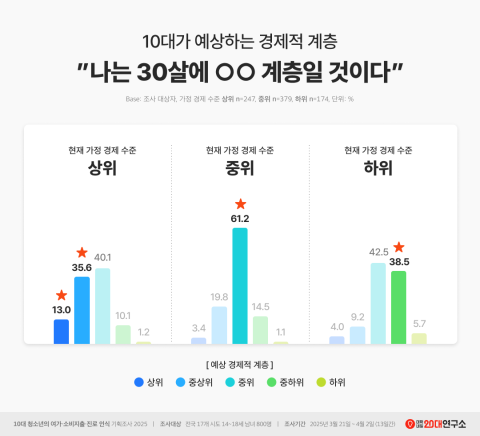
Respondents perceived that upward mobility in terms of wealth would be difficult even by the time they reached 30. Among those whose current household economic status is high, a relatively higher proportion expected to be in the upper class (13.0%) or upper-middle class (35.6%) at age 30. In contrast, among those from lower economic backgrounds, a higher proportion (38.5%) expected to be in the lower-middle class. Among those currently in the middle class, more than half (61.2%) expected to remain in the middle class.
The correlation between academic achievement and wealth was also found to be strong. Among those whose current academic performance is upper-middle or higher, about half (49.1%) expected to be in the upper-middle class or higher at age 30. Meanwhile, among those whose academic performance is lower-middle or below, 4 out of 10 (40.0%) expected to be in the lower-middle class or below at age 30.
How do teenagers view career paths outside of university? The survey found that 42.3% expressed a positive intention to start a business in the future, while 36.9% expressed a positive intention to become an influencer, both falling short of half. However, the intention to start a business was noticeably higher among those from high-income households (51.0%) and those with high academic achievement (48.6%) compared to other groups. While the overall intention to become an influencer was low, it was also slightly higher among those from high-income households (40.9%) and those with high academic achievement (40.5%) than in other groups. This suggests that household economic power and academic achievement provide teenagers with a variety of future opportunities and influence the formation of self-confidence.
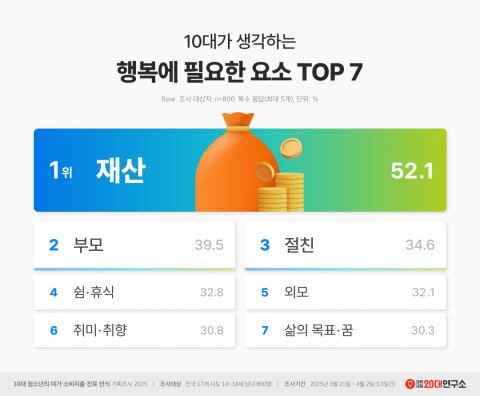
When asked what is necessary for happiness, the overwhelming top choice among teenagers was wealth (52.1%). This was followed by parents (39.5%), close friends (34.6%), rest and relaxation (32.8%), appearance (32.1%), hobbies and personal tastes (30.8%), and life goals or dreams (30.3%). Overall, female students had higher response rates than male students, suggesting that they perceive a greater need for various factors in life. However, when it came to "romantic partners," the response rate was much higher among male students (26.9%) than among female students (18.6%).
In addition, among those with lower academic achievement, a higher percentage cited life goals or dreams (36.5%) and a home (30.0%) as necessary for happiness. Among those from lower-income households, a notable proportion (31.0%) cited mental strength or resilience as important.
© The Asia Business Daily(www.asiae.co.kr). All rights reserved.
![Clutching a Stolen Dior Bag, Saying "I Hate Being Poor but Real"... The Grotesque Con of a "Human Knockoff" [Slate]](https://cwcontent.asiae.co.kr/asiaresize/183/2026021902243444107_1771435474.jpg)

















