A new platform that simultaneously enhances the speed and security of Li-Fi has been proposed in South Korea. Li-Fi is a wireless communication technology that utilizes the visible light spectrum (400?800 THz), such as that emitted by LED lights. It offers speeds up to 100 times faster than Wi-Fi (up to 224 Gbps). In addition, it is not subject to frequency allocation restrictions and is less susceptible to radio interference, which are considered its advantages. On the other hand, its disadvantage has been its relative vulnerability to security breaches, as it is accessible to anyone.
On June 24, KAIST announced that a research team led by Professor Himchan Cho from the Department of Materials Science and Engineering, in collaboration with Dr. Kyunggeun Lim from the Korea Research Institute of Standards and Science (KRISS), has developed an "on-device encrypted optical communication device" technology for Li-Fi applications.
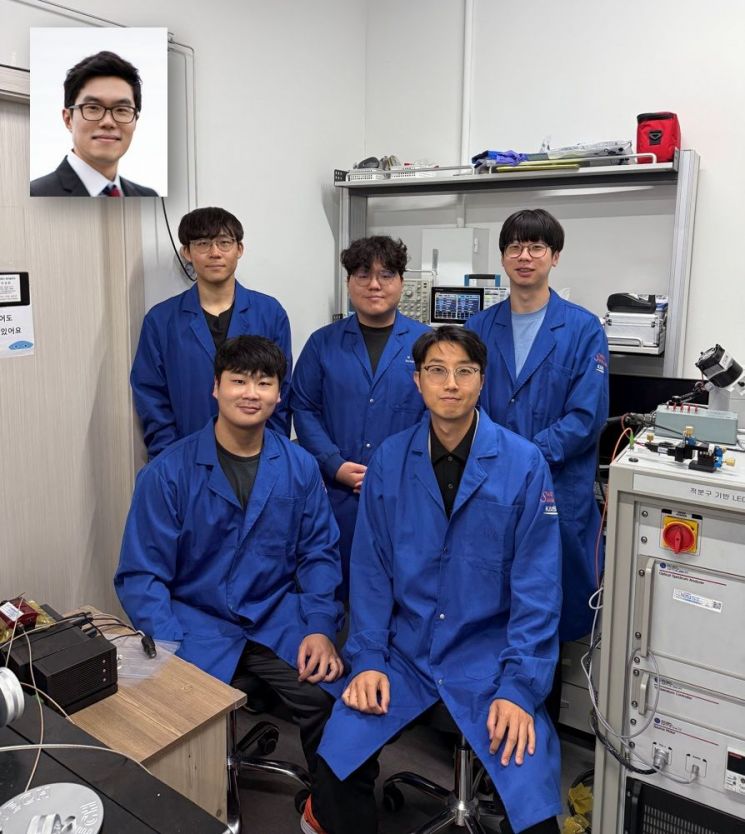 (Front row from left) Seungmin Shin, PhD candidate, Department of Materials Science and Engineering, KAIST; Himchan Cho, Professor; (Back row from left) Hyungdo Lee, Seungwoo Lee, Wonbeom Lee; (Top left) Kyunggeun Lim, PhD. Provided by KAIST
The core of this technology lies in its ability to convert information into light and encrypt it simultaneously within the device itself. In other words, this technology enables secure data transmission without the need for additional equipment.
The device developed by the joint research team achieved an external quantum efficiency (EQE) of 17.4%. EQE is an indicator of how efficiently electricity is converted into light. The typical EQE required for commercialization is around 20%.
The device's luminance reached 29,000 nits, which is more than ten times the maximum brightness of a smartphone OLED display at 2,000 nits. Luminance refers to the luminous flux (amount of light) emitted per unit area per unit solid angle from a light source.
To better understand how this device converts information into light, the joint research team analyzed the device's emission characteristics using a "transient electroluminescence analysis" method, which involves applying a voltage pulse for a very short period (hundreds of nanoseconds, or billionths of a second).
Through this, they were able to observe charge movement within the device on the scale of hundreds of nanoseconds and elucidated the operating mechanism of dual-channel optical modulation implemented within a single device.
Professor Himchan Cho stated, "This study is significant in that it presents a new communication platform that overcomes the limitations of conventional optical communication devices by simultaneously enhancing transmission speed and security. Most importantly, the technology developed by the joint research team enables both encryption and transmission without additional equipment, suggesting its potential for wide application in the field of security in the future."
This research was supported by the National Research Foundation of Korea, the National Research Council of Science and Technology (NST), and the Korea Institute for Advancement of Technology.
This study, with Seungmin Shin, a PhD candidate in the Department of Materials Science and Engineering at KAIST, as the first author, and Professor Himchan Cho and Dr. Kyunggeun Lim from KRISS as corresponding authors, was also featured in the May 30 issue of the international journal Advanced Materials.
© The Asia Business Daily(www.asiae.co.kr). All rights reserved.
![Clutching a Stolen Dior Bag, Saying "I Hate Being Poor but Real"... The Grotesque Con of a "Human Knockoff" [Slate]](https://cwcontent.asiae.co.kr/asiaresize/183/2026021902243444107_1771435474.jpg)















