Mark Rutte, Secretary General of the North Atlantic Treaty Organization (NATO), stated on June 23 (local time) that the '5% of GDP defense spending' to be agreed upon at this year's NATO summit will become the baseline for all member states.
On this day, one day before the opening of the NATO summit, Secretary General Rutte held a press conference in The Hague, Netherlands, and announced that the plan to increase defense spending to 5% of GDP by 2035?comprising 3.5% direct military spending and an additional 1.5% for security-related indirect costs?would serve as a "quantum leap" for the alliance.
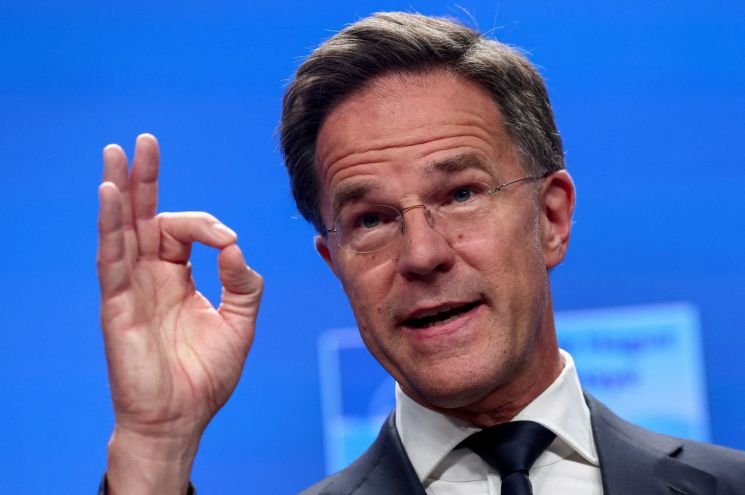 Mark Rutte, Secretary General of the North Atlantic Treaty Organization (NATO). Photo by Reuters Yonhap News
The '5% of GDP' is the defense spending demand that U.S. President Donald Trump has made of NATO allies. If the agreement is adopted, President Trump is expected to highlight this as his own political and diplomatic achievement. Currently, 22 out of NATO's 32 member states have achieved direct military spending equivalent to 2% of GDP.
Secretary General Rutte added that, to monitor the implementation of this agreement, each country will be required to submit an interim report in 2029. While the NATO plan is not legally binding, this effectively establishes a kind of safeguard.
When asked whether Spain would be granted an 'exemption from the agreement,' Secretary General Rutte dismissed the idea, stating, "There is no opt-out clause in NATO. There are no other side agreements either." This remark appears to be mindful of the possibility that the significance of the defense spending plan could be diminished before it is officially agreed upon at tomorrow's summit.
On June 19, Spanish Prime Minister Pedro Sanchez sent a letter to Secretary General Rutte, arguing that the '5% target' was unreasonable. As of last year, Spain's defense spending was 1.24% of GDP?the lowest among the 31 countries, excluding Iceland, which does not have a military and is omitted from official statistics.
As a result, during the negotiations for the joint statement at the summit, which continued throughout the weekend, the wording of the agreement was changed from "We pledge" to "The Allies pledge." It has also been reported that Secretary General Rutte sent a reply to Prime Minister Sanchez promising to allow for "flexibility."
However, there are predictions that, even if an agreement is reached, actual implementation will not be easy. Although not as vocal as Spain, Slovakia and Belgium also expressed on this day the need to seek flexibility.
According to the British daily The Guardian and others, Slovak Prime Minister Robert Fico issued a statement asserting the right to determine the pace of defense spending increases. Prime Minister Fico pointed out, "Slovakia has other priorities besides military expansion, as it needs to restore government finances and catch up with the average cost of living in the European Union (EU)."
Belgian Foreign Minister Maxime Pr?vot also stated in an interview with local radio RTBF, "Although we have not made as much noise as Spain, our diplomats have been working over the past few weeks to secure a flexibility mechanism," emphasizing, "We are hoping for the maximum possible flexibility."
When asked about the potential impact of the absence of South Korea, Japan, and Australia?the three out of four Indo-Pacific partners (IP4)?from the summit, Secretary General Rutte responded, "Very high-level representatives will attend and hold important meetings," adding, "For events like these held in the summer, schedules can change on a daily basis."
He continued, "Since late February 2022, when the war in Ukraine began, security in the Atlantic and Indo-Pacific regions has become more closely connected than ever. In particular, China and North Korea are supporting Russia in its unjustified attack on Ukraine," emphasizing the importance of cooperation between NATO and the IP4 countries.
In his opening remarks at the press conference, Secretary General Rutte also mentioned that, regarding the development of the defense industry, close cooperation is needed not only with Ukraine and the EU but also with the IP4 countries.
Regarding the Russia-Ukraine war, he stated, "The most important and immediate threat facing this alliance is still Russia," adding, "Russia continues its war against Ukraine with support not only from Belarus but also from North Korea, Iran, and China." He continued, "Our support for Ukraine remains unwavering and will continue in the future," pledging, "Next year, we will provide more than 35 billion euros in additional security assistance to Ukraine."
© The Asia Business Daily(www.asiae.co.kr). All rights reserved.
![Clutching a Stolen Dior Bag, Saying "I Hate Being Poor but Real"... The Grotesque Con of a "Human Knockoff" [Slate]](https://cwcontent.asiae.co.kr/asiaresize/183/2026021902243444107_1771435474.jpg)
















