Intermediate Medical Zones Based on Administrative Boundaries Differ from Residents' Actual Living Areas
Essential Medical Policies Centered on Public Hospitals, but Patients Seek Private Hospitals
As the Lee Jaemyung administration has pledged to strengthen regional and essential medical care, there are calls for each local government to be able to independently establish and implement essential medical plans tailored to local conditions. Criticism has also been raised that the intermediate medical zone system set by the government does not align with actual healthcare usage patterns or daily living areas, resulting in medical service gaps and inefficient resource allocation.
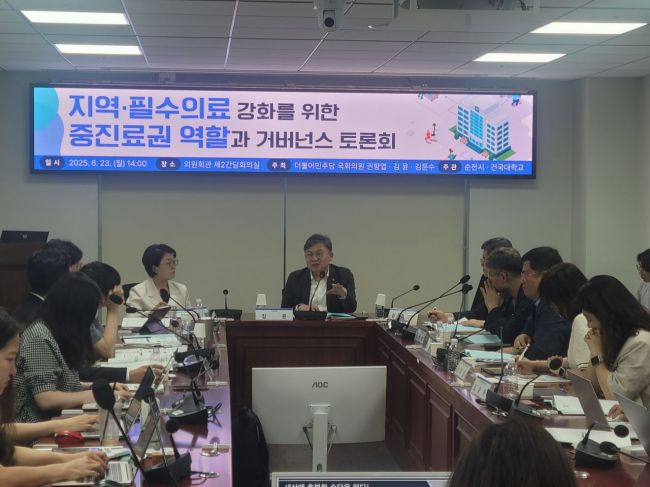 At the 'Discussion on the Role and Governance of Intermediate Medical Zones to Strengthen Regional and Essential Medical Care' held at the National Assembly Members' Office Building on the 23rd, Kim Yoon, a member of the Democratic Party, is speaking. Photo by Jo Inkyung
At the "Discussion on the Role and Governance of Intermediate Medical Zones to Strengthen Regional and Essential Medical Care" held at the National Assembly on the 23rd and hosted by Kim Yoon, a member of the Democratic Party, Lee Keonse, a professor at the Department of Preventive Medicine at Konkuk University College of Medicine, stated, "One of the reasons for the collapse of regional healthcare in our country is that there is almost no cooperation among medical institutions," and pointed out, "The current system for designating medical service zones is disconnected from reality, so a redesign that reflects local circumstances is urgently needed."
A medical service zone refers to the area in which local residents routinely access healthcare services. It is the most basic unit for identifying regional healthcare disparities and efficiently allocating resources. Currently, South Korea has 70 intermediate medical zones at the city, county, and district level, and 11 large medical zones at the metropolitan and provincial level.
However, experts say that these intermediate medical zones do not reflect the actual healthcare utilization patterns or hospital accessibility of residents. For example, Gimpo and Ilsan in Gyeonggi Province are separated by the Han River but are grouped into the same medical zone.
Professor Lee said, "Intermediate medical zones are set based on administrative boundaries rather than the actual medical institutions, transportation, culture, or living areas that residents use, making them unrealistic. In particular, the authority to establish essential medical plans mostly lies with metropolitan governments, so even though basic local governments are the main actors in implementation, they are unable to fulfill their roles."
Another issue is that South Korea's regional essential medical policies are centered around public hospitals, resulting in little cooperation with local private medical institutions, which are used by most patients.
Professor Lee explained, "For example, half of the patients visiting private medical institutions in Suncheon come from other areas such as Goheung, Yeosu, and Gwangyang, so it is no exaggeration to say that private hospitals in these regions are responsible for essential medical care. With shortages in staffing and support, hospitals are passing patients to each other. If private hospitals in Suncheon stop handling essential medical patients, even Chonnam National University Hospital, the regional public hospital, would collapse." He went on to argue, "Basic local governments should be able to independently establish essential medical plans based on intermediate medical zones, and be given the authority and responsibility to play a substantive role."
Ok Minsu, a professor at the Department of Preventive Medicine at the University of Ulsan College of Medicine, diagnosed, "The imbalance in the distribution of medical personnel is a problem faced by other countries as well, but in South Korea, it has gone beyond the point where it can be solved by providing subsidies to doctors working in local areas or by improving living conditions."
Professor Ok said, "Many expert committees responsible for regional essential medical care have already been established, but they lack authority and therefore have little to discuss. If committees at the intermediate medical zone level, such as the Public Health and Medical Committee, are established, they should be given the authority to deliberate and make decisions on local public health issues such as bed management, as well as the power to execute budgets." He also suggested introducing a regional doctor system, establishing special-purpose medical schools, and creating a public health and medical fund as ways to strengthen regional essential medical care.
The government has also agreed on the need for a cooperative system at the intermediate medical zone level and said it will reflect this in future policy designs. Cho Seungah, Director of the Public Healthcare Division at the Ministry of Health and Welfare, said, "Medical service zones are not a fixed concept, so they can be flexibly adjusted whenever new medical institutions are established or roads are opened. However, if the central government unilaterally sets the standards, it will be difficult for the field to accept them. Therefore, we will carefully consider how to balance the regions and activate regionally integrated healthcare."
Kim Yoon, a member of the National Assembly, emphasized, "If we do not know where the patients are and where hospitals are lacking, no matter how much budget is spent and how many systems are implemented, failures in healthcare policy will inevitably be repeated. Only by identifying medical demand based on medical service zones and establishing a supply and support system accordingly can we truly fill the gaps in essential medical care."
© The Asia Business Daily(www.asiae.co.kr). All rights reserved.
![Clutching a Stolen Dior Bag, Saying "I Hate Being Poor but Real"... The Grotesque Con of a "Human Knockoff" [Slate]](https://cwcontent.asiae.co.kr/asiaresize/183/2026021902243444107_1771435474.jpg)















