Oil Prices Hold Steady Despite Hormuz Blockade Fears
WTI Up 0.16%... Brent Down 0.19%
Market Watches Closely as Iran's Retaliation Expected to Be Limited
The three major indices on the New York Stock Exchange opened slightly lower on June 23 (local time). Although geopolitical risks from the Middle East have increased following the United States' surprise airstrike on Iran's nuclear facilities over the weekend, investors appear to be taking a wait-and-see approach, expecting that Iran's retaliatory response will likely be limited. International oil prices are also moving sideways, despite Iran's consideration of closing the Strait of Hormuz.
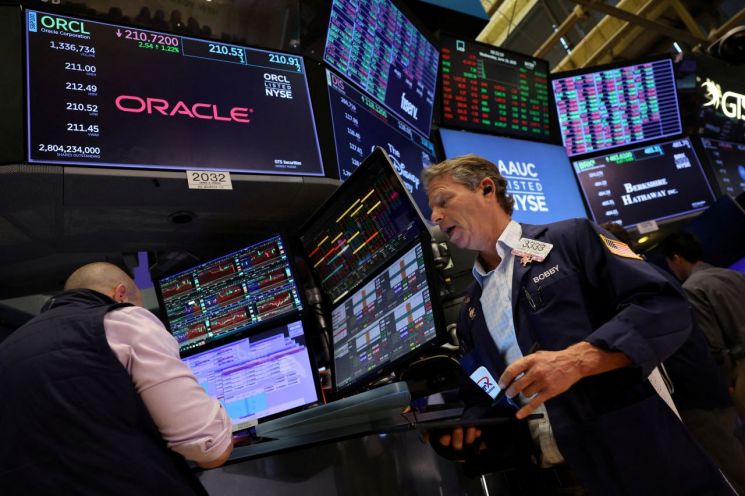
As of 9:31 a.m. on the same day on the New York Stock Exchange, the blue-chip Dow Jones Industrial Average (Dow) was down 69.57 points (0.16%) at 42,137.25 compared to the previous trading day. The S&P 500 index, which focuses on large-cap stocks, had fallen 2.83 points (0.05%) to 5,965.01, while the tech-heavy Nasdaq index was down 22.26 points (0.11%) at 19,425.15.
International oil prices were mixed, remaining in a narrow range despite heightened tensions in the Middle East. West Texas Intermediate (WTI) crude rose $0.12 (0.16%) from the previous session to $73.96 per barrel, while Brent crude, the global oil price benchmark, was down $0.14 (0.19%) to $75.34 per barrel.
On the night of June 21, the United States launched airstrikes on three major Iranian nuclear facilities?Fordow, Natanz, and Isfahan?under the "Midnight Hammer" operation. This marked the first direct U.S. intervention just eight days after Israel's attack on Iran on June 13. The White House had left open the possibility of negotiations, stating on June 19, two days before the airstrikes, that it would decide within two weeks whether to take military action against Iran. However, the unexpected strikes have heightened investor anxiety.
U.S. President Donald Trump has warned that additional strikes will be inevitable if Iran continues its provocations. Immediately following the airstrikes on June 21, he cautioned, "If Iran does not stop its provocations, the next attack will be much faster and stronger." On June 22, he added, "Using the term 'regime change' may not be politically correct, but if the current Iranian regime cannot make Iran great again, why shouldn't there be regime change?"?further increasing pressure on Iran.
The future of the Middle East crisis, now at a critical crossroads, depends on the level of Iran's response. Attention is focused on whether Iran will attack U.S. military bases in the Middle East or block the Strait of Hormuz, a vital oil shipping route in the region. In particular, if the Strait of Hormuz?which handles 20% of the world's daily oil supply?is completely closed, a sharp rise in international oil prices and increased global economic uncertainty are expected. Bloomberg Economics (BE), JP Morgan, and Oxford Economics have all predicted that if the Strait of Hormuz is blocked, disruptions to global oil supply could drive prices up to $130 per barrel. U.S. Secretary of State Marco Rubio's call in a Fox News interview the previous day for diplomatic intervention by China?which is highly dependent on Iranian oil?to prevent the closure of the Strait of Hormuz is seen as reflecting these concerns.
However, experts believe that the likelihood of Iran completely closing the Strait of Hormuz is low. Adam Crisafulli, founder of Vital Knowledge, stated, "Iran is considering closing the Strait of Hormuz, but investors are not in a state of panic over a potential oil market disaster. While there is no doubt that geopolitical risks in the Middle East are elevated, the extreme imbalance of the conflict, Iran's relative isolation, and the ample supply of international oil are expected to limit the fallout."
Mohit Kumar, chief European strategist at Jefferies International, said, "We do not expect the Strait of Hormuz to be closed, but there is a possibility of disruption. While uncertainty may persist for several weeks, our base scenario is that there will not be a sharp escalation in tensions."
Nevertheless, there are still concerns in the market that volatility could increase in the future, as uncertainty over President Trump's trade policy is compounded by the Middle East situation.
Due to a preference for safe-haven assets, the U.S. dollar and Treasury prices are strengthening. The dollar index, which measures the value of the dollar against the currencies of six major countries, was up 0.58% from the previous session at 98.85.
In contrast to rising Treasury prices, Treasury yields are weakening. The yield on the U.S. 10-year Treasury, the global benchmark, was down 3 basis points (1bp = 0.01 percentage points) from the previous day at 4.33%, while the yield on the 2-year Treasury, which is sensitive to monetary policy, was down 1bp at 3.89%.
© The Asia Business Daily(www.asiae.co.kr). All rights reserved.
![Clutching a Stolen Dior Bag, Saying "I Hate Being Poor but Real"... The Grotesque Con of a "Human Knockoff" [Slate]](https://cwcontent.asiae.co.kr/asiaresize/183/2026021902243444107_1771435474.jpg)















