Employment Rates for Youth, Women, and the Elderly Gradually Improve
Korea Economic Association: "Qualitative Improvements in Employment Needed"
Over the past decade, the employment rate of vulnerable groups has gradually improved, but structural vulnerabilities remain, according to a recent analysis. There are calls not only for qualitative improvements in employment but also for strengthening customized employment support policies tailored to each group.
The Korea Economic Association reported this analysis on June 24, based on its review of employment indicators for youth, women, and the elderly in 38 OECD countries from 2014 to 2023. The association noted that while the employment rate for vulnerable groups has gradually improved, qualitative enhancements in employment are still needed.

During this period, the employment rate for youth (ages 15-29) rose from 38.7% (31st) to 45.0% (27th), for women from 55.0% (30th) to 61.4% (30th), and for the elderly from 65.7% (7th) to 69.9% (15th). Although the employment rate for the elderly improved numerically, its ranking dropped by eight places. The employment rates for vulnerable groups were found to be distributed between 15th and 30th among OECD countries, indicating that they remain in the lower tier.
For the youth cohort, the number of full-time workers declined from 1.2 million to 800,000, representing an average annual decrease of 4.4%. In terms of growth rate, this was the lowest among the 38 OECD countries. In contrast, the number of part-time workers increased from 380,000 to 560,000, with an average annual growth of 4.4%, ranking sixth. The association analyzed that this trend is due not only to the prolonged economic downturn but also to structural issues such as the dual labor market and changes in industrial structure, which have reduced the number of full-time positions desired by young people and led to an increase in youth entering part-time jobs.
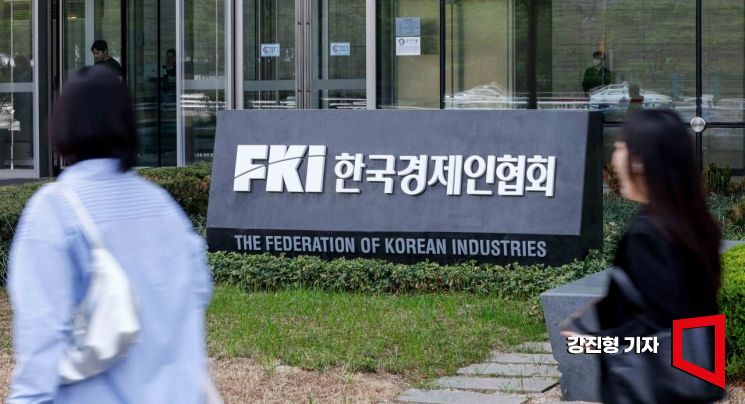 Employees of tenant companies are moving at the Korea Economic Association in Yeouido, Seoul. Photo by Kang Jinhyung
For women, the proportion of low-wage earners has somewhat improved. The share of low-wage workers among female full-time wage earners dropped from 37.8% in 2014 to 24.5% in 2023. However, during the same period, this figure still ranked between first and fifth among OECD countries. This is interpreted as a result of women's jobs being concentrated in sectors with lower wage levels, such as food service, hospitality, and care work.
The employment rate for the elderly has consistently exceeded the OECD average over the past ten years. During this period, it rose by 4.2 percentage points, from 65.7% to 69.9%, maintaining a position in the mid-to-upper range among OECD countries. However, the association pointed out that this is due to the phenomenon of retired elderly individuals having to continue working to make a living.
As global economic uncertainty persists, major countries around the world are announcing policies to support vulnerable groups in employment. Lee Sangho, head of the Economic and Industrial Division at the Korea Economic Association, stated, "There are concerns that continued stagnation in domestic demand could further worsen employment instability for vulnerable groups," and added, "To promote economic activity and employment stability among these groups, it is necessary to strengthen customized employment support and social safety net policies for each group."
© The Asia Business Daily(www.asiae.co.kr). All rights reserved.
![Clutching a Stolen Dior Bag, Saying "I Hate Being Poor but Real"... The Grotesque Con of a "Human Knockoff" [Slate]](https://cwcontent.asiae.co.kr/asiaresize/183/2026021902243444107_1771435474.jpg)
















