Kristalina Georgieva, Managing Director of the International Monetary Fund (IMF), has warned that the recent U.S. airstrike on Iran could have far-reaching consequences beyond the energy sector, as global uncertainty continues to rise.
According to Bloomberg News on June 23 (local time), Georgieva stated in an interview with Bloomberg TV that "this (the U.S. attack on Iran) is seen as yet another source of uncertainty in an already highly uncertain environment."
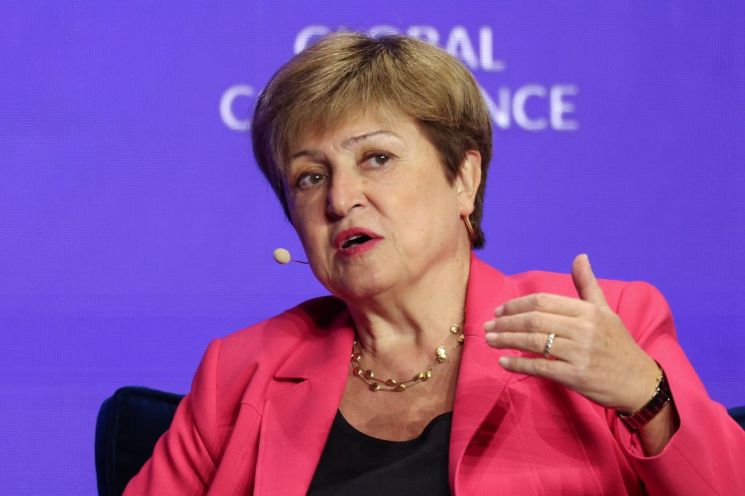 Kristalina Georgieva, Managing Director of the International Monetary Fund (IMF). Photo by AFP Yonhap News
Georgieva noted that so far, the biggest shock has been seen in energy prices, which the IMF is closely monitoring, but she also projected that "secondary and tertiary effects may occur."
She explained that, for example, if further disruptions occur that negatively impact the growth outlook of major economies, this could serve as a trigger for a downward revision of the global economic growth forecast.
In April, the IMF had already revised its global economic growth outlook downward, warning that the U.S.-led 'reboot' of world trade would slow growth this year.
Georgieva emphasized that the first and second quarters of this year have continued to show this trend, and while it appears the world will avoid a recession, the heightened uncertainty also tends to suppress growth prospects.
She specifically pointed out that the IMF is watching closely to see how the current conflict will affect the risk premium (extra cost) for oil and gas. On this day, the global benchmark Brent crude futures price surged by 5.7%, reaching $81.40 per barrel, before giving up most of those gains. Georgieva said, "We will be watching to see how the situation unfolds," and added, "We are monitoring whether there will be disruptions to energy supply routes or spillover effects to other countries."
Regarding the U.S. economy, Georgieva said she expects disinflation (a slowdown in price increases) to continue, but pointed out that the U.S. Federal Reserve is not yet in a comfortable position to cut interest rates.
She said, "We see a high likelihood that by the end of the year, the Fed will judge it is time to cut rates," highlighting the strength of the U.S. labor market and solid wage growth.
At the same time, she warned that increased volatility would further deteriorate the situation for businesses. She asked, "What happens when there is uncertainty?" and explained, "Investors do not invest, consumers do not spend, and as a result, growth prospects decline."
© The Asia Business Daily(www.asiae.co.kr). All rights reserved.
![Clutching a Stolen Dior Bag, Saying "I Hate Being Poor but Real"... The Grotesque Con of a "Human Knockoff" [Slate]](https://cwcontent.asiae.co.kr/asiaresize/183/2026021902243444107_1771435474.jpg)















