Opened with a Drop of Over 1%,
but Individual Investors Narrowed the Losses
The KOSPI managed to hold above the 3,000 mark despite concerns over U.S.-driven uncertainties.
On the 23rd, the KOSPI closed at 3,014.47, down 0.24% from the previous trading day. After starting the session at 2,992.20, a decline of about 1%, the index dropped as low as 2,971.36 at around 9:26 a.m., but later rebounded and regained the 3,000 level.
By investor type, foreign investors and institutions recorded net sales of KRW 464.7 billion and KRW 969.1 billion, respectively. Individual investors were net buyers, purchasing KRW 1.5098 trillion.
Most sectors declined, resulting in a mixed performance. Several sectors fell by more than 2%, including electricity·gas (-2.24%), paper·wood (-2.20%), transportation equipment·parts (-2.19%), medical·precision instruments (-2.18%), and pharmaceuticals (-2.15%). In contrast, machinery·equipment surged by 7.95%. Securities also rose by 4.88%. Financials (1.38%) and construction (1.02%) also performed relatively well.
The divergence among the top 10 market capitalization stocks was even more pronounced. Doosan Enerbility soared by 14.7%. NAVER also rose by 6.3%. Other gainers included KB Financial Group (0.9%) and SK Hynix (0.5%). On the other hand, Hyundai Motor (-3.8%), LG Energy Solution (-3.4%), Samsung Electronics (-2.3%), HD Hyundai Heavy Industries (-2.2%), Samsung Biologics (-2.1%), and Hanwha Aerospace (-1.9%) all declined by more than 1%.
The rebound in the KOSDAQ was somewhat slower. The KOSDAQ closed at 784.79, down 0.85% from the previous trading day. After opening 1.5% lower at 779.67 and falling to 772.91, the index recovered to climb back above the 780 level.
In the KOSDAQ market, foreign investors and institutions posted net sales of KRW 14 billion and KRW 69.9 billion, respectively. Individual investors were net buyers, with net purchases totaling KRW 126.8 billion.
Almost all sectors declined. Many sectors fell by more than 1%, including chemicals (-2.26%), general services (-2.15%), textiles·apparel (-1.87%), publishing·media replication (-1.80%), entertainment·culture (-1.71%), telecommunications (-1.63%), electrical·electronics (-1.50%), non-metals (-1.46%), and financials (-1.36%). Unlike the KOSPI, the scale of gains in rebounding sectors was small. Only IT services (2.44%), construction (0.89%), and transportation·storage (0.26%) recorded gains.
Among the top 10 KOSDAQ stocks by market capitalization, only two?Pharmaresearch (7.1%) and Rainbow Robotics (4.8%)?rose. In contrast, Peptron (-4.3%), HLB (-4.1%), Ecopro (-3.2%), Ecopro BM (-2.9%), Alteogen (-2.6%), Hugel (-1.4%), Samchundang Pharm (-1.4%), and Classys (-0.6%) all declined.
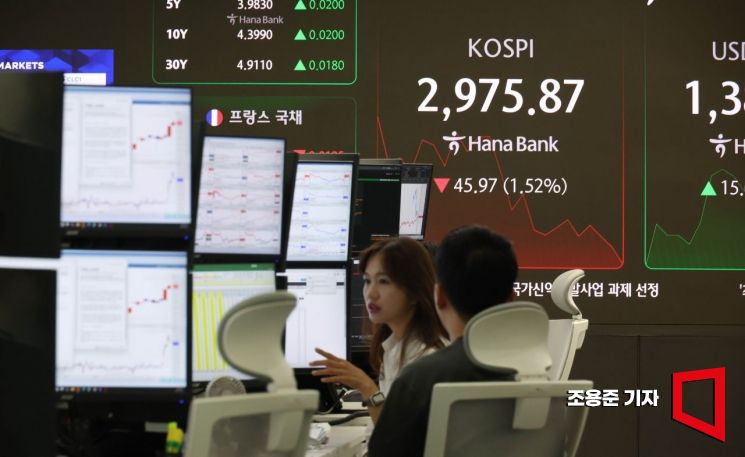 Amid growing Middle East risks following the U.S. airstrike on Iran, the KOSPI index fell below the 3,000 mark during the trading session on the 23rd. The KOSPI index and the KRW/USD exchange rate are displayed on the status board in the dealing room of Hana Bank in Jung-gu, Seoul. On that day, the KOSPI index opened down 0.98% from the previous trading day at 2,992.83 points (0.24%). 2025.6.23 Photo by Jo Yongjun
© The Asia Business Daily(www.asiae.co.kr). All rights reserved.
![Clutching a Stolen Dior Bag, Saying "I Hate Being Poor but Real"... The Grotesque Con of a "Human Knockoff" [Slate]](https://cwcontent.asiae.co.kr/asiaresize/183/2026021902243444107_1771435474.jpg)















