Trump and Iran Clash Over Claims of Nuclear Facility Destruction
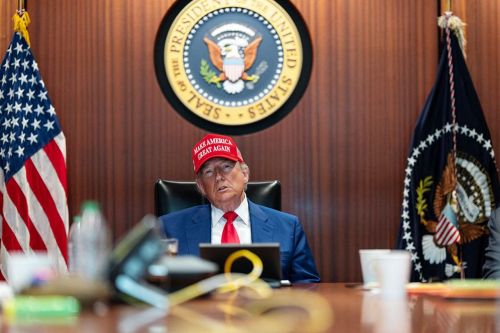 President Donald Trump, wearing a red "MAGA (Make America Great Again)" hat, is sitting and discussing in the White House Situation Room, also known as the "War Room," on the 21st (local time). Photo by AFP Yonhap News
On the night of June 22 (local time), U.S. President Donald Trump once again took to social networking services (SNS) to personally claim that the Iranian nuclear facilities targeted by the U.S. military's airstrikes had suffered "monumental damage."
In a post on Truth Social, the platform he founded, Trump asserted, "As can be seen in the satellite images, all nuclear facilities in Iran have sustained monumental damage," emphasizing, "Annihilated is the accurate description." He added, "The greatest damage occurred well below the surface," and stated, "The strike hit the exact center of the target."
Regarding the apparent lack of damage to the above-ground structures of Iran's Fordow nuclear facility in Qom Province, Trump explained, "The white structure visible in the photo is buried so deep in the rock that even its roof is below ground level, so it was completely protected from the flames caused by the explosion."
Trump's remarks appear to be a rebuttal to Iran's statements that only parts of the surface structures, such as entrances, were damaged and that the Fordow nuclear facility did not suffer significant harm. On June 20, Mohsen Rezaei, a general in the Islamic Revolutionary Guard Corps (IRGC), stated, "All enriched material has been moved to a safe location." Mohammad Reza Kardan, deputy chief of the Atomic Energy Organization of Iran (AEOI), claimed, "No radioactive contamination or radiation has been detected inside or outside the nuclear facility."
On June 22, U.S. commercial satellite company Maxar Technologies released satellite images of the Fordow nuclear facility area. Compared to images published on June 19, six large craters are clearly visible, which are presumed to be the points where U.S. bombs were dropped.
Stuart Ray, a photo analyst at the UK intelligence firm McKenzie Intelligence Services, told the BBC that "it appears that three bombs were dropped on each of two locations," and analyzed that "the dispersed white dust is due to destroyed concrete." Ray further explained, "'Bunker buster' bombs are designed to detonate deep inside the facility, not at the entry point." This suggests that the actual damage to the Fordow facility may be greater than what is visible. However, the BBC pointed out that it is uncertain how much damage the Fordow nuclear facility sustained in this airstrike.
In the early morning of June 21, following President Trump's orders, the U.S. Air Force deployed B-2 stealth bombers to drop massive bunker buster bombs on three nuclear facilities in Iran, including the Fordow site, which is considered the heart of Iran's nuclear program. The Fordow nuclear facility is located in a mountainous area about 160 kilometers south of Tehran, the capital of Iran, and about 30 kilometers north of the holy city of Qom. Built in secret, the existence of this facility was first revealed by Western intelligence agencies in 2009.
Meanwhile, Rafael Grossi, Director General of the International Atomic Energy Agency (IAEA), stated on June 22 that no increase in external radiation levels had been detected following the U.S. attacks on the three Iranian nuclear facilities. He provided this explanation regarding the situation at the Iranian nuclear facilities during a briefing at an emergency United Nations Security Council meeting convened in New York at Iran's request.
© The Asia Business Daily(www.asiae.co.kr). All rights reserved.
![Clutching a Stolen Dior Bag, Saying "I Hate Being Poor but Real"... The Grotesque Con of a "Human Knockoff" [Slate]](https://cwcontent.asiae.co.kr/asiaresize/183/2026021902243444107_1771435474.jpg)















