Food Prices Up 28%, Vegetables Soar 55.9%
Living Necessities Index Rises 18.2%, Perceived Price Hikes Intensify
Broad Price Increases in Services and Travel Expenses
Consumer prices in Gwangju have increased by 15.9% over the past five years. The rise was particularly notable for items on the dining table. The prices of food and fresh produce, which consumers feel most directly when shopping, nearly doubled during the same period.
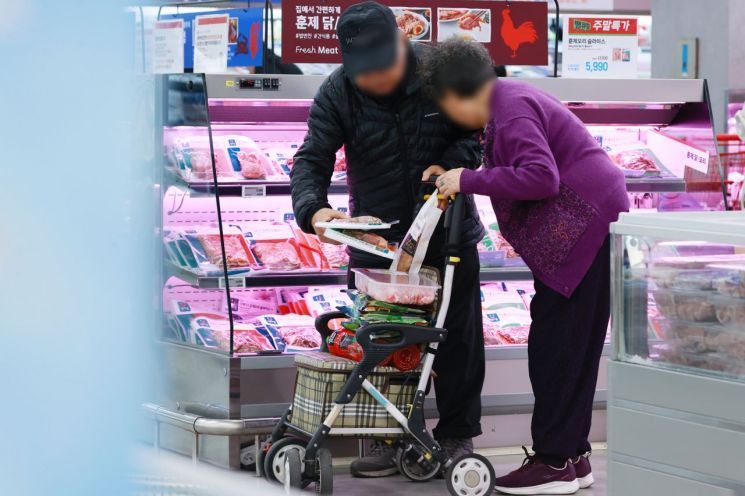 An elderly couple checking their shopping cart is comparing food prices at the meat section of a large supermarket. Photo by Yonhap News
According to the "2019-2024 Changes in Consumer Prices in Gwangju" report released by the Honam Regional Statistics Office on June 23, consumer prices in Gwangju rose by an average of 0.6% per quarter over five years. The annual increases were 0.2% in 2019, 0.4% in 2020, 2.6% in 2021, 5.1% in 2022, 3.7% in 2023, and 2.5% in 2024.
During the same period, the national averages were 0.4%, 0.5%, 2.5%, 5.1%, 3.6%, and 2.3%, respectively. Gwangju's rate was lower than the national average in 2019 and 2020, but in 2023 and 2024, it was higher by 0.1 percentage points and 0.2 percentage points, respectively.
Since the fourth quarter of 2020, a combination of external factors such as high oil prices, a strong exchange rate, and the Russia-Ukraine war have driven prices in Gwangju up rapidly. Although the rate of increase moderated somewhat after peaking in the third quarter of 2022, high inflation has persisted.
The living necessities price index rose by 18.2% during the same period. Food prices increased the most, rising by 28.0%, while non-food items rose by 13.0%. The fresh food index climbed by 36.5%, with fresh vegetables up by 55.9%, fresh fruit by 36.2%, and fresh fish and seafood by 18.0%.
Service prices rose by 12.9% over five years. Among these, the personal services category saw the highest increase at 20.0%. Domestic group travel expenses jumped by 41.9%, movie ticket prices by 32.1%, and insurance service fees by 25.6%.
Based on the living necessities price index, the food category rose to 105.8 from the second quarter of 2020 to the third quarter of 2022, and then further increased to 119.8 by the fourth quarter of 2024. The surge in grocery prices continues unabated.
According to OECD statistics for 2023, food and non-alcoholic beverage prices in South Korea were 47% higher than the OECD average. This was the second highest among the 38 member countries, following Switzerland.
© The Asia Business Daily(www.asiae.co.kr). All rights reserved.
![Clutching a Stolen Dior Bag, Saying "I Hate Being Poor but Real"... The Grotesque Con of a "Human Knockoff" [Slate]](https://cwcontent.asiae.co.kr/asiaresize/183/2026021902243444107_1771435474.jpg)















