$4.20 Fare Marks the Start of Direct Competition With Waymo
On June 22 (local time), U.S. electric vehicle company Tesla began operating autonomous robotaxis (driverless taxis) in Austin, Texas.
Elon Musk, CEO of Tesla, announced the launch of the robotaxi service on his social media platform X (formerly Twitter) that day.
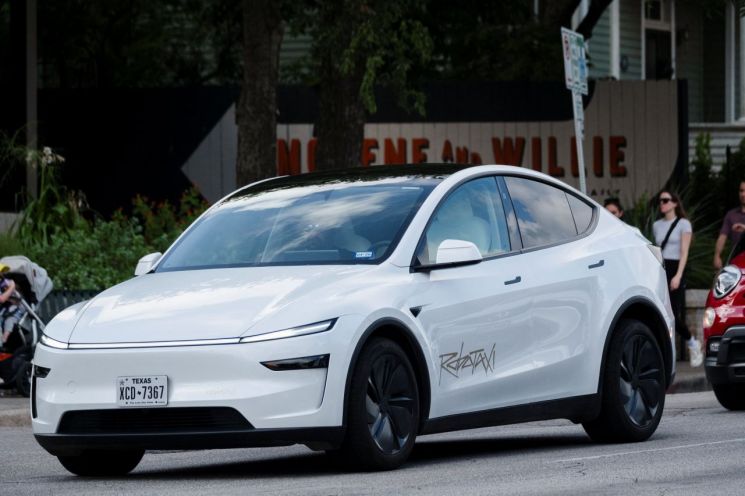
On this day, Tesla deployed about 10 Model Y vehicles to provide the service to a select group of social media influencers and key investors. Videos of passengers riding in the robotaxi were posted on X and other platforms, and CEO Musk reposted them.
CEO Musk said on X, "This is the result of 10 years of effort," and emphasized, "Both the artificial intelligence (AI) chip and the software team were developed entirely in-house at Tesla from the ground up."
Prior to the service launch, CEO Musk announced that the robotaxi’s flat fare would be $4.20 (approximately 5,800 KRW). The vehicles operate only within limited zones to avoid complex intersections and other challenging areas, and remote operators intervene if any issues arise.
With the start of this pilot operation, Tesla is now entering direct competition with Google Waymo, the leading company in the robotaxi sector. Waymo currently operates services in San Francisco, Los Angeles (LA), Silicon Valley, and Phoenix. Waymo provides 250,000 paid rides per week, with total paid rides exceeding 10 million.
Zoox, Amazon’s autonomous driving division, also recently began producing robotaxis in California. Zoox is operating on a limited basis in San Francisco and Las Vegas, with plans to launch a full-scale service in the future.
Analysts assess that Tesla, which operates its vehicles using a set of cameras rather than the expensive radar and lidar sensors used by competitors, has a significant cost advantage. As a result, there is growing market anticipation that the robotaxi business could help Tesla, which has been facing difficulties due to CEO Musk’s political activities.
However, some believe that Tesla still has a long way to go. Paul Miller, principal analyst at Forrester Research, stated, "This launch falls significantly short compared to the company’s promises and the level already offered by competitors."
Bryant Walker Smith, associate professor at the University of South Carolina, pointed out, "Tesla has not demonstrated that its system possesses the level of accuracy and reliability required to be deployed under diverse driving conditions."
There are also concerns about Texas’ move toward stricter regulations. While Texas has traditionally taken a deregulatory stance on autonomous vehicles, the shift toward tighter regulations could pose a burden for Tesla. On June 20, Texas Governor Greg Abbott signed an autonomous vehicle regulation bill that requires state approval for autonomous vehicle operations. On June 18, seven Democratic state legislators in Texas requested a delay in robotaxi operations until the new state regulations take effect.
During the first quarter earnings conference call on April 1, CEO Musk stated, "We will begin fully autonomous robotaxi operations in Austin in June as planned," and although the first day of service may be small in scale, "we will rapidly scale up." He also said, "By the end of this year, we will expand the service to other cities across the United States, and by the second half of next year, there will be millions of fully autonomous Teslas in operation."
© The Asia Business Daily(www.asiae.co.kr). All rights reserved.
![Clutching a Stolen Dior Bag, Saying "I Hate Being Poor but Real"... The Grotesque Con of a "Human Knockoff" [Slate]](https://cwcontent.asiae.co.kr/asiaresize/183/2026021902243444107_1771435474.jpg)















