June 24 to August 10 at Jeonbuk Provincial Museum of Art Seoul Branch
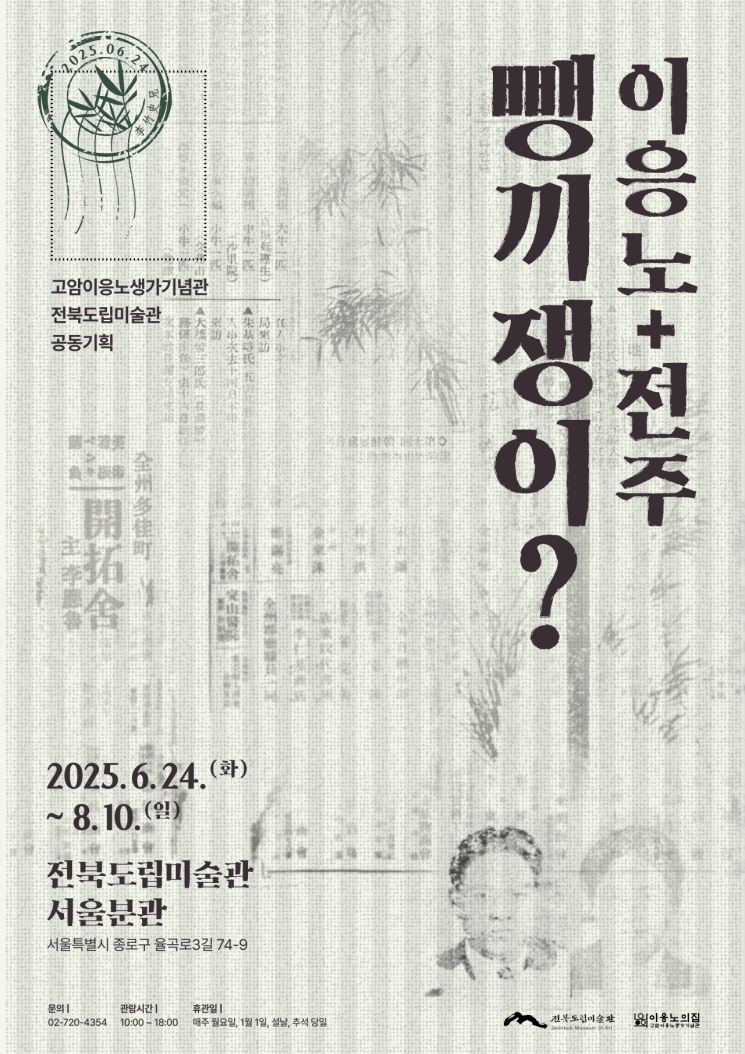 Promotional photo for the special exhibition "Ppaenggijaengi Lee Ungno + Jeonju," jointly planned by the Lee Ungno Birthplace Memorial Hall and the Jeonbuk Provincial Museum of Art. / Courtesy of Lee Ungno's House
The Lee Ungno Birthplace Memorial Hall, located in Hongbuk-eup, Hongseong-gun, Chungnam, announced on the 23rd that it will hold the special exhibition "Ppaenggijaengi? Lee Ungno + Jeonju," jointly organized with the Jeonbuk Provincial Museum of Art, at the Seoul branch of the Jeonbuk Provincial Museum of Art from June 24 to August 10.
This exhibition marks the first time that Lee Ungno's House has co-organized a special exhibition with a metropolitan or provincial-level art museum. It is also the first exhibition by Lee Ungno's House to focus on the period when artist Lee Ungno lived in Jeonju, drawing significant attention.
Lee Ungno (1904-1989), a master of modern art born in Junggye-ri, Hongbuk-eup, Hongseong-gun, learned painting under Song Taehoe, a painter and calligrapher active in Jeonbuk, during his teenage years.
Around 1925 to 1926, Lee settled in Jeonju and established "Gaecheoksa," where, for 12 years until 1936, he worked as an art dealer, buying and selling works and art supplies from artists in the Chungcheong and Jeolla regions. He also created signboards used for promotion and decoration, acted as a mediator for artists' exchanges, and served as a director in establishing exhibition spaces.
However, in the history of modern Korean art, Lee Ungno's career has mainly been viewed through the lens of his activities in France, and his time in Jeonju has often been reduced to the role of a "signboard maker."
Therefore, Lee Ungno's House and the Jeonbuk Provincial Museum of Art are holding this joint special exhibition to shed new light on Lee Ungno's early activities in Jeonju. They have jointly researched over 100 postcards preserved by Lee Ungno's House and are sharing the results, aiming to lay the groundwork for establishing the history of modern Korean art.
In the first-floor exhibition hall of the Seoul branch of the Jeonbuk Provincial Museum of Art, where this special exhibition is being held, more than 100 postcards exchanged by Lee Ungno during his Jeonju period, as well as works by artists with whom he interacted, will be on display.
The postcards from the Jeonju period are particularly noteworthy as they are being made available to the public for the first time as archival materials. Through the postcards, it is possible to see Lee's exchanges with Kim Younggi, the eldest son of his teacher Kim Kyujin and an Oriental painter, as well as with Jung Unmyeon and Cho Donguk, who led the new Southern School painting style in the Honam art scene and were skilled in the Four Gracious Plants and ink painting.
In addition, although not featured in the postcards, works by Kim Kyujin, Lee Gwangyeol and Bae Seokrin?both calligraphers and painters from Jeonbuk?and Hwang Yongha, who established an art research institute in Gunsan, can also be found in the exhibition.
The second-floor exhibition hall will mainly feature bamboo paintings believed to have been created by Lee Ungno during his time in Jeonju, from around 1926 to 1937.
A representative from Lee Ungno's House stated, "This exhibition is not only the first collaboration between Lee Ungno's House and a metropolitan or provincial art museum, but also the first time the postcard archive is being made available to visitors. We hope many people will take an interest and follow the exhibition closely."
© The Asia Business Daily(www.asiae.co.kr). All rights reserved.
![Clutching a Stolen Dior Bag, Saying "I Hate Being Poor but Real"... The Grotesque Con of a "Human Knockoff" [Slate]](https://cwcontent.asiae.co.kr/asiaresize/183/2026021902243444107_1771435474.jpg)















