Iranian Foreign Minister Announces Planned Talks with Russian President Putin
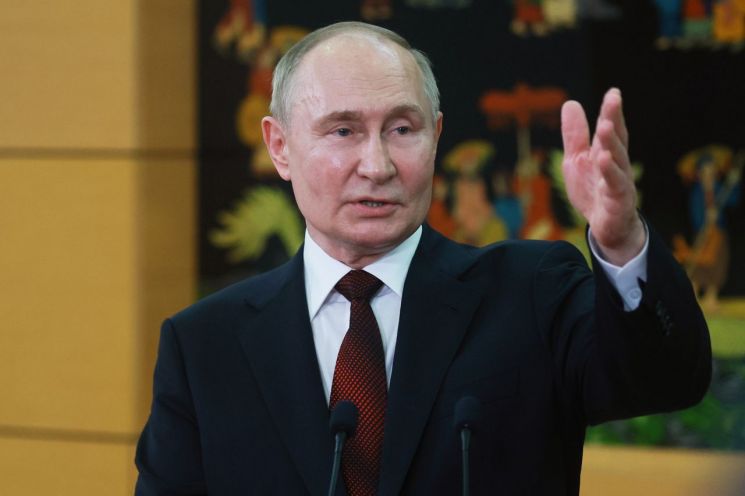 Russian President Vladimir Putin, on a state visit to Vietnam, is holding a press conference in Hanoi in June 2024. Russia is strengthening close ties with Iran following the U.S. airstrike on three Iranian nuclear facilities on the 21st. Photo by EPA Yonhap News
Following the U.S. airstrike on three Iranian nuclear facilities on the 21st (local time), Russia and Iran, which maintain a strategic alliance, are drawing closer. China, a major consumer of Iranian oil, has also called for an end to the war and voiced support for Iran.
The Financial Times (FT) reported that Iranian Foreign Minister Abbas Araghchi announced at a press conference on the night of the 22nd that he would hold talks with President Vladimir Putin in Moscow, Russia. He stated, "We will have very important and serious discussions with President Putin," adding, "This meeting will serve the interests of both countries."
Since the U.S. airstrike, Russia has been strengthening its ties with its strategic ally Iran. In fact, Foreign Minister Araghchi said that the upcoming talks would address "shared threats and challenges."
Dmitry Medvedev, former Russian president and current deputy chairman of Russia's Security Council, claimed that, following the U.S. strike on Iran, several countries are prepared to directly supply their own nuclear warheads to Iran. Dmitry is considered a close associate of Russian President Vladimir Putin.
On the 22nd, he wrote on social media (X, formerly Twitter), "The enrichment of nuclear material and the production of nuclear weapons will continue," and added, "Several countries are ready to provide their own nuclear warheads directly to Iran." While he did not specify which countries, given Russia's traditional support for nuclear programs, it is widely assumed that Russia is among them.
President Putin has positioned himself as a 'mediator' in the conflict since Israel launched a surprise airstrike on Iran's nuclear and military facilities on the 13th. President Donald Trump initially responded favorably on the 15th, saying he was "open" to Putin's mediation, but three days later, on the 18th, he indirectly rejected the idea by saying, "Let's have Russia mediate its own affairs first." This was a suggestion that Russia should focus more on its own issues, such as the Ukraine-Russia war.
The Chinese government also strongly criticized the U.S. attack on Iran's nuclear facilities and called for an immediate ceasefire. Fu Cong, China's ambassador to the United Nations, stated, "Actions that add fuel to the conflict must stop," and voiced criticism against Israel. Previously, a spokesperson for China's Ministry of Foreign Affairs also issued an official statement, declaring, "This airstrike is a serious violation of the purposes and principles of the UN Charter and international law."
Iran is reportedly considering measures to paralyze global shipping by laying mines in the Strait of Hormuz or intensifying attacks on vessels in the Red Sea through Yemen's Houthi rebels. If this happens, China, which cannot easily produce its own oil, would face significant disruptions to its energy supply. The Iranian parliament has already voted to close the Strait of Hormuz, and only a final decision by the Supreme National Security Council (SNSC) remains.
© The Asia Business Daily(www.asiae.co.kr). All rights reserved.
![Clutching a Stolen Dior Bag, Saying "I Hate Being Poor but Real"... The Grotesque Con of a "Human Knockoff" [Slate]](https://cwcontent.asiae.co.kr/asiaresize/183/2026021902243444107_1771435474.jpg)
















