Spain Claims "2.1% Is Appropriate... We Are 'Exempt'"
U.S. Expands Demand for 5% of GDP to Asian Allies
Focus on South Korea and Japan's Response... "A Matter to Decide Independently"
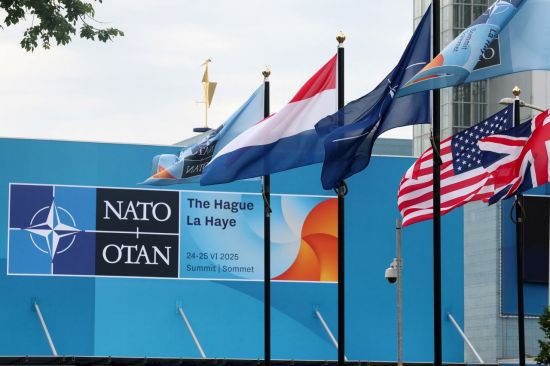 On the 22nd (local time), NATO flags installed in The Hague, Netherlands, are fluttering in the wind. Photo by Reuters Yonhap News
On the 22nd (local time), just two days before the opening of the NATO summit, member countries of the North Atlantic Treaty Organization (NATO), including the United States, agreed on a defense spending guideline targeting 5% of GDP by 2035, according to reports by Reuters, AFP, and DPA.
NATO Secretary-General Mark Rutte proposed a defense budget of 5% of GDP, consisting of 3.5% for direct military spending and 1.5% for indirect security-related costs. He has been pushing for this agreement ahead of the summit scheduled for the 24th. This move is intended to meet the level demanded by U.S. President Donald Trump, who has called on European allies to take greater responsibility for their own defense.
However, Spain, which has the lowest defense spending among NATO members, claimed to have been exempted from this target. For Spain, which spent only 1.24% of its GDP on defense last year, the 5% guideline is considered unattainable. In addition, Prime Minister Pedro Sanchez is under pressure from coalition partners who oppose increasing defense spending. He has argued that an appropriate level of defense expenditure for Spain is 2.1% of GDP.
The Trump administration's pressure is spreading not only across the North Atlantic but also to Asian allies. On the 19th, U.S. Department of Defense spokesperson Sean Parnell stated, "Our European allies are setting a global standard for our Asian allies," adding, "That standard is spending 5% of GDP on defense."
Japan, under former Prime Minister Fumio Kishida, decided to raise its defense budget to about 2% of GDP by 2027 and has been securing the necessary revenue. However, in March, U.S. Deputy Under Secretary of Defense for Policy Elbridge Colby argued during a confirmation hearing that the 2% increase was insufficient and that Japan should raise its defense spending to 3% of GDP. In response, the Japanese government stated, "Japan's defense budget is determined by Japan." Japanese Prime Minister Shigeru Ishiba also expressed displeasure, saying, "We have no intention of engaging in crude discussions."
Recently, tensions between the U.S. and Japan over defense spending have resurfaced. The Financial Times (FT) reported, citing multiple sources, that the Japanese government decided to cancel the "2+2 meeting" with the U.S., which was scheduled to be held in Washington, D.C. early next month for the first time in a year. According to FT, the direct cause was Deputy Under Secretary Colby's recent request that Japan raise its defense spending to 3.5% of GDP, higher than the previously requested 3%. However, a senior official from the Japanese Ministry of Foreign Affairs told the Yomiuri Shimbun, "We have never been asked by the U.S. to increase our defense budget," and "The 2+2 meeting has not been scheduled due to coordination issues," denying the FT report.
South Korea has also drawn a line against direct U.S. intervention, stating that the issue of increasing its defense budget, which currently stands at 2.8% of GDP, is a matter to be decided independently. An official from the Ministry of Foreign Affairs explained on the 20th, "We intend to determine our defense budget by comprehensively reviewing both domestic and international security environments as well as the government's fiscal conditions," adding, "The government has been increasing the necessary defense budget in order to continuously strengthen our national defense amid a grave security environment."
© The Asia Business Daily(www.asiae.co.kr). All rights reserved.

















