Iranian Ambassador: "Another Stain for the U.S.... Iran Will Decide Timing, Nature, and Scale of Response"
U.S. Ambassador: "Any Attack on U.S. Forces Will Be Met with Retaliation"
Security Council Resolution Calls for Ceasefire... South Korea Urges Diplomatic Solution
On June 22 (local time), an emergency meeting of the United Nations Security Council was convened following a U.S. airstrike on Iranian nuclear facilities, during which the United States and Iran clashed. Iran criticized the U.S. strike on its nuclear facilities as being politically motivated and baseless, and pointed out that the U.S. action constitutes an illegal act that violates international law, the regulations and treaties of international organizations, and Security Council resolutions. In contrast, the United States asserted that Iran's nuclear threat is real and described its actions as an exercise of collective self-defense. The U.S. also warned that any attack against Americans or U.S. military personnel would be met with retaliation.
Amir Saeid Iravani, Iran's Ambassador to the United Nations, stated at the Security Council emergency meeting held at the UN headquarters in New York that the U.S. airstrikes on three Iranian nuclear facilities marked "another stain on the political history of the United States." He further criticized, "Benjamin Netanyahu, the Israeli Prime Minister who is wanted by the International Criminal Court as a war criminal, has once again succeeded in dragging the United States into another costly and baseless war."
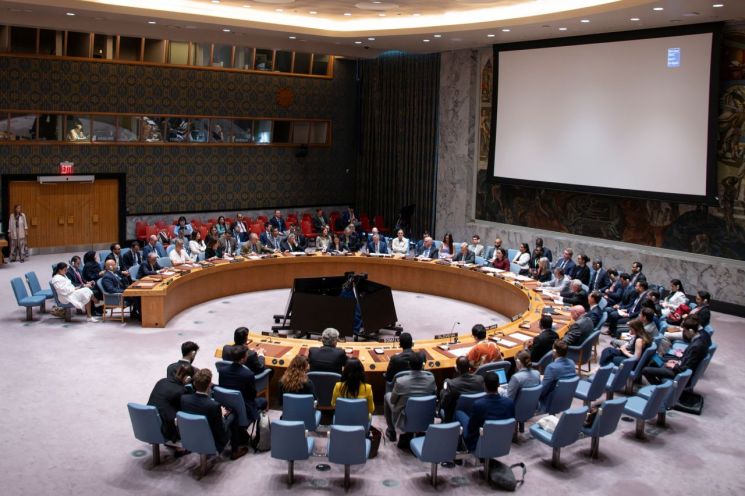
Ambassador Iravani stated, "All of the United States' claims against Iran lack evidence or legal basis and are politically motivated." He added, "While Iran's Foreign Minister was in contact with three European countries this week, the United States decided to undermine diplomacy." He asserted, "The aggression by the United States and the Israeli regime violates international law, the UN Charter, the International Atomic Energy Agency (IAEA) regulations, Security Council Resolutions 487 and 2331, and the Non-Proliferation Treaty (NPT)." He warned of retaliation, stating, "Iran retains the right to defend itself against blatant U.S. aggression. The timing, nature, and scale of Iran's proportional response will be determined by the Iranian military."
He also criticized Israel, stating, "On June 15, Iran was preparing for diplomatic engagement with the United States, but Israel attacked Iran two days before the talks. The so-called diplomatic proposals are nothing more than a deceptive policy intended to mislead the international community."
On the other hand, Dorothy Shea, Acting U.S. Ambassador to the United Nations, stated at the meeting, "Last night, the U.S. military struck Iranian nuclear facilities in Fordow, Natanz, and Isfahan to dismantle Iran's uranium enrichment capability and deter the nuclear threat posed by Iran." She criticized Iran for concealing its nuclear program and for recently obstructing negotiations.
Acting Ambassador Shea explained that the operation "had been in planning for a long time, but was carried out to eliminate the source of rapidly escalating global instability and to support our ally Israel under the inherent right of collective self-defense in accordance with the UN Charter." She warned, "As President Trump has stated, any direct or indirect Iranian attack on Americans or U.S. military bases will be met with devastating retaliation."
Meanwhile, China, Russia, and Pakistan, all Security Council member states, proposed a draft Security Council resolution calling for an unconditional ceasefire. The draft also urges the protection of civilians, respect for international law, and participation in dialogue and negotiations. These countries requested support for the draft from other member states.
South Korea also called for a diplomatic resolution. Hwang Joon-kook, South Korea's Ambassador to the United Nations, stated, "Despite the recent very concerning developments, South Korea remains convinced that a sustainable solution to the crisis cannot be achieved by military means alone," and urged, "Everyone should exercise maximum restraint and strive to revive dialogue and diplomacy."
Rafael Grossi, Director General of the International Atomic Energy Agency (IAEA), emphasized that "armed attacks on nuclear facilities must never occur, as they can cause radioactive releases with serious consequences not only for the targeted country but also for neighboring states." He noted that no increase in external radiation levels had been detected following the U.S. strikes on the three Iranian nuclear facilities, but expressed caution, stating that he could not confirm the extent of damage to the Fordow underground enrichment facility, Iran's key uranium enrichment site.
© The Asia Business Daily(www.asiae.co.kr). All rights reserved.
![Clutching a Stolen Dior Bag, Saying "I Hate Being Poor but Real"... The Grotesque Con of a "Human Knockoff" [Slate]](https://cwcontent.asiae.co.kr/asiaresize/183/2026021902243444107_1771435474.jpg)















