KOSPI Drops Below 3,000 After Just One Day
Direction of Oil Prices in Focus
Volatility Unavoidable... Tug-of-War Around the 3,000 Mark Expected
The KOSPI fell back below the 3,000 mark just one day after recovering it, amid escalating tensions in the Middle East. With international oil prices cited as the biggest variable, increased market volatility is expected to be unavoidable for the time being.
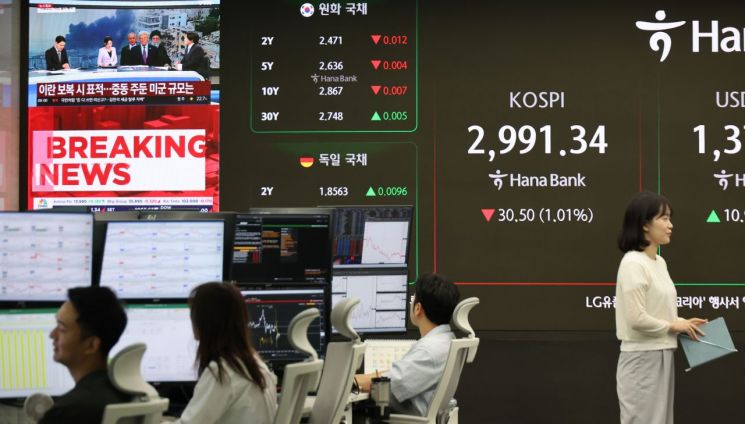
As of 9:15 a.m. on June 23, the KOSPI was trading at 2,984.84, down 37.00 points (1.22%) from the previous session. The KOSDAQ was at 776.09, down 15.44 points (1.95%).
Last week, the KOSPI rose by 4.40% and the KOSDAQ by 2.95%. The KOSPI had reclaimed the 3,000 level for the first time in three and a half years. However, the rapidly deteriorating situation in the Middle East over the weekend appears likely to halt the KOSPI's upward momentum. On June 21 (local time), U.S. President Donald Trump announced that the United States had directly struck Iran's nuclear facilities. In response, Iran, which declared retaliation, officially approved the closure of the Strait of Hormuz, a key oil shipping route in the Middle East. As tensions in the region escalate, market volatility seems inevitable.
Shin Seungjin, head of investment information at Samsung Securities, commented, "There was a lot of major news over the weekend, including the U.S. attack on Iran's nuclear facilities and the Iranian parliament's approval to close the Strait of Hormuz. Iran is hinting at retaliation against U.S. military bases in the Middle East, while the U.S. is signaling even stronger attacks if retaliation occurs, raising the level of tension." He added, "With geopolitical risks in the Middle East coming to the fore, a market correction this week is unavoidable."
The future direction of oil prices is expected to be the key factor. Lee Euntaek, a researcher at KB Securities, noted, "South Korea's energy import dependency is over 90%, which could provide grounds for a market correction. In particular, more than 70% of all crude oil is imported from the Middle East, so if the closure of the Strait of Hormuz becomes a reality, the shock will be significant, and global inflation concerns will also intensify." He added, "By sector, shipping and airlines will be directly affected, while the defense industry could see a significant boost from secondary effects."
The potential delay of a U.S. Federal Reserve rate cut due to this crisis is also cited as a risk factor. Noh Geunchang, head of research at Hyundai Motor Securities, explained, "Another threat from geopolitical instability in the Middle East and rising oil prices is the expansion of inflationary pressure, which could delay a Fed rate cut. As the inflationary impact of U.S. tariffs is expected to intensify, if rising oil prices?which had been helping to keep prices down?continue, inflationary pressure could temporarily increase, weakening expectations for a Fed rate cut."
However, some analysts predict that this correction will be short-lived. Shin Seungjin stated, "There is a high possibility that this correction will be limited to short-term issues. This is because a full-scale ground war between Israel and Iran is impossible due to the physical distance, and the closure of the Strait of Hormuz is complicated by the interests of multiple countries. The U.S. also maintains a fundamental stance of not seeking war."
Lee Kyungmin, a researcher at Daishin Securities, also remarked, "If the Strait of Hormuz is closed, oil prices could exceed $80 and a short-term shock to global risk assets would be inevitable. However, the likelihood of a prolonged crisis is low, and it is possible that swift U.S. intervention could bring an early end to the Israel-Iran conflict."
Amid a mix of positive and negative factors, the KOSPI is expected to focus on consolidating above the 3,000 mark. Han Jiyoung, a researcher at Kiwoom Securities, stated, "Policy momentum remains valid, and with expectations for MSCI advanced index inclusion on June 25 still present, there is upward pressure on the index. However, it is important to note that the desire to realize profits has accumulated following last week's sharp 4% rally in the KOSPI. Therefore, this week, the KOSPI is likely to fluctuate around the 3,000 level, influenced by events such as the Middle East crisis, U.S. semiconductor export restrictions, the congressional hearing for Fed Chair Jerome Powell, and Micron's earnings."
© The Asia Business Daily(www.asiae.co.kr). All rights reserved.

















