Acceleration of Women's Universities Transitioning to Coeducation Amid Declining School-Age Population
Opposition to Coeducation Spreads Among Current Students
Mukogawa Women's University, the largest women's university in Japan, is facing strong backlash as it moves to transition to a coeducational system, with more than 30,000 people signing a petition in opposition. On June 19, the Sankei Shimbun reported that Mukogawa Women's University, located in Hyogo Prefecture, Japan, recently announced, "We will transition to a coeducational system starting in 2027. The school name will be changed to Mukogawa University." In response, opposition is spreading, particularly among current students.
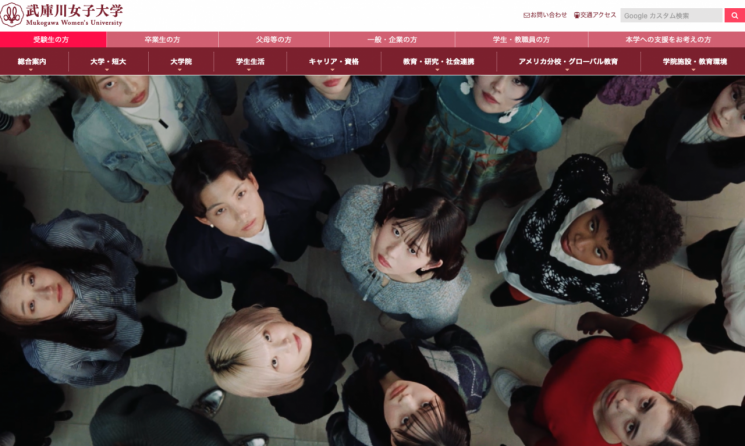 Mukogawa Women's University is the largest women's university in Japan, with 21 departments and over 10,000 enrolled students. Mukogawa Women's University website
Those opposing the transition to coeducation conducted an online petition demanding the "halt and postponement of engineering," which garnered the support of over 30,000 people. The petition conveyed the message, "Respect the wishes of students who chose this university on the premise that it is a women's university." The petitioners are demanding that the school hold explanatory and opinion exchange sessions, maintain the women's university status until the current first-year students graduate, and disclose the meetings and discussions involved in the decision-making process.
A current student who signed the petition on the website commented, "Because it is the largest women's university in Japan, I felt reassured that there would be no transition to coeducation or closure. I can't believe this is happening," and "I feel betrayed." Another student shared, "In the past, I suffered from severe androphobia, so a women's university was my only option. There are people who have reasons why it must be a women's university. Such a sudden change is also disrespectful to prospective students." The petition will continue until July 17 and is scheduled to be submitted to the university board on July 20. Mukogawa Women's University is expected to make a final decision on the transition to coeducation at the board meeting scheduled for July 28.
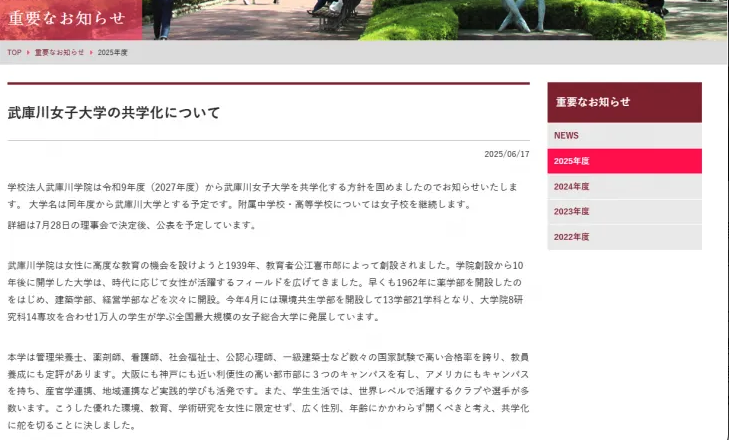 The opposition to this engineering transition conducted an online petition demanding the "halt and postponement of engineering," gaining the support of over 30,000 people. Mukogawa Women's University website
Mukogawa Women's University is the largest women's university in Japan, with 21 departments and over 10,000 enrolled students. The student enrollment rate is around 95%, so there are currently no management issues. However, due to the ongoing decline in the student population in Japan's super-aged society, the university is proactively pursuing the transition to coeducation to maintain its scale. According to Japanese authorities, the number of 18-year-olds, the typical age for university entrance exams, exceeded 2 million per year in the 1990s, but this year it is 1.09 million. By 2050, the number of university entrants is estimated to drop to 430,000. As the school-age population decreases, women's universities in Japan are increasingly transitioning to coeducational systems. The number of four-year women's universities in Japan was over 100 in the late 1990s, but has decreased to around 70 in the 2020s. Earlier in March, Kyoto Koka Women's University in Kyoto Prefecture announced that it would transition to a coeducational system starting in the 2026 academic year.
Meanwhile, in South Korea, where a decline in the school-age population is also expected, there have already been various discussions among major women's universities such as Sookmyung Women's University and Sungshin Women's University regarding the partial admission of male students and transitions to coeducation. However, following protests at Dongduk Women's University after discussions on transitioning to coeducation last year, the debate over coeducation at women's universities is currently on hold.
© The Asia Business Daily(www.asiae.co.kr). All rights reserved.
![Clutching a Stolen Dior Bag, Saying "I Hate Being Poor but Real"... The Grotesque Con of a "Human Knockoff" [Slate]](https://cwcontent.asiae.co.kr/asiaresize/183/2026021902243444107_1771435474.jpg)
















