The Korea Institute of Ocean Science and Technology (KIOST) has identified, through genetic connectivity analysis, that the northward migration of conch habitats from the southern coast to the eastern coast of Korea is closely related to rising sea surface temperatures caused by climate change. The related research findings have been published in an international academic journal.
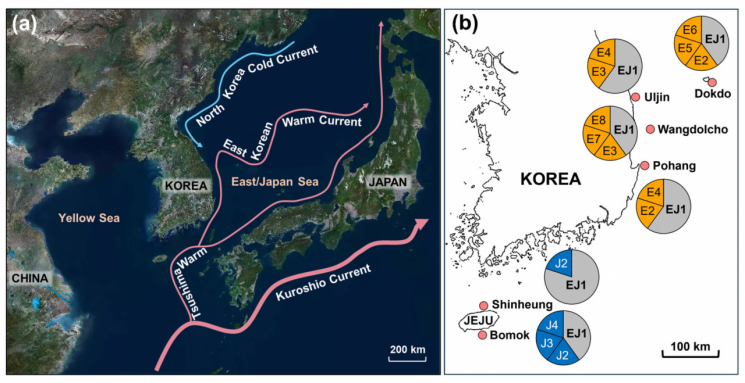
According to the "National Marine Ecosystem Comprehensive Survey" conducted by the Korea Marine Environment Management Corporation, the conch (Turbo sazae), which primarily inhabited the southern coast, had expanded its habitat range as of 2018 to as far north as latitude 37 degrees (near Uljin).
This indicates that the northern boundary for marine life survival is gradually shifting due to rising sea temperatures caused by climate change. The KIOST research team has demonstrated this phenomenon through genetic connectivity analysis of the conch.
The research team led by Dr. Yang Hyunseong at the KIOST Tropical and Subtropical Research Center, in collaboration with Dr. Cho Youngkwan's team at the National Institute of Fisheries Science Tidal Flat Research Center, predicted that the phenomenon of "getnogeum" (coastal desertification) caused by climate change would significantly impact the benthic ecosystem. They analyzed the physiological, ecological, and genetic characteristics of the conch.
As a result, they confirmed that conch populations inhabiting Jeju and the east coast share the same genetic characteristics.
The "getnogeum" phenomenon refers to the disappearance of seaweed from coastal rocky areas and the attachment of white calcareous algae, turning the rocky regions white. This is also called "marine desertification."
Additionally, the KIOST Jeju Bio Research Center team discovered that the main cause of the decline in conch populations is a weakened immune function due to rising sea temperatures.
Previously, it was assumed that the decrease in conch populations in the waters around Jeju was caused by changes in their diet resulting from the "getnogeum" phenomenon. However, according to the research findings, changes in diet did not significantly affect the conch's reproduction or internal physiological changes. Instead, high-temperature environments were identified as the main factor lowering immune function.
These research results scientifically support the possibility that conch larvae have expanded and settled along the east coast by following ocean currents such as the Tsushima Warm Current. By comprehensively analyzing the morphological features and genetic information of populations in Jeju and the east coast, the study provides concrete evidence of how climate change affects the distribution of marine species.
In particular, the fact that rising sea temperatures create favorable conditions for the northward migration and settlement of conch is expected to serve as important foundational data for understanding the climate adaptation mechanisms of marine organisms and for establishing response strategies to climate change in the future.
Lee Heeseung, President of KIOST, stated, "Rising sea temperatures due to climate change are a key variable that directly impacts marine ecosystems. Through this research, we will continue to scientifically assess changes in the distribution of marine organisms and pursue foundational studies for the management and conservation of our marine ecosystems."
© The Asia Business Daily(www.asiae.co.kr). All rights reserved.
![Clutching a Stolen Dior Bag, Saying "I Hate Being Poor but Real"... The Grotesque Con of a "Human Knockoff" [Slate]](https://cwcontent.asiae.co.kr/asiaresize/183/2026021902243444107_1771435474.jpg)















