No Signs of Resolution in Government-Medical Conflict...
Contacting Lawmakers from Both Parties
Demands Include Guaranteed Positions and Special Provisions in September Recruitment
Even after the inauguration of the Lee Jaemyung administration, there are no signs of resolving the conflict between the government and the medical community. As a result, some resigned resident doctors have begun to directly meet with lawmakers from both the ruling and opposition parties to urge for solutions. Medical associations have also called on the new government to take action to prevent the disruption of medical education and to restore normalcy in the healthcare field.
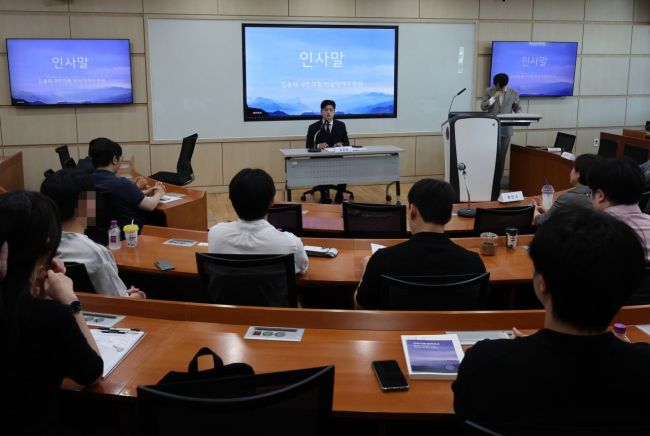 On the 22nd, at Korea University College of Medicine in Seongbuk-gu, Seoul, Kim Yongtae, Emergency Response Committee Chairman of the People Power Party, delivered a greeting during the discussion titled "Solutions to the Medical Crisis from Residents and Medical Students." Photo by Yonhap News
According to the medical community on the 23rd, some resigned residents and medical students attended a discussion titled "Solutions to the Medical Crisis from Residents and Medical Students" hosted by the Korean Medical Policy School the previous day. During the event, they met with Kim Yongtae, Emergency Response Committee Chairman of the People Power Party, and requested that opportunities for their return be opened through measures such as special training provisions and flexible academic policies. They also argued that a forum for discussion, such as a bipartisan consultative body, is needed to resolve the conflict between the government and the medical community. On the 24th, they are also scheduled to meet with Park Jumin, Chairman of the National Assembly Health and Welfare Committee.
Unlike the more hardline Korean Intern Resident Association and the Korean Medical Student Association, it is known that the residents and medical students who attended this event were mainly moderates. As neither the Korean Medical Association nor the existing resident and student organizations have found a breakthrough in resolving the conflict, it is analyzed that moderates have begun to take independent action.
In principle, resigned residents who wish to return can do so by participating in the regular recruitment for the second half of the year and returning to their training hospitals. However, since the second-half recruitment usually fills vacancies left after the first-half recruitment, there may be no positions available in certain hospitals or departments if they are already full. Therefore, the residents are demanding that their return be guaranteed regardless of these circumstances.
For those who have not completed their mandatory military service, resigning as a resident puts them in a state of waiting for enlistment. Even if they return in September, they would have to enlist immediately if a draft notice is issued, so they are also requesting a deferment of military service. In addition, senior residents who begin training in September would have difficulty taking the specialist qualification exam scheduled for February next year, so there are calls for an additional exam to be held.
However, there is growing criticism that these demands from resigned residents constitute "excessive privileges." The government has already granted special provisions several times, yet most residents have not returned. If special measures are applied again, it would be unfair to those who have already returned or who have remained at their training posts. The Ministry of Health and Welfare has also stated that, at present, it is not considering any special measures, and that the second-half recruitment will be announced at the end of July as usual.
A source in the medical community said, "Initially, residents had planned to negotiate special training provisions and return in September once the Lee Jaemyung administration was inaugurated, but as the new government has not responded proactively to medical issues due to its early personnel appointments and other matters, some are feeling anxious."
Meanwhile, in addition to the Korean Medical Association, regional medical societies are also calling on the new government to prioritize resolving issues such as the return of residents and the normalization of medical school classes.
The Gwangju Medical Association stated, "The government must listen to the voices of medical students and residents, accept their reasonable demands, and immediately dismiss the Minister and Vice Minister of Health and Welfare, who are the main culprits behind the medical crisis." The Daegu Medical Association also asserted, "The government should establish institutional mechanisms to allow returning residents to continue their training, and the state must take responsibility to ensure that there are no gaps in the medical workforce."
© The Asia Business Daily(www.asiae.co.kr). All rights reserved.
![Clutching a Stolen Dior Bag, Saying "I Hate Being Poor but Real"... The Grotesque Con of a "Human Knockoff" [Slate]](https://cwcontent.asiae.co.kr/asiaresize/183/2026021902243444107_1771435474.jpg)















