Presentation at the Honam Policy Society Spring Academic Conference
Development by Autonomous District... Setting a Clear Direction is Crucial
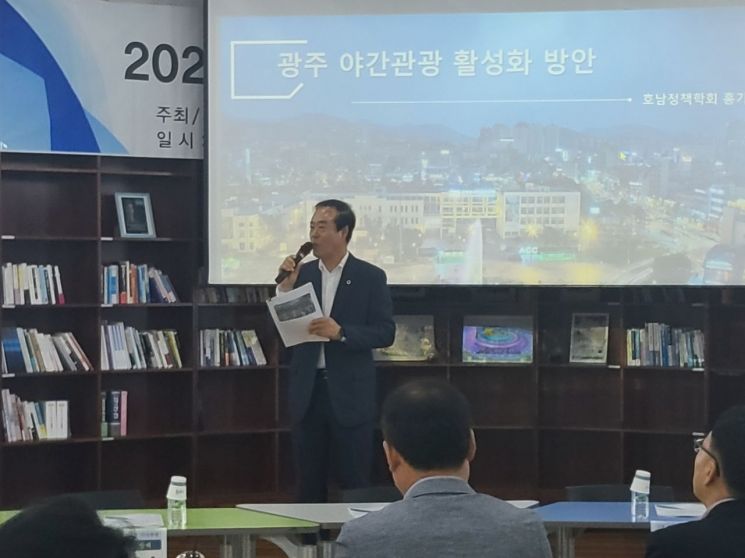 Hong Giwol, a member of the Gwangju Metropolitan Council, is giving a presentation on the topic of "Measures to Revitalize Night Tourism in Gwangju" at the 2025 Honam Policy Society Academic Conference held on the 20th at the Iplex conference room in Dong-gu. Provided by Gwangju Metropolitan Council
It has been argued that, in order to revitalize night tourism in Gwangju, efforts should focus on developing "stay-type route experiences" that connect different spaces and specialize in themes and stories.
Hong Giwol, a member of the Gwangju Metropolitan Council (Democratic Party of Korea, Dong-gu District 1), presented detailed action plans for Gwangju's night tourism during her presentation on "Measures to Revitalize Night Tourism in Gwangju" at the 2025 Honam Policy Society Academic Conference held on the 20th at the Iplex conference room in Dong-gu.
On that day, Hong set out her vision for Gwangju's night tourism as "a shining Gwangju revived by nighttime activities, a dynamic Gwangju at night." As key strategies, she proposed: ▲setting a clear direction ▲developing regionally specialized content ▲and focusing on branding.
As detailed action plans, Hong emphasized "a clear approach from the perspectives of culture and arts, urban engineering, and policy," as well as "strengthening the convergence and utilization of local resources." She proposed designating Art Street, the Asia Culture Center, and Yangnim-dong Historic Village as specialized zones for night culture and arts, and stressed the importance of an urban engineering approach to night tourism, including creating nighttime activity environments around railway station areas and expanding the use of multicultural resources.
She also explained the need to create multi-purpose, multi-functional complex spaces to make use of both tangible and intangible resources and spaces, thereby improving the night tourism environment and diversifying the use of unique local resources. In particular, Hong proposed establishing night tourism districts in each of the five autonomous districts, each with its own specialized attractions, food, and entertainment, and called for essential administrative and financial support for these specialized districts.
Above all, using virtual scenarios for night tourism resources by theme and space, she described, for example: ▲a tour in which the 3.2 million annual visitors to the Asia Culture Center could enjoy a coffee walk along Donglidan-gil, a tour of Donggyecheon (assuming its restoration), a visit to famous old restaurants in Gwangju, an emotional lantern experience on Chunjang-ro 1-5-ga, and busking performances at Gwangju Park's pojangmacha before staying overnight.
She also suggested: ▲operating modular experience programs using the space under the riverside cantilever in connection with the Yangdong Market Tongmaek Festival and watching busking cultural events along the riverside ▲experiencing late-night culture and arts events connecting Yangnim-dong Holly Tree Road and the Lee Lee-nam Cafe, watching a starlit night cultural performance at Sajik Tower, and experiencing local food culture at a traveler's accommodation before staying overnight.
Hong emphasized, "Night tourism in Gwangju should be approached not as a declarative or slogan-based policy, but through practical and realistic policies and projects." She urged, "Continuous efforts are needed so that Gwangju, the city of light, can shine even brighter and become more attractive through night tourism."
© The Asia Business Daily(www.asiae.co.kr). All rights reserved.

















