"It May Be Endurable for About a Week,
But Anything Beyond That Is a Different Story"
The cost of war for Israel is estimated to reach hundreds of billions of won per day.
On June 20, Yonhap News cited the Wall Street Journal (WSJ), reporting that the Aaron Institute for Economic Policy at Reichman University in Israel estimated that if the conflict with Iran continues for a month, the war expenses would amount to about $12 billion, or approximately 16.4 trillion won.
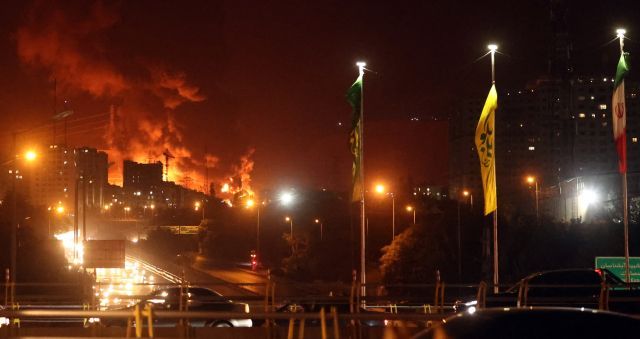 On the 15th (local time), the Sharan oil storage near Tehran, the capital of Iran, is burning due to an airstrike by the Israeli military. Photo by EPA Yonhap News
Zvi Eckstein, director of the institute, stated, "More resources are being invested now than during clashes with Iran-backed proxies such as Palestinian Hamas or Lebanon's Hezbollah," adding, "Missiles are the largest cost factor for both defense and offense."
According to expert analysis, the most significant burden comes from the cost of intercepting Iranian missiles. It is projected that between tens of millions and $200 million (about 270 billion won) per day are required for this purpose.
Israel boasts one of the world's most advanced air defense systems, including Arrow (high-altitude long-range missiles), David's Sling (medium-altitude missiles), and Iron Dome (short-range rockets).
According to Yehoshua Kalisky, senior researcher at the Institute for National Security Studies (INSS), an Israeli think tank, David's Sling typically uses two interceptor missiles, costing about $700,000 (about 960 million won) per interception. The Arrow 3 and Arrow 2 systems cost $4 million (about 5.48 billion won) and $3 million (about 4.11 billion won) per interceptor missile, respectively.
Operating an F-35 fighter jet costs $10,000 (about 1.4 million won) per hour. Additional expenses include fuel and ammunition for the fighter jets. The costs of missiles, such as Joint Direct Attack Munitions (JDAM), large aerial bombs like the MK84, and aerial refueling for jets must also be considered.
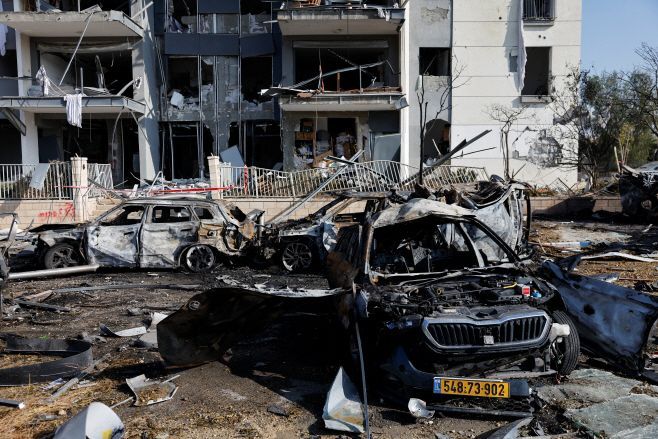 On the 20th (local time), buildings and vehicles in the southern Israeli city of Beersheba were destroyed by a missile attack from Iran. Photo by Reuters Yonhap News
Some Iranian missiles have penetrated the air defense system, causing damage to civilian facilities in Israel, including hospitals. According to the WSJ, as of now, Israel is expected to spend at least $400 million (about 54.87 billion won) to restore damaged buildings.
Zvi Eckstein, director of the Aaron Institute for Economic Policy, explained, "The daily cost is much higher than in wars with Gaza or Hezbollah."
Currently, due to Iran's missile attacks, Israel's economy has come to a near standstill over the past few days. Only essential industry workers have been reporting to work, and many businesses, including restaurants, have closed. Major international airports were also shut down for several days, with limited operations resuming only to allow citizens abroad to return home.
Meanwhile, as the armed conflict with Iran, which began with Israel's surprise attack, continues into its seventh day, concerns have been raised that a prolonged crisis could negatively impact South Korea's exports to the Middle East.
The Korea Trade-Investment Promotion Agency (KOTRA) assessed that, due to growing concerns over disruptions in Middle Eastern oil supplies, the freight rates for very large crude carriers (VLCCs) have risen by more than 20%. There is also a possibility that oil prices could exceed $100 per barrel, further increasing instability in the global economy.
© The Asia Business Daily(www.asiae.co.kr). All rights reserved.
![Clutching a Stolen Dior Bag, Saying "I Hate Being Poor but Real"... The Grotesque Con of a "Human Knockoff" [Slate]](https://cwcontent.asiae.co.kr/asiaresize/183/2026021902243444107_1771435474.jpg)

















