LEO Transport Cost to Drop to $2,500 per Kilogram
Expansion into Space Resources and Space Tourism Technologies After the 2030s
The Space Agency has announced its plan to develop a reusable launch vehicle by 2035 to remain competitive in the space industry.
On June 20, at the Seoul Biz Center in Yongsan-gu, Seoul, the agency held a brown bag meeting on the next-generation launch vehicle development project and explained the details of this project revision.
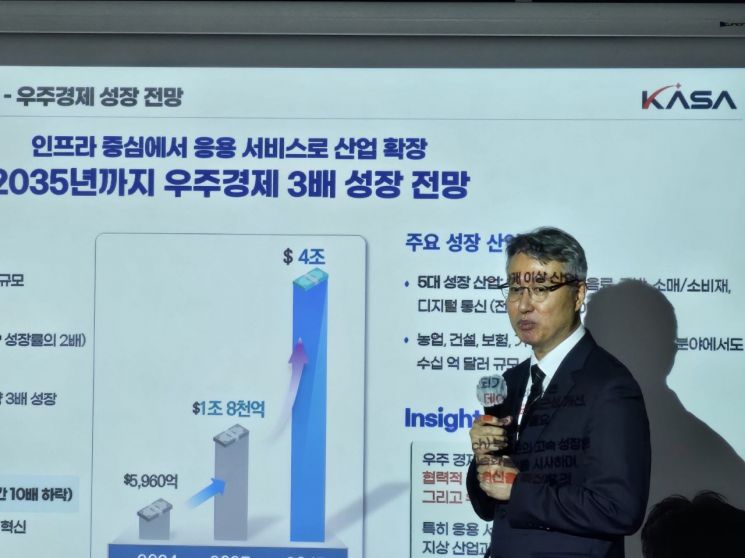
Previously, the agency had established a plan to invest 2.0132 trillion won by 2032 to develop expendable launch vehicles capable of carrying lunar probes and geostationary satellites. However, as the global space transportation sector has recently shifted toward developing reusable launch vehicles, the agency is now introducing reusable launch vehicle technology and has increased the related budget by approximately 298 billion won. The agency is currently awaiting a review of the project plan's validity by the Ministry of Economy and Finance.
Jae Sung Park, Head of the Space Transportation Division at the agency, emphasized, "Since all countries are aiming to develop reusable launch vehicles around the 2030s, we expect that developing ours by 2032 will allow us to enter the competition. Missing the right timing, as in the complete aircraft market, could solidify entry barriers in the space industry."
By country, China is targeting 2033, Europe the early 2030s, Russia 2028, Japan the late 2030s, and India 2034 for the development of reusable launch vehicles, with various projects underway.
Sun Young Park, Head of the Reusable Launch Vehicle Program at the agency, explained that for the project restructuring, options such as separate development of the reusable system and early transition to reusability were discussed. Through benefit analysis and other considerations, the agency decided to switch to early reusability.
He stated, "Through early development of reusability, we will be able to conduct two launches per year from 2032 to 2034, and secure the capability for three launches per year thereafter. If the next-generation launch vehicle is reused early, we will be able to accommodate a significant portion of space transportation demand from 2034."
He added, "Due to the change in the next-generation launch vehicle development plan, the first test launch will be postponed from 2030 to the fourth quarter of 2031. However, the second and third launches will take place in 2032, allowing us to achieve our original goal of launching a lunar lander in 2032."
The agency estimates that once the reusable launch vehicle development system is completed in 2035, more than 10 launches per year will be possible, and the cost to reach low Earth orbit will decrease to $2,500 per kilogram. Currently, it costs over $20,000 per kilogram.
Furthermore, after the 2030s, the agency expects that securing low-cost, high-frequency launch systems and orbital transfer vehicle technology will enable the launch of about 100 satellites per year. By integrating these technologies, the agency anticipates expansion into space resource utilization and space tourism technologies, as well as the revitalization of the private space industry driven by innovative technologies.
© The Asia Business Daily(www.asiae.co.kr). All rights reserved.
![Clutching a Stolen Dior Bag, Saying "I Hate Being Poor but Real"... The Grotesque Con of a "Human Knockoff" [Slate]](https://cwcontent.asiae.co.kr/asiaresize/183/2026021902243444107_1771435474.jpg)
















