Designation of 'RE100 Semiconductor Cluster' in Southern Gyeonggi
Turning Jeonnam, the Southwest Sea, and Jeju into Offshore Wind Power Hubs
Securing Funds Through Green Bond Issuance and Climate Environment Charges
Proposal to Reintroduce Small-Scale Renewable Energy Connection Guarantee System
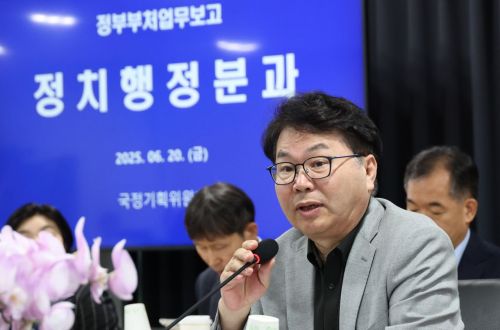 Hanju Lee, Chairman of the National Policy Planning Committee, is giving a speech at the prosecution office work report held at the Changseong-dong annex of the Government Seoul Office in Jongno-gu, Seoul on the morning of the 20th. 2025.6.20 Photo by Yongjun Cho
The National Policy Planning Committee, which received work reports from various government ministries from the 18th to the 20th, stated that it was "very disappointed" and announced it would request the reports again. The main reason cited was the overall lack of analysis of pledges, vision, and planning by each ministry.
The National Policy Planning Committee, which serves as the transition committee for the Lee Jaemyung administration, released a 'New Government Growth Policy Guidebook' prior to the ministry work reports. This guidebook further details President Lee Jaemyung's campaign pledges and serves as a guideline for policy formulation by each ministry.
According to the guidebook, energy is one of the five key tasks for implementing the Lee Jaemyung administration's three major growth strategies (strengthening growth engines, expanding growth areas, and enhancing growth incentives), highlighting its significant importance. The highest priority is 'entering the ranks of the top three AI powerhouses and fostering future strategic industries,' followed by 'energy transition and industrial upgrade.'
A distinctive feature of the Lee Jaemyung administration's energy policy is that energy is regarded not only as a means of responding to the climate crisis and achieving carbon neutrality, but also as an important tool for driving job creation and economic growth. In this respect, the attempt to link energy and growth sets it apart from the previous Moon Jaein administration.
Transitioning Industrial Structure from Fossil Fuels to Renewable Energy
In the energy sector, the National Policy Planning Committee has repeatedly emphasized its intention to transform the structure of the energy industry. The committee believes that unless the current fossil fuel-dependent industrial structure is reorganized around renewable energy, it will be impossible to achieve carbon neutrality and international industrial competitiveness may be weakened.
To this end, a new Ministry of Climate and Energy will be established as a control tower. This ministry will consolidate the energy functions of the Ministry of Trade, Industry and Energy and the climate functions of the Ministry of Environment. The specific functions and organizational structure of the Ministry of Climate and Energy are currently being developed by a government reorganization task force.
The new administration plans to reorganize the 2050 Carbon Neutrality and Green Growth Committee into a public participation body to achieve the 2030 Nationally Determined Contribution (NDC) target, establish a reduction roadmap beyond 2035, and strengthen carbon reduction incentives. Through amendments to the Framework Act on Carbon Neutrality and the enactment of the Carbon Neutral Industry Act, government support for energy transition industries such as electric vehicles, renewable energy, and green hydrogen is also expected to be strengthened.
Designation of RE100 Semiconductor Cluster... Strengthening R&D for Low-Carbon Processes
Global companies such as Apple are pressuring domestic partners to adopt RE100 (100% use of renewable energy), while Europe is implementing the Carbon Border Adjustment Mechanism (CBAM), making carbon neutrality an invisible trade barrier.
The new administration plans to designate specialized industrial complexes to enable domestic supply chain companies to procure 100% renewable energy. Small and medium-sized enterprises that move into 'carbon-neutral industry (RE100) complexes' will be able to respond to international environmental regulations.
Specifically, the National Policy Planning Committee proposed establishing an RE100 semiconductor cluster in the southeastern part of Gyeonggi Province, building an RE100 industrial complex in Jeonnam, and creating RE100-dedicated zones within the National Advanced Strategic Industry Specialized Complex.
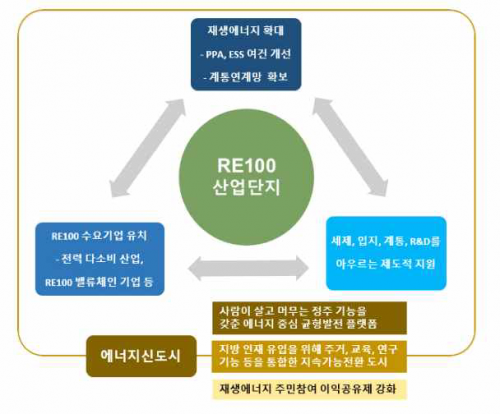
For carbon-intensive manufacturing sectors such as petrochemicals, steel, and cement, where immediate achievement of RE100 is difficult, the government plans to support a smooth transition by introducing intermediate technologies such as low-carbon processes. Research and development (R&D) will be strengthened for new low-carbon technologies in key industries, such as hydrogen-based steelmaking (steel), low-carbonization of naphtha cracking processes (petrochemicals), and eco-friendly fuel propulsion ships (shipbuilding).
The government will also promote the development of carbon neutrality technologies such as Carbon Capture, Utilization, and Storage (CCUS), the transition to green mobility, and the electrification of petroleum-based ships, construction machinery, and agricultural machinery. Regarding the decision to phase out coal-fired power plants by 2040, the National Policy Planning Committee stated that it is necessary to establish a basic plan, including the designation of just transition zones, to support employment stability and vocational skill development for residents and workers in areas affected by the closure of thermal power plants.
Turning Jeonnam, Southwest Sea, and Jeju into Offshore Wind Power Hubs
To expand the supply of renewable energy, the committee proposed turning Jeonnam, the southwest sea, and Jeju into offshore wind power hubs and building floating offshore wind power facilities along the east coast. The committee emphasized the need to include solar and wind power generation as national strategic technologies to provide tax support and to vitalize the offshore wind power vessel market, thereby establishing a supply chain ecosystem for related materials, parts, and equipment.
The committee also stated that to address power grid instability resulting from the expansion of renewable energy, it is necessary to simultaneously invest in transforming the power grid structure and securing flexibility. Early construction of national backbone power grids and improvement of grid connection and usage incentive systems were also identified as necessary measures.
To secure the funds needed for facility investment, the committee suggested that measures to ease the financial burden on Korea Electric Power Corporation should also be considered, such as issuing green bonds and utilizing climate environment charges.
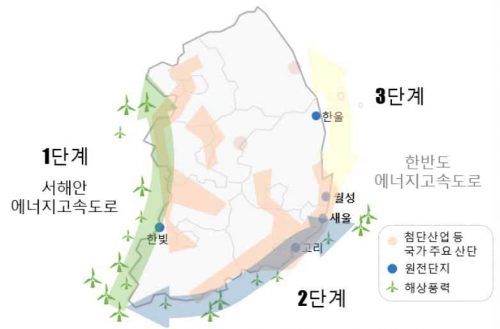
The National Policy Planning Committee also emphasized the necessity of building an energy highway to transmit surplus renewable energy produced in the Honam region to other areas. The government is urged to pursue the construction of the energy highway by 2030 and to establish a plan to complete a U-shaped offshore power grid around the Korean Peninsula (from the waters off Incheon to the southwest sea, the southern coast, and the east coast of Gyeongbuk) by 2040.
The committee also called for expanding flexible resources such as High Voltage Direct Current (HVDC) transmission for connecting renewable energy production sites and large-scale business areas, and Battery Energy Storage Systems (BESS) to ensure grid stability.
Expansion of Resident-Participatory Renewable Energy
Securing the acceptance of local residents is crucial for the successful implementation of renewable energy. The committee stressed that profit-sharing models such as 'sunlight and wind pension' can transform the energy industry into a resident income-based local economy. The goal is to identify profit-sharing renewable energy projects that both increase resident income and enhance acceptance.
To promote resident participation, the committee also proposed reintroducing the small-scale renewable energy connection guarantee system, increasing the Renewable Energy Certificate (REC) weighting according to the resident participation rate, and reintroducing the Feed-in Tariff (FIT) system for projects eligible for resident participation.
© The Asia Business Daily(www.asiae.co.kr). All rights reserved.
![Clutching a Stolen Dior Bag, Saying "I Hate Being Poor but Real"... The Grotesque Con of a "Human Knockoff" [Slate]](https://cwcontent.asiae.co.kr/asiaresize/183/2026021902243444107_1771435474.jpg)

















