Introduction of "American-Style" Couple-Based Tax Base
Transition to "French-Style" N-Split System
Simulation Shows Tax Revenue Could Drop by Up to 32 Trillion Won
Tax Incentives for Married Couples and Families with Children
The government is considering shifting the income tax system to an American or French model. This review comes as President Lee Jaemyung, during his candidacy, proposed in his policy pledges to change the current individual-based income tax unit to one based on couples or families. However, both systems are estimated to cause a massive decrease in tax revenue?about 24 trillion won or 32 trillion won. Additionally, since these systems significantly favor married couples and households with children, there are assessments that immediate implementation would be difficult.
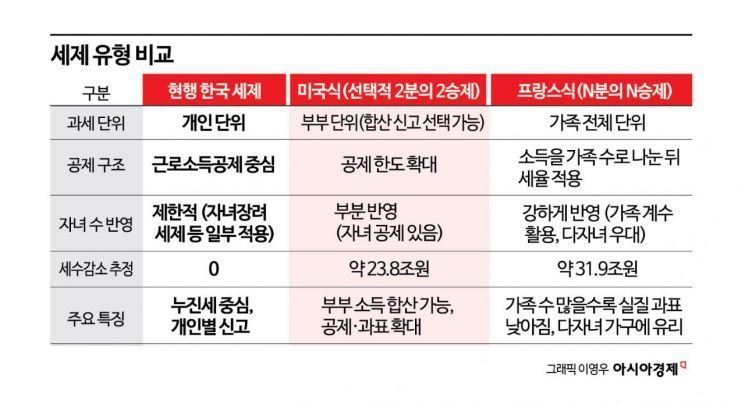
According to relevant ministries on June 20, the Ministry of Economy and Finance is examining a family-friendly income tax reform plan as part of efforts to specify national policy tasks based on President Lee Jaemyung’s campaign pledges. The presidential policy booklet explicitly states: ▲ the introduction of a “couple-based tax base” to make year-end tax settlements easier for married couples, and ▲ a plan to transition to a tax system that comprehensively considers both couple’s incomes and the number of children. Both systems are designed to provide strong tax incentives for childbirth and marriage. The “couple-based tax base” refers to the American model, while the system that comprehensively considers income and number of children is modeled after the French N-split system (PAC).
American model: Joint filing for couples leads to double the deductions and tax rate benefits
The system that allows taxpayers to choose between individual and couple-based taxation is currently implemented in the United States. Taxpayers can select the more advantageous method, and in most cases, joint filing as a couple is more beneficial. This is because the amount eligible for deductions and the tax bracket thresholds are effectively doubled, resulting in a significantly reduced tax burden.
For example, the standard deduction for joint filing is $9,500 (about 13 million won), which is twice the $4,750 available for individual filing. Households with a high-earning husband and a homemaker wife?single-income families?can receive greater deduction benefits than if they filed individually.
If taxpayers choose to file jointly as a couple, the tax-saving effect is even greater for “single-income families” with unequal incomes. For instance, if one spouse earns 100 million won and the other earns 30 million won, the spouse earning 100 million won would fall into a higher tax bracket if filing individually. However, with joint filing, the total income is counted as 130 million won, and since the tax base is doubled, it is similar to each spouse being taxed at a lower rate on 65 million won each. In the United States, all earned, business, and capital income, except for some non-taxable income (such as life insurance payouts and assets acquired through inheritance or gifts), are subject to progressive taxation, providing significant incentives for married couples.
French model: Divide by number of family members, then apply tax rate?more children, greater benefits
France is considered to have an even more family-friendly tax system than the United States. The more children a family has, the more their tax burden is reduced. In this system, N increases with family size. The father counts as 1, the mother as 1, the first child as 0.5, the second child as 0.5, and each additional child as 1. For a family of seven with five children, N becomes 6. The parents’ income is divided by 6, and tax is calculated per person according to the tax brackets, then multiplied by N to determine the final tax amount.
The more children a family has, the lower their effective tax base becomes, resulting in a substantial reduction in tax burden. This is essentially a “multi-child preferential tax system,” with the explicit policy goals of overcoming low birth rates and reducing the burden of child-rearing. President Lee Jaemyung’s pledge to “establish a tax system that comprehensively considers couple’s incomes and the number of children” closely resembles this French model.
Massive tax revenue loss of 24 trillion or 32 trillion won
The government views both tax systems as family-friendly, providing strong incentives for childbirth and marriage. The problem, however, is the massive decrease in tax revenue. The government estimates that implementing these systems could lead to a tax revenue loss of 20 trillion to 30 trillion won. According to a simulation by Oh Jonghyun, head of tax research at the Korea Institute of Public Finance, simply changing the tax unit to the 2-split model (similar to the American system) or the N-split model (French system) without revising the deduction and tax rate systems would result in tax revenue losses of 23.8 trillion won and 31.9 trillion won, respectively.
Oh stated, “The simulation results show a tax revenue loss of several tens of trillions of won,” and added, “To prevent such a massive decrease, the abolition of the earned income tax credit, reduction of other deduction items, and increases in tax rates would all need to be implemented together.” He also pointed out that family-based taxation could result in reverse discrimination against single-person and single-household taxpayers. The concentration of benefits on households with couples and children could undermine tax fairness. The Ministry of Economy and Finance stated that, since this stage is focused on fulfilling campaign pledges and determining national policy tasks, it will continue to communicate with the National Policy Planning Committee, taking into account the social acceptability of the system design.
© The Asia Business Daily(www.asiae.co.kr). All rights reserved.
![Clutching a Stolen Dior Bag, Saying "I Hate Being Poor but Real"... The Grotesque Con of a "Human Knockoff" [Slate]](https://cwcontent.asiae.co.kr/asiaresize/183/2026021902243444107_1771435474.jpg)
















