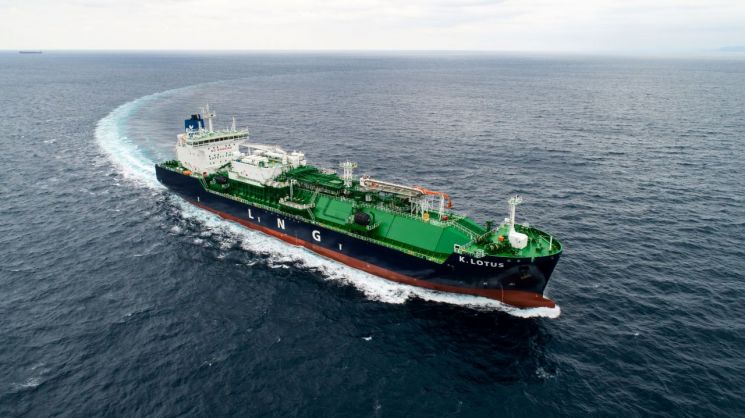
On June 20, Daishin Securities released a report titled "The Biggest Beneficiary of the Israel-Iran War Is U.S. Natural Gas," analyzing that the Israel-Iran war will inevitably restrict LNG exports from Qatar, the world's third-largest natural gas producer after Russia and the United States, through the Strait of Hormuz. As a result, the report expects the United States to expand its market share.
U.S. natural gas prices typically rise in the summer due to increased power plant demand from air conditioning use, then decline starting in August. This year, a heatwave with temperatures ranging from 25 to 38 degrees Celsius is sweeping through two-thirds of the United States, causing U.S. LNG inventories to already begin decreasing.
In addition, on June 17, the European Commission unveiled a draft legislative bill that would completely ban imports of Russian energy. The bill includes a full ban on new contracts for Russian energy and on LNG terminal service contracts involving Russian companies starting in January next year. Existing short-term contracts will be forcibly terminated as of June 17 next year, and for landlocked countries with long-term contracts, all transactions will end after December 2027. It is estimated that the United States could replace 19% of the EU's total natural gas imports, which currently come from Russia.
In particular, the Israel-Iran war presents the United States with an opportunity to take market share from Qatar. While it is virtually impossible for Iran to directly blockade the Strait of Hormuz, the real concern is the potential for a prolonged conflict. Iran's Supreme Leader Ali Khamenei has been attempting behind-the-scenes contact with the United States, but has stated publicly that he will continue to resist. Qatar, for its part, has requested that ships only enter the Strait of Hormuz on the day before loading crude oil and LNG, in preparation for any unforeseen incidents. This situation is causing significant concern for countries that rely on Qatari supplies.
Choi Jinyoung, an analyst at Daishin Securities, stated, "Qatari LNG primarily flows into countries such as South Korea, India, China, and Japan, which are engaged in trade negotiations with the Trump administration. The instability in their energy security presents another opportunity for the United States to expand its market share and for U.S. natural gas prices." This suggests that the United States could leverage tariffs in trade negotiations to force imports of U.S. natural gas and investments in the Alaska LNG project.
The Russia-Ukraine war, which broke out in 2022 and has become protracted, served as a structural turning point for the expansion of U.S. LNG exports. As past cases have demonstrated, it is now time to focus on the structural expansion of U.S. natural gas exports and the resulting increase in U.S. natural gas prices.
© The Asia Business Daily(www.asiae.co.kr). All rights reserved.

















