The Korea Research Institute of Bioscience and Biotechnology announced on June 20 that the research team led by Dr. Yang Yongyeol of the Aging Convergence Research Group, together with the team of Professor Kim Nakseong at Chonnam National University, has discovered the protein CLCF1 (cardiotrophin-like cytokine factor 1). The teams revealed that this protein is secreted from muscles during exercise and helps strengthen both muscles and bones, thereby suppressing musculoskeletal aging.
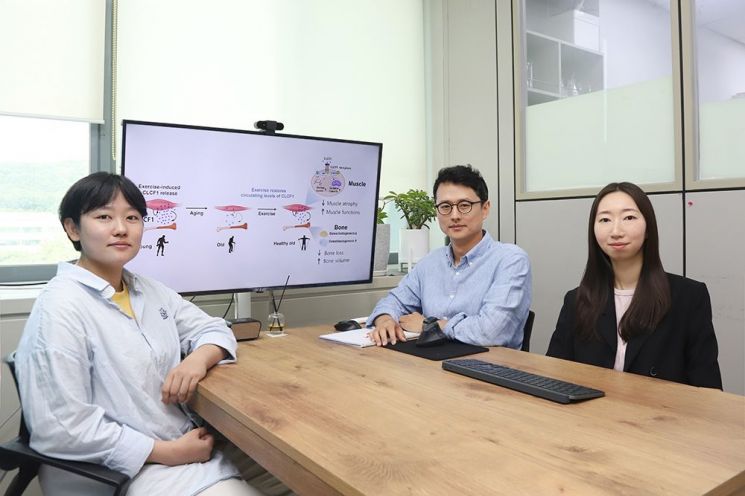 Dr. Yang Yongyeol (center) and research team. Courtesy of Korea Research Institute of Bioscience and Biotechnology
The researchers divided participants into younger and older age groups and analyzed changes in the CLCF1 protein in the blood after exercise.
The results showed that in the younger group, the increase in the protein was pronounced even with a small amount of exercise. In contrast, in the older group, the protein level increased again only after more than 12 weeks of continued exercise.
Additionally, in experiments with aged mice, the researchers found that injecting CLCF1 into older mice led to increased muscle strength and higher bone density. Conversely, when the action of CLCF1 was inhibited, exercise did not produce any significant effects. These findings demonstrate that CLCF1 enhances the effects of exercise.
The research team also confirmed that CLCF1 improves the function of mitochondria, known as the "cellular power plants" in muscle, and in bone cells, it suppresses the formation of osteoclasts (which break down bone) while promoting the differentiation of osteoblasts (which build bone).
The team emphasized that these results scientifically demonstrate that the progression of musculoskeletal aging with age, as well as the changing criteria for achieving the effects of exercise, are due to changes in proteins secreted within the body.
Dr. Yang Yongyeol stated, "Our team has identified the biological basis for the reduced effectiveness of exercise with advancing age. We expect that these research results will lay the foundation for developing new therapeutic strategies for healthy aging and provide new directions for treating sarcopenia and osteoporosis, which are common in the elderly."
This research was supported by the Basic Research Program of the Ministry of Science and ICT, the Science and Technology Project for Regional Future, the Convergence Research Program of the National Research Council of Science and Technology, and major projects of the Korea Research Institute of Bioscience and Biotechnology.
© The Asia Business Daily(www.asiae.co.kr). All rights reserved.
![Clutching a Stolen Dior Bag, Saying "I Hate Being Poor but Real"... The Grotesque Con of a "Human Knockoff" [Slate]](https://cwcontent.asiae.co.kr/asiaresize/183/2026021902243444107_1771435474.jpg)















