Public-Private Partnership 'Seongsu Town Management' Introduced for the First Time in Korea
Mayor Jung Wono: "We Will Make Seongsu-dong the World's Most Attractive and Sustainable Neighborhood"
"Seongsu-dong, which has transformed from a neglected semi-industrial area into one of the world's most attractive neighborhoods, is now entering another important phase. By establishing 'Town Management'?a collaborative effort among local government, residents, and businesses?we will develop Seongsu-dong into a globally competitive and sustainable city."
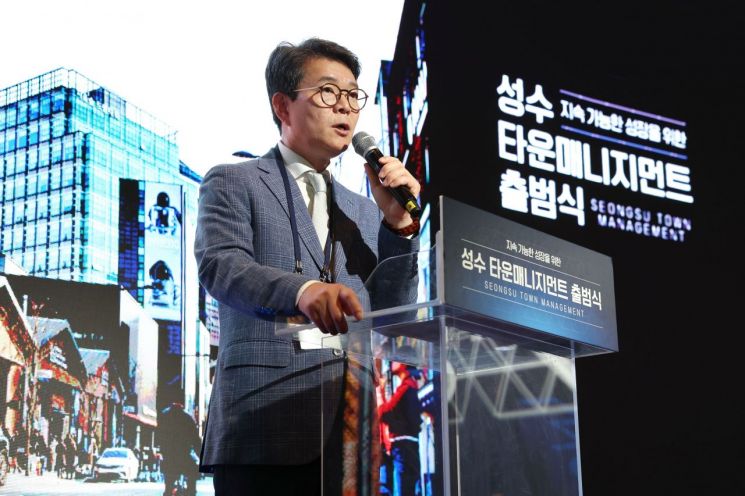 Jung Wono, mayor of Seongdong District, said, "Seongsu Town Management will become a leading model that aligns with the new government's emphasis on balanced regional development and locally driven growth strategies." Provided by Seongdong District.
On the evening of the 19th, around 50 large corporations, local businesses, and startups headquartered in Seongsu-dong, along with Seongdong District officials and resident representatives, gathered at the Under Stand Avenue Art Stand near Seoul Forest Station on the Suin-Bundang subway line.
This was the launch ceremony announcing the introduction of 'Seongsu Town Management.' At the event, Jung Wono, mayor of Seongdong District, stated, "Seongsu-dong is now facing the question of whether its rapid growth can be sustained," and added, "From now on, the role of administration is not to lead from the front, but to serve as a platform that connects and coordinates all stakeholders so that everyone can grow together. The district office will fulfill this role in Seongsu-dong."
Town Management is a public-private regional management model in which local businesses, landlords, tenants, and residents, together with the local government, jointly take responsibility for urban sanitation, environmental management, joint promotions, local festivals, and community activities. Notable examples of successful implementation include New York's Times Square district and Tokyo Station's Marunouchi district.
Seongsu-dong, once known for its image as a neglected semi-industrial area, was selected as an urban regeneration pilot district in 2014. Since then, it has preserved and utilized its red brick buildings, actively attracted businesses, and fostered a unique local culture of mutual growth and social innovation, making it a hub of global trends not only in Seoul but internationally.
With explosive growth, a distinctive cultural and economic ecosystem has formed. The number of social economy organizations, including social ventures in Seongsu-dong, increased from 12 in 2014 to around 540 last year. The number of business employees rose from 82,000 in 2014 to 124,923. Last year, the number of foreign visitors to Seongsu-dong reached 3 million, a 46-fold increase compared to 2020.
However, Seongsu-dong's rapid development has led to issues such as rising rents, increased household waste from pop-up stores, and overcrowding. Town Management is being introduced in Korea for the first time as a model to address these problems and promote sustainable growth.
Seongdong District plans to implement various projects through the Town Management Committee, which is jointly organized by the public and private sectors. These projects include joint management of the area by local businesses, landlords, tenants, and residents; operation of public and eco-friendly pop-up stores; launching and managing the local brand 'We Make Seongsu'; and hosting local festivals.
Additionally, to help small and medium-sized enterprises actively promote and sell their products to visitors, the district office will rent out pop-up store spaces in the Seongsu Industrial Innovation Space at less than half the usual rent. The district also plans to institutionalize Town Management by enacting related ordinances in the second half of this year.
Mayor Jung stated, "The core of Town Management is a virtuous cycle in which the tangible and intangible contributions of landowners and businesses lead to an increase in local value, which is then returned as an increase in asset value for contributors. Tenants benefit from increased sales, and residents enjoy a more pleasant urban environment. The active participation of local businesses is essential for successful implementation." He added, "Seongsu Town Management will become a leading model that aligns with the new government's emphasis on balanced regional development and locally driven growth strategies."
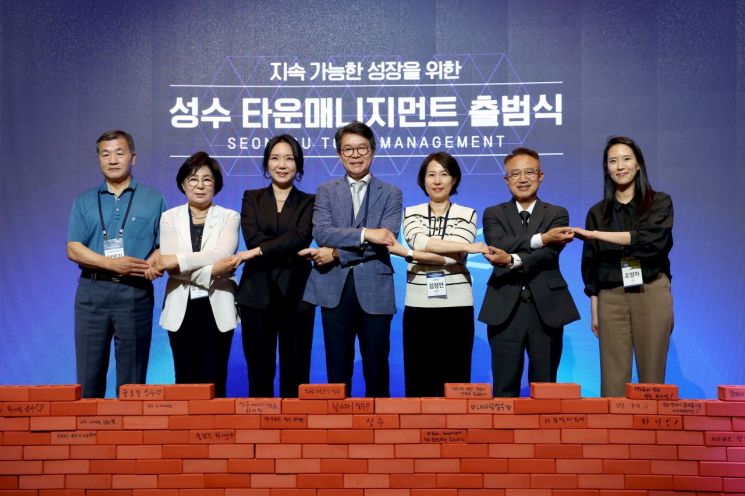
More than 150 people attended the launch ceremony, including Park Junmo, CEO of Musinsa; Choi Jungmin, Global Chief Officer of SM Entertainment; and Heo Jaehyung, CEO of Root Impact?business leaders based in Seongsu-dong. Krafton, which plans to relocate to Seongsu in 2028, announced plans to hire dedicated Town Management personnel and establish related departments, emphasizing the importance of joint growth between the region and businesses.
© The Asia Business Daily(www.asiae.co.kr). All rights reserved.
![Clutching a Stolen Dior Bag, Saying "I Hate Being Poor but Real"... The Grotesque Con of a "Human Knockoff" [Slate]](https://cwcontent.asiae.co.kr/asiaresize/183/2026021902243444107_1771435474.jpg)

















